How to clarify brand purpose: 85% succeed in 3 months
Many purpose-driven entrepreneurs struggle to define a clear, actionable brand purpose beyond profit. Without this clarity, you risk building a business that feels hollow, fails to connect with your audience, and relies on expensive ads to survive. This guide provides structured steps to clarify brand purpose and align it with audience needs for sustainable, ad-free growth. You will learn how to prepare, introspect, validate, integrate, and avoid common pitfalls. Research shows 85% of startups using structured frameworks gain clearer brand identity within 3 months, proving that systematic approaches work.
Table of Contents
- Prerequisites: What You Need Before Starting
- Step 1: Prepare And Introspect
- Step 2: Understand Your Audience
- Step 3: Use Tools And Frameworks
- Step 4: Test And Validate
- Step 5: Integrate Purpose Into Business Practices
- Common Mistakes And Pitfalls
- Alternative Approaches And Tradeoffs
- Expected Results And Outcomes
- Boost Your Clarity With Starfireblast Solutions
Key takeaways
| Point | Details |
|---|---|
| Introspection and audience understanding are foundational | Clarifying brand purpose requires deep self-reflection and mapping real audience needs to ensure authentic alignment. |
| AI tools and frameworks accelerate clarity | Technology and structured approaches reduce analysis time and enable faster validation of purpose statements. |
| Testing purpose statements improves engagement | Iterative feedback from target audiences refines messaging and can boost engagement by up to 40%. |
| Integration drives sustainable growth | Embedding purpose into operations, communication, and culture increases retention and employee satisfaction significantly. |
| Avoid generic statements and prioritize impact | Specific, impact-focused purpose statements outperform vague profit-driven missions by creating stronger community connections. |
Prerequisites: what you need before starting
Before diving into the clarification process, you need the right mindset, knowledge, and resources. A mindset of introspection and openness is critical to success. You must be willing to question assumptions, explore uncomfortable truths, and accept that your initial ideas may evolve. This mental preparation separates entrepreneurs who achieve clarity from those who stay stuck.
Basic understanding of your target audience enables relevant purpose. If you don’t know who you serve, you can’t define why you serve them. Start by reviewing any existing customer data, feedback, or market research you have. Access to customer feedback data helps validate assumptions and prevents you from building purpose statements in a vacuum.
Tools such as empathy maps and brand analysis frameworks aid clarity by providing structure. A clear personal and business value set is necessary before defining brand purpose, as this foundation ensures authenticity. Consider exploring a purpose-driven entrepreneurship checklist to prepare effectively.
Key resources to gather before starting:
- Customer feedback from surveys, interviews, or reviews
- Core personal and business values documented in writing
- Competitor analysis to identify gaps and differentiation opportunities
- Access to empathy mapping templates or brand strategy frameworks
- Time commitment of 10 to 15 hours over several weeks for deep work
If you lack technical resources, consider partnering with technology services for purpose-driven entrepreneurs to accelerate your setup. The preparation phase sets the tone for everything that follows, so invest the time upfront.
Step 1: prepare and introspect
This step begins the execution by focusing inward on core value discovery as a vital first step. Identify both personal and business core values through structured reflection. Ask yourself what principles guide your decisions, what impact you want to create beyond revenue, and what legacy you want to leave. Write down your answers without filtering or judging them.
Consider impact beyond profit to define broader purpose. Purpose-driven brands thrive because they solve real problems and improve lives, not just extract value. Understanding core values first ensures authenticity and strategic direction, making your brand resilient against market shifts. Document initial purpose statements as hypotheses to refine, treating them as experiments rather than final declarations.
Maintain openness to evolving ideas through the process. Your first draft will likely be too broad, too vague, or too self-centered. That’s normal. The goal is to capture raw material you’ll sharpen later.
Actionable introspection prompts:
- What problem do I feel compelled to solve, even if it wasn’t profitable?
- What values do I refuse to compromise, regardless of market pressure?
- How do I want my customers to feel after interacting with my brand?
- What would success look like if money were no object?
Pro Tip: Set a timer for 20 minutes and write continuously without stopping. This freewriting technique bypasses your inner critic and reveals authentic values buried under surface-level thinking.
Review your notes after a day or two with fresh eyes. Circle recurring themes, words, or concepts. These patterns often point to your core purpose. For additional guidance, explore this step-by-step branding process to deepen your introspection.
Step 2: understand your audience
After uncovering personal values, the next logical step is understanding the audience to ensure your purpose truly resonates with them. Use empathy mapping to explore audience feelings, needs, and challenges. Empathy maps visualize what your audience thinks, feels, says, and does, helping you step into their shoes.

Segment your audience by shared values and pain points for targeted clarity. Not every customer wants the same thing. Group them into segments based on what they care about most, whether sustainability, efficiency, community, or innovation. Aligning purpose with real audience needs ensures relevance and stronger engagement, making your brand indispensable rather than optional.
Validate brand purpose hypotheses with authentic customer feedback. Reach out to existing customers or prospects through interviews, surveys, or social media polls. Ask open-ended questions about their biggest challenges, what they value in brands, and what impact they want to create in their own lives.
| Audience Segment | Core Values | Primary Challenges |
|---|---|---|
| Eco-conscious creators | Sustainability, transparency | Finding affordable eco-friendly tools, avoiding greenwashing |
| Solo entrepreneurs | Autonomy, efficiency | Overwhelm from juggling tasks, limited budget for help |
| Purpose-driven businesses | Impact, community | Measuring social impact, scaling without losing authenticity |
| Early-stage founders | Innovation, growth | Clarifying niche, building credibility with no track record |
This table helps you match your purpose with the right audience segment. If your purpose centers on sustainability, the eco-conscious creators segment aligns perfectly. If you emphasize efficiency, solo entrepreneurs are your people.
For deeper insights, check out resources on the importance of audience alignment in branding and learn how to start mapping your ideal customer with precision.
Step 3: use tools and frameworks
With audience insights in hand, leveraging technology and frameworks helps you accelerate refining your brand purpose effectively. Demonstrate AI tools that provide customer insight analysis quickly. AI can process hundreds of customer reviews, social media comments, or survey responses in minutes, identifying recurring themes and sentiment patterns you might miss manually.
Highlight frameworks connecting brand purpose, audience needs, and business goals. Tools like the Golden Circle framework ask “why, how, what” to structure your purpose statement logically. The Brand Purpose Canvas maps purpose, values, audience, and differentiation on one page for clarity. AI-assisted insights reduce analysis time and enhance purpose clarity, freeing you to focus on strategy rather than data crunching.
Showcase example purpose statements refined using these tools. For instance, a generic statement like “We help people succeed” becomes “We empower solo entrepreneurs to build sustainable businesses without burnout by providing clarity and community-driven growth tools.” The refined version specifies the audience, the problem, and the unique approach.
Practical tools to consider:
- AI sentiment analysis platforms for customer feedback
- Brand strategy templates like the Value Proposition Canvas
- Empathy mapping software for visualizing audience insights
- Positioning statement generators to draft and iterate quickly
Pro Tip: Use AI to automate iterative feedback analysis for faster validation. Feed customer comments into an AI tool, ask it to identify top pain points and desired outcomes, then cross-reference these with your purpose hypotheses. This loop speeds up refinement dramatically.
Explore AI tools for entrepreneurs in 2026 for the latest platforms. Learn how to define brand strategy effectively using proven frameworks. If you need implementation support, consider technology services that integrate AI into your workflow.
Step 4: test and validate
After crafting your purpose statement with tools, this section guides how to validate it through audience feedback for real-world effectiveness. Iterative feedback improves purpose statement resonance and engagement by up to 40%, making validation a non-negotiable step.
Step-by-step process for conducting surveys and interviews:
- Draft 2 to 3 purpose statement variations to test against each other.
- Recruit 15 to 30 participants from your target audience segments for feedback.
- Present each statement and ask which resonates most and why.
- Follow up with open-ended questions about clarity, authenticity, and relevance.
- Analyze responses for patterns, noting which words, phrases, or concepts drive connection.
- Refine your statement based on majority feedback and retest if needed.
How to collect and analyze feedback effectively: Use a mix of quantitative and qualitative methods. Surveys give you scalable data, while interviews provide depth. Look for emotional reactions, not just logical agreement. If someone says “That speaks to me” or shares a personal story, you’ve hit a nerve.
Adjusting purpose statements based on data insights: If feedback reveals confusion, simplify your language. If it feels generic, add specificity about who you serve or what unique value you provide. If it sounds self-serving, reframe around customer impact rather than your goals.
The test-validate-refine cycle might repeat 2 to 4 times before you land on a statement that consistently resonates. Don’t rush this process. Clarity compounds over time. For additional validation strategies, review insights on business purpose validation.
Step 5: integrate purpose into business practices
Following successful validation, this section focuses on embedding your brand purpose into everyday business to realize sustainable growth. Align internal operations with your defined brand purpose. This means making decisions, from hiring to product development, through the lens of your purpose. If your purpose emphasizes sustainability, source eco-friendly materials. If it centers on community, involve customers in product roadmaps.
Communicate your purpose consistently across all channels and touchpoints. Your website, social media, email campaigns, customer service interactions, and packaging should all reflect the same purpose-driven message. Inconsistency breeds distrust. Integrating brand purpose increases employee satisfaction by 50% and customer retention by up to 40%, proving that internal and external alignment drives measurable results.
Monitor employee satisfaction and retention as purpose integration indicators. When your team understands and believes in your purpose, they stay longer, work harder, and advocate for your brand. Survey employees quarterly to gauge alignment and identify gaps. Ensure ongoing measurement of purpose’s impact on customer loyalty through Net Promoter Score, repeat purchase rates, and qualitative feedback.
Integration checklist:
- Update mission and vision statements on your website and internal documents
- Train employees on how to communicate purpose in their roles
- Review product and service offerings to ensure alignment
- Audit marketing materials for consistent purpose-driven messaging
- Celebrate purpose wins publicly to reinforce culture
For guidance on maintaining consistency, explore brand positioning for clear messaging. Discover growth strategies for sustainable brand development that reinforce purpose integration.
Common mistakes and pitfalls
Having integrated your purpose, this section reinforces sustainable success by addressing common mistakes and how to fix them. Avoid overly generic purpose statements lacking specificity. Phrases like “We want to make the world better” or “We empower people” sound nice but mean nothing. 60% of failed brand purpose attempts are due to generic or vague statements, so specificity saves you from this trap.
Prioritize societal and customer impact over purely profit motives. Purpose-driven brands succeed because they solve real problems, not because they chase revenue. If your purpose statement focuses on what you gain rather than what you give, rewrite it. Include ongoing audience feedback to maintain relevance. Markets shift, customer needs evolve, and your purpose must adapt without losing its core.
Maintain consistent communication to build trust and loyalty. If you talk about sustainability but use wasteful packaging, customers notice. If you claim to value community but ignore feedback, you lose credibility. Consistency isn’t optional.
Common pitfalls and fixes:
- Pitfall: Copying competitor purpose statements. Fix: Root your purpose in your unique values and story.
- Pitfall: Treating purpose as a marketing gimmick. Fix: Integrate it into operations and culture genuinely.
- Pitfall: Setting it and forgetting it. Fix: Review and refine your purpose annually based on feedback and growth.
- Pitfall: Overcomplicating the statement. Fix: Aim for one clear sentence anyone can understand and remember.
For deeper insights, review common pitfalls in brand purpose clarification and learn how to avoid them systematically.
Alternative approaches and tradeoffs
After learning best practices, readers are introduced to alternative methods with their tradeoffs to choose the best fit for their brand. Community-driven growth prioritizes authentic engagement over paid ads. Instead of spending thousands on Facebook ads, you invest time building relationships, hosting events, and co-creating with your audience. This approach takes longer but creates deeper loyalty.
Collaborative purpose building involves audience and partner input for richer clarity. You run workshops, surveys, or brainstorming sessions where customers help shape your purpose. This democratizes the process and ensures buy-in, but it can slow decision-making if you over-index on consensus.
Tradeoffs include time investment, resource allocation, and growth speed. Community-driven approaches require patience and consistent effort. Paid advertising delivers faster reach but often attracts transactional customers. Founder vision drives 40% more community growth compared to ad-driven approaches, showing the power of organic methods.
| Approach | Benefits | Drawbacks | Best For |
|---|---|---|---|
| Community-driven | Deep loyalty, low cost, authentic connections | Slower growth, requires consistent engagement | Purpose-driven entrepreneurs, creators |
| Collaborative | High buy-in, diverse perspectives, co-creation | Time-consuming, risk of analysis paralysis | Brands valuing transparency and inclusion |
| Ad-driven | Fast reach, scalable, measurable ROI | High cost, attracts transactional customers | Established brands with budget |
| Hybrid | Balances speed and authenticity | Complex to manage, requires multiple skill sets | Growing businesses seeking sustainable scale |
For more on building authentic communities, explore community-driven brand growth strategies that align with purpose.
Expected results and outcomes
Concluding the methodology, this section prepares readers for what success looks like and how to measure it effectively. Expect 1 to 3 months to reach clear, audience-aligned brand purpose if you follow the structured process consistently. This timeline assumes weekly effort of 5 to 10 hours, including introspection, audience research, testing, and integration.
Look for 30 to 40% increases in customer engagement and retention once your purpose is clear and communicated effectively. Metrics like email open rates, social media interactions, repeat purchases, and referral rates should improve as your message resonates more deeply. Monitor employee satisfaction improvements up to 50%, measured through surveys, retention rates, and qualitative feedback.
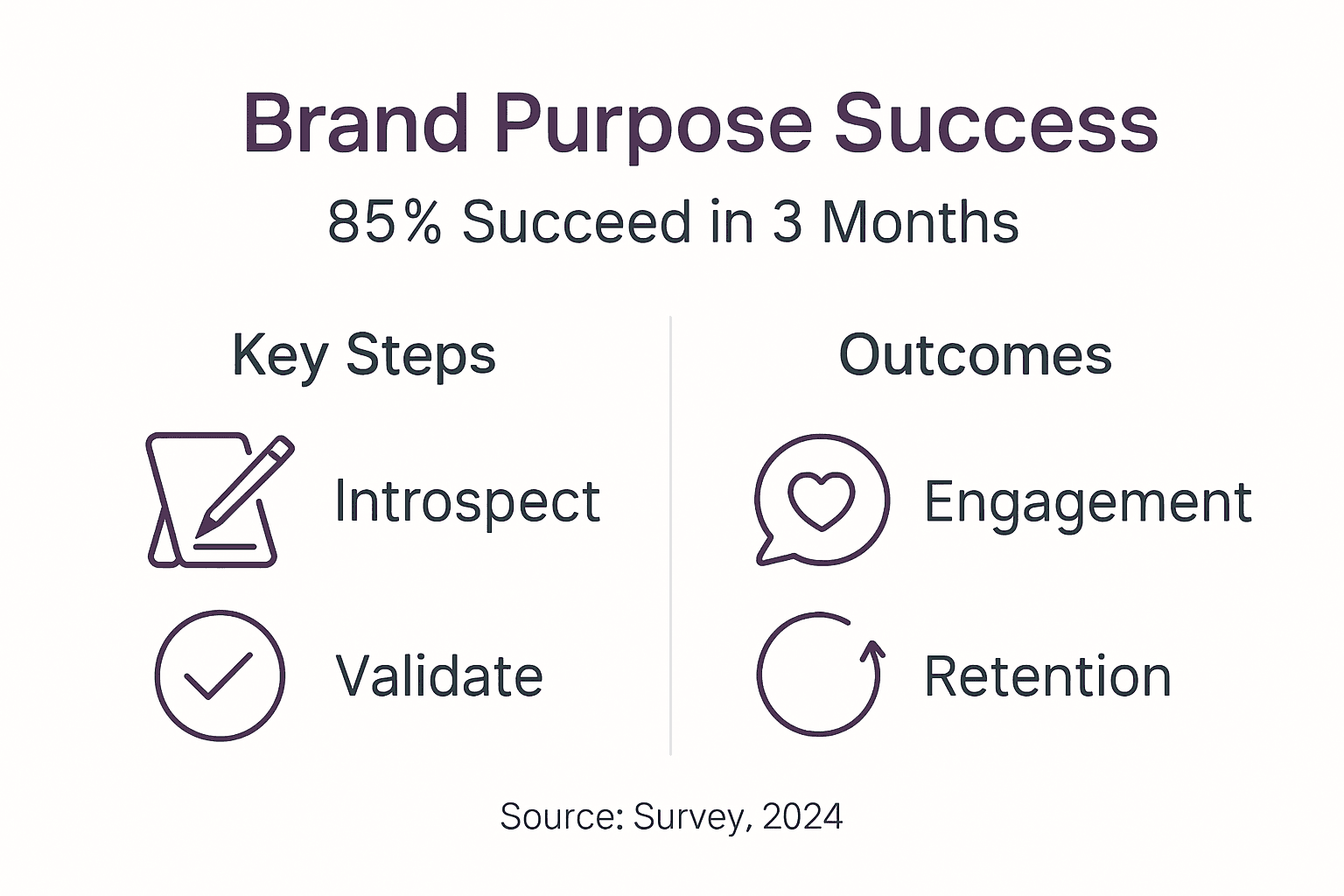
Maintain under 5% deviation in purpose messaging across channels for consistency. Audit your website, social media, emails, and customer service scripts quarterly to ensure alignment. Inconsistent messaging confuses customers and dilutes impact. Typical clarity timeline is 1 to 3 months with measurable gains in engagement and culture alignment, making this a realistic and achievable goal.
Success indicators to track:
- Customer feedback mentioning your purpose or values unprompted
- Increased inbound inquiries from ideal customers
- Higher employee engagement scores and lower turnover
- Growth in organic traffic and social media followers
- Stronger partnerships with aligned brands and organizations
For actionable benchmarks, review sustainable progress benchmarks that help you measure long-term success.
Boost your clarity with Starfireblast solutions
After learning how to clarify brand purpose, this promo section offers concrete resources to implement these strategies successfully. Starfireblast offers proven tools to clarify messaging that boost conversion rates, helping you turn insights into action without guesswork. Leverage expert strategies to map and understand your ideal customer, ensuring your purpose aligns with real needs rather than assumptions.
Access actionable growth frameworks designed for purpose-driven entrepreneurs who want to build sustainable businesses without relying on ads or burning out. Starfireblast combines customer understanding, brand clarity, and AI-assisted tools to help you move from ideas to meaningful action. Whether you need to refine your messaging, map your audience, or scale sustainably, the platform provides step-by-step guidance grounded in real results.
Explore messaging fixes that increase conversions and see how small clarity improvements drive big results. Learn to map your ideal customer with Starfireblast using frameworks that eliminate guesswork. Discover growth strategies for sustainable brands that prioritize community over ads and impact over hype.
Faq
How long does it typically take to clarify a brand purpose?
Most purpose-driven entrepreneurs achieve clarity in 1 to 3 months when following a structured process with consistent weekly effort. The timeline depends on your starting point, audience complexity, and willingness to iterate based on feedback. Rushing the process produces generic statements, while overthinking causes paralysis.
Can brand purpose alone drive growth without advertising?
Yes, but it requires consistent effort and authentic audience engagement. Purpose-driven brands grow through word of mouth, community building, and organic content that resonates deeply with target customers. This approach takes longer than paid ads but creates sustainable, loyal customer bases that don’t disappear when you stop spending.
What if my audience feedback conflicts with my initial purpose ideas?
Conflicting feedback is valuable, not a setback. It reveals misalignment between your assumptions and reality, giving you a chance to refine before investing heavily. Prioritize feedback from your ideal customers over noise from people outside your target audience. If multiple ideal customers share the same concern, adjust your purpose statement accordingly.
How often should I revisit and refine my brand purpose?
Review your brand purpose annually or when major business shifts occur, such as launching new products, entering new markets, or experiencing significant customer feedback trends. Your core purpose should remain stable, but the way you communicate it may evolve as your business and audience grow. Quarterly audits of messaging consistency help maintain alignment.
Are there tools to simplify the brand purpose clarification process?
Yes, AI-powered sentiment analysis tools, empathy mapping templates, brand strategy frameworks like the Golden Circle, and customer feedback platforms all accelerate clarity. These tools structure your thinking, surface patterns in data, and help you iterate faster than manual methods alone. Combining technology with human insight produces the best results.
Recommended
- Brand Positioning Step by Step for Clear Messaging Success – Starfireblast
- Why Purpose Matters in Branding for Entrepreneurs – Starfireblast
- How to Clarify Business Vision: 66% More Customer Growth – Starfireblast
- How to Define Brand Strategy for Lasting Impact – Starfireblast
- Social Media Support | Nine Archs LLC