How to Define Brand Strategy for Lasting Impact
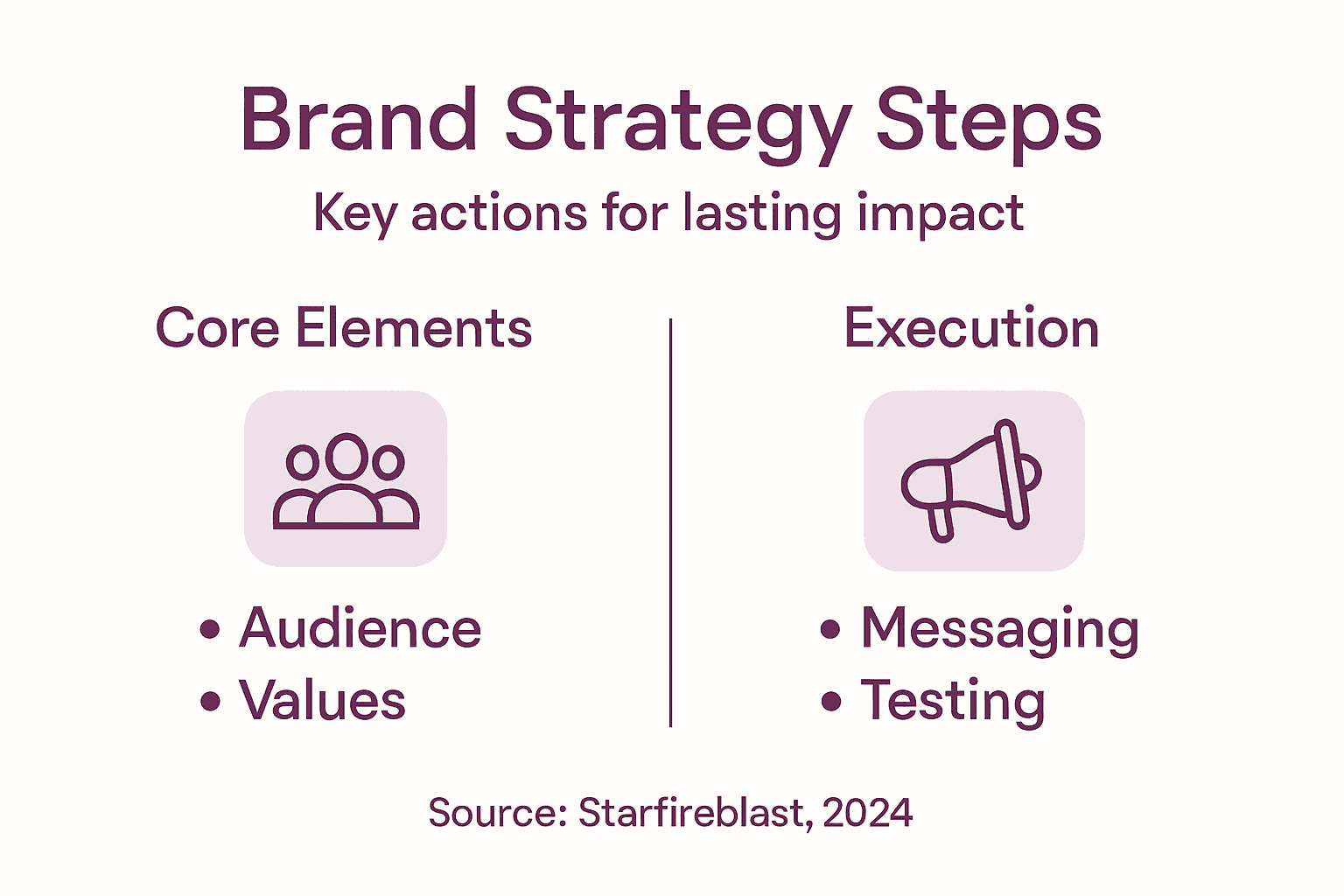
Every brand starts with a spark, but bringing lasting clarity to whom you serve and why your business matters can be tough for solo entrepreneurs and small creative teams. Clarity about your ideal audience and purpose is the groundwork for building a brand that stands out without sacrificing what you believe in. By focusing on understanding your audience and the unique value your brand brings, you set the stage for genuine connections that drive long-term loyalty and real engagement.
Table of Contents
- Step 1: Clarify Your Ideal Audience And Purpose
- Step 2: Analyze Core Values And Unique Strengths
- Step 3: Craft A Compelling Brand Positioning Statement
- Step 4: Align Messaging With Customer Needs And Values
- Step 5: Test And Refine Your Brand Strategy In Real Scenarios
Quick Summary
| Key Point | Explanation |
|---|---|
| 1. Define Your Target Audience | Create a detailed customer persona to understand their challenges and motivations, ensuring your messaging resonates genuinely. |
| 2. Articulate Your Brand Purpose | Clearly state your mission and unique value, guiding your decisions and aligning your business efforts toward meaningful goals. |
| 3. Craft a Compelling Positioning Statement | Develop a concise statement that highlights your unique value and differentiates your brand to communicate effectively with your audience. |
| 4. Align Messaging with Customer Needs | Create customer-centric messaging by understanding their emotions, challenges, and values, fostering authentic connections. |
| 5. Continuously Test and Refine Strategy | Implement a robust feedback and review process to adapt your brand strategy, ensuring it evolves with market changes and customer insights. |
Step 1: Clarify your ideal audience and purpose
Knowing who you serve and why you exist is the foundation of a powerful brand strategy. In this step, you’ll uncover the essential insights that transform your business from generic to genuinely meaningful.
To understand your target audience, start by creating a detailed customer persona. Imagine your ideal client as a real person with specific characteristics, challenges, and aspirations. Go beyond basic demographics and dive into their deeper motivations:
- What problems are they struggling to solve?
- What dreams or goals drive their decisions?
- What frustrations have they experienced with existing solutions?
- What values matter most to them?
Building this persona helps you craft messaging that resonates deeply and authentically. It’s not about appealing to everyone - it’s about connecting powerfully with the right people.
Your audience isn’t a faceless market segment. They’re individuals with real needs, hopes, and potential waiting to be understood.
Next, articulate your brand’s purpose by asking fundamental questions about your mission:
- Why did you start this business?
- What unique value do you provide?
- How do you make your customers’ lives meaningfully better?
- What core principles guide your work?
Documenting these insights creates a north star for everything you do - from product development to marketing communication. Audience analysis ensures meaningful connections that transcend transactional interactions.
Pro tip: Revisit your audience and purpose definition every six months, as both your business and your customers will evolve over time.
Here’s a quick summary of audience analysis versus purpose definition:
| Aspect | Audience Analysis | Purpose Definition |
|---|---|---|
| Focus | Who you serve | Why your brand exists |
| Key Output | Customer persona details | Brand mission statement |
| Business Benefit | Better segmentation | Strong directional clarity |
| Strategic Role | Guides messaging | Sets core values and direction |
Step 2: Analyze core values and unique strengths
Understanding what truly sets your brand apart is the key to creating a compelling and authentic business identity. In this step, you’ll dig deep to uncover the fundamental principles and distinctive capabilities that make your business unique.
Analyzing core brand strengths requires honest introspection and strategic thinking. Start by gathering your team or taking dedicated time to explore your business’s foundational characteristics:
- What principles guide your decision making?
- What skills or approaches differentiate you from competitors?
- What unique perspective do you bring to your industry?
- What achievements or capabilities make you proud?
Your unique strengths are not just features - they are the DNA of your brand’s competitive advantage.
To systematically map out your core values and strengths, consider these strategic assessment methods:
- Conduct a comprehensive skills inventory
- Solicit feedback from customers and team members
- Analyze your most successful projects or interactions
- Compare your approach to industry standards
The goal is to build brand equity through authentic differentiation. Your core values aren’t just marketing language - they’re the promise you make to your customers about who you are and what you stand for.

Pro tip: Document your core values in a living handbook that can evolve as your business grows, ensuring consistent communication and strategic alignment.
Step 3: Craft a compelling brand positioning statement
A powerful brand positioning statement is your strategic blueprint for communicating what makes your business truly unique. In this step, you’ll distill your brand’s essence into a clear, memorable declaration that sets you apart in the marketplace.
Brand positioning defines your competitive advantage by creating a distinctive narrative that resonates with your target audience. To craft an effective positioning statement, focus on these critical components:
- Your target customer’s specific needs
- Your unique value proposition
- The key benefits you deliver
- What differentiates you from competitors
Your brand positioning statement is the strategic heart of your communication - concise, powerful, and intentional.
Structure your positioning statement using this proven framework:
- Identify your target audience precisely
- Describe the key problem you solve
- Explain your unique solution
- Articulate the specific benefits
- Differentiate from competitive alternatives
The goal is to create a memorable brand promise that instantly communicates your brand’s distinctive value. Think of it as a strategic compass that guides all your marketing and communication efforts.
Pro tip: Test your positioning statement with trusted customers and team members to ensure it genuinely reflects your brand’s core essence and resonates authentically.
Step 4: Align messaging with customer needs and values
Building a genuine connection with your audience requires more than surface-level communication. In this step, you’ll learn how to create messaging that speaks directly to your customers’ deepest needs and most cherished values.
Customer-centric messaging builds authentic relationships by understanding the emotional landscape of your target audience. To truly align your brand’s voice with customer expectations, you’ll need to go beyond demographics and dig into their core motivations:
- What keeps them up at night?
- What dreams drive their decisions?
- What challenges are they desperately trying to solve?
- What values matter most in their lives?
Authentic messaging isn’t about talking at your customers - it’s about creating a meaningful dialogue that reflects their true needs.
To systematically align your messaging, follow these strategic steps:
- Conduct deep customer research
- Map emotional triggers and pain points
- Review your current messaging against customer insights
- Reframe communications to address real needs
- Test and refine your approach
The goal is to uncover deeper customer insights that transform your messaging from generic to genuinely compelling. Your words should feel like they were crafted specifically for your ideal customer.
Pro tip: Create a messaging framework that includes specific language patterns, emotional triggers, and value statements that authentically represent your customers’ inner world.
Step 5: Test and refine your brand strategy in real scenarios
Developing a brand strategy isn’t a one-time event - it’s an ongoing process of learning, adapting, and improving. In this step, you’ll discover how to validate your brand strategy through systematic testing and continuous refinement.
Perceptual mapping helps measure brand performance by providing insights into how customers perceive your brand in real-world contexts. To effectively test your strategy, you’ll need multiple approaches that provide comprehensive feedback:
- Gather direct customer feedback
- Monitor market response and engagement
- Track key performance indicators
- Compare against competitive benchmarks
- Analyze customer behavior patterns
Your brand strategy is a living document - it should evolve as your understanding deepens and market dynamics shift.
Implement a rigorous testing framework through these strategic steps:
- Define clear measurement criteria
- Create controlled testing environments
- Collect quantitative and qualitative data
- Analyze results objectively
- Implement incremental improvements
The goal is to validate brand strategy through iterative learning that transforms initial assumptions into robust, market-validated approaches. Your strategy becomes stronger with each cycle of testing and refinement.
Pro tip: Establish a quarterly review process where you systematically assess your brand strategy’s performance, ensuring your approach remains dynamic and responsive to changing market conditions.
Compare key methods for testing and refining brand strategy:
| Method | Measurement Focus | Business Outcome |
|---|---|---|
| Customer Feedback | Direct user perceptions | Reveals improvement areas |
| Market Responses | Engagement and interest | Informs marketing adjustments |
| KPI Tracking | Quantitative brand metrics | Tracks strategy effectiveness |
| Benchmark Comparison | Relative industry position | Identifies competitive advantages |
Transform Your Brand Strategy into Meaningful Action Today
Understanding your ideal audience and crafting a clear brand purpose can feel overwhelming when trying to stand out in a crowded market. The article highlights the need to connect deeply with customer motivations and refine messaging to truly reflect your core values. Many entrepreneurs struggle to translate these insights into practical steps that drive lasting impact.
At Starfireblast, we help you bridge this exact gap by combining customer understanding, precise brand positioning, and AI-assisted tools that simplify everyday execution. Whether you need to clarify who you build for or align your messaging with real customer needs, our purpose-driven platform supports you through every stage of defining and refining your brand strategy.
Harness the power of community-driven growth without the burnout or noise. Explore how you can build a living, evolving business that stays authentic and impactful. Visit Starfireblast now and take the first step toward turning insights from “How to Define Brand Strategy for Lasting Impact” into sustainable success.
Looking for practical guidance on brand clarity and positioning? Discover more on brand and strategy clarity and how to act next before scaling your marketing or sales.
Ready to stop guessing and start connecting deeply? Join Starfireblast today and build your brand strategy with purpose and precision.
Frequently Asked Questions
What is the first step to defining a brand strategy for lasting impact?
To define a brand strategy, start by clarifying your ideal audience and purpose. Create a detailed customer persona that outlines their characteristics, challenges, and motivations to ensure your brand connects authentically.
How can I analyze my brand’s core values and strengths?
You can analyze your brand’s core values by gathering your team and conducting a strategic assessment. List guiding principles, unique skills, and meaningful achievements to help articulate what sets your brand apart in the market.
What components should I include in my brand positioning statement?
A strong brand positioning statement should address your target customer’s needs, your unique value proposition, the benefits you offer, and how you differentiate from competitors. Use this framework as a guide to create a concise statement that communicates your brand’s essence.
How do I ensure my messaging aligns with customer needs and values?
To align messaging with customer needs, conduct in-depth customer research to identify emotional triggers and pain points. Regularly review and adjust your messaging to ensure it reflects the true motivations and values of your audience.
What are effective methods for testing and refining my brand strategy?
Effective methods include gathering direct customer feedback, tracking key performance indicators, and comparing your brand against competitors. Use this data to make informed, incremental improvements to your strategy, focusing on areas that need enhancement within 30 to 60 days.
How often should I revisit my brand strategy?
Revisit your brand strategy at least every six months to ensure it stays relevant and aligned with both your business goals and the evolving needs of your customers. This practice allows you to adapt to market changes and maintain a strong brand presence.