Clarifying Business Purpose: Pathway to Sustainable Growth
Balancing ambition with personal values can feel complicated for solo entrepreneurs and small teams across Central Europe. With constant pressure to deliver results, many wonder if a clear business purpose really sets them apart or just adds another burden. Clarifying your business purpose is more than a corporate trend—it becomes the foundation for authentic growth, helping you stay true to what matters most while building lasting strategies that go beyond profit.
Table of Contents
- Defining Business Purpose And Common Myths
- Types Of Business Purpose And Key Distinctions
- How Purpose Shapes Customer And Brand Alignment
- Legal, Social, And Ecological Considerations In Central Europe
- Overcoming Barriers And Common Pitfalls
Key Takeaways
| Point | Details |
|---|---|
| Business Purpose is Essential | It serves as a strategic guide for organizations and is critical for long-term success beyond mere profit. |
| Purpose Types Vary | Organizations can adopt different purpose archetypes, including Profit-First, Social Impact, Balanced, and Innovation-Driven, each requiring distinct strategies. |
| Consumer Expectation | Modern consumers seek brands with authentic purposes, demanding deeper engagement and transparent communication from organizations. |
| Address Implementation Barriers | Overcoming challenges such as resistance, ambiguity, and measurement difficulties is crucial to successfully embedding purpose within an organization. |
Defining Business Purpose and Common Myths
Business purpose is not just a trendy corporate buzzword — it’s a strategic compass that guides organizations beyond traditional profit metrics. Systematic literature reviews reveal that corporate purpose represents a multifaceted strategic driver with profound implications for organizational success.
Contrary to popular misconceptions, defining a business purpose goes far deeper than crafting a mission statement or setting financial targets. Business purpose represents the fundamental reason an organization exists — beyond monetary gains. It articulates the unique value an enterprise creates for customers, employees, and society at large.
Common myths about business purpose often prevent entrepreneurs from fully leveraging its strategic potential. Here are the most pervasive misconceptions:
- Purpose is optional: Incorrect. Purpose provides strategic clarity and motivational alignment
- Purpose only matters for large corporations: False. Small businesses benefit equally from clear purpose
- Purpose is just marketing: Inaccurate. True purpose drives genuine organizational transformation
- Purpose conflicts with profitability: Misleading. Authentic purpose often enhances long-term financial performance
Recent scholarly research highlights that corporate purpose has evolved from a peripheral concept to a central strategic framework. Modern stakeholders — including employees, customers, and investors — increasingly expect organizations to articulate a meaningful societal contribution.
Successful purpose implementation requires more than eloquent statements. It demands systematic integration across organizational strategies, management practices, and operational behaviors. Business purpose must be actionable, measurable, and genuinely reflective of an organization’s core capabilities and values.
Pro tip: Conduct a purpose workshop with your team to collaboratively articulate your organization’s unique value proposition and societal contribution.
Types of Business Purpose and Key Distinctions
Business purpose is not a monolithic concept, but a nuanced framework with multiple strategic dimensions. Research analyzing purpose-driven firms reveals distinct approaches to integrating social and financial objectives, highlighting the complex landscape of organizational motivation.
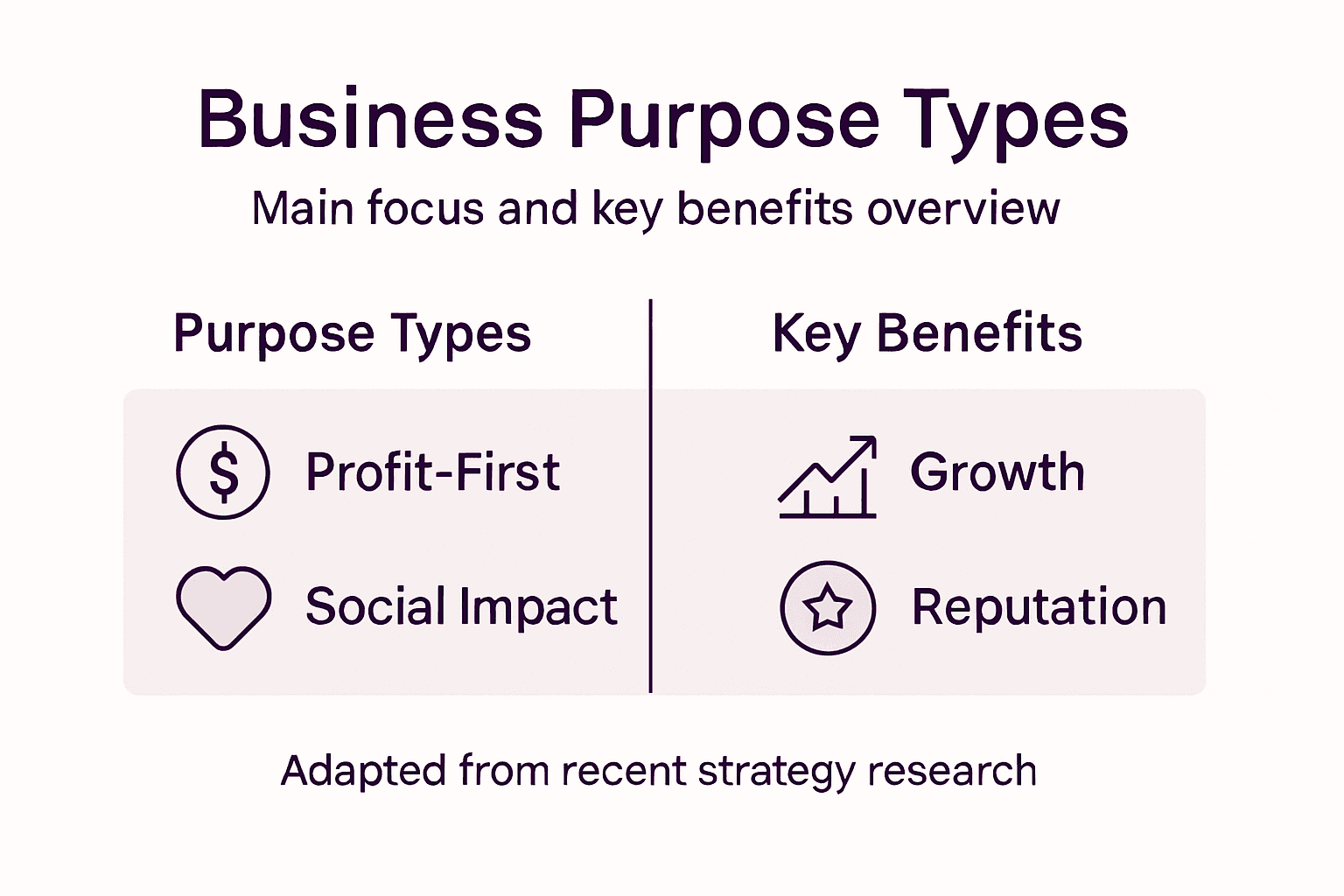
Companies typically manifest business purpose through several fundamental archetypes that reflect their core strategic orientation. These types represent different approaches to balancing economic performance with broader societal contributions:
- Profit-First Purpose: Prioritizes financial sustainability while maintaining ethical standards
- Social Impact Purpose: Emphasizes solving societal challenges as the primary organizational goal
- Balanced Purpose: Seeks equal emphasis on financial and social outcomes
- Innovation-Driven Purpose: Focuses on creating transformative solutions to systemic challenges
Pluralistic research perspectives underscore that business purposes are fundamentally shaped by a complex interplay of normative intentions, legal frameworks, and organizational contexts. This means purpose is not static but dynamically evolves with changing stakeholder expectations and societal needs.
Understanding these distinctions helps entrepreneurs design more intentional and holistic business models. Each purpose type requires different strategic approaches, resource allocations, and measurement frameworks to effectively translate aspirational goals into tangible organizational outcomes.

Here’s a concise comparison of business purpose archetypes and their strategic outcomes:
| Purpose Type | Primary Focus | Typical Benefits |
|---|---|---|
| Profit-First | Financial sustainability | Stable growth and investor trust |
| Social Impact | Societal challenges | Enhanced reputation, social value |
| Balanced | Financial & social goals | Broader stakeholder engagement |
| Innovation-Driven | Systemic transformation | Market leadership, adaptability |
Contextual Factors Influencing Purpose Type:
Review these key contextual factors shaping business purpose selection across organizations:
| Factor | How It Influences Purpose | Example Impact |
|---|---|---|
| Founder’s Values | Sets direction and priorities | Social vs profit focus |
| Industry Ecosystem | Determines market expectations | Regulatory needs |
| Target Market | Aligns with customer demands | Sustainability emphasis |
| Organizational Scale | Limits or expands possibilities | Global reach or local impact |
| Regulatory Environment | Requires compliance strategies | ESG reporting necessity |
- Founder’s personal values
- Industry ecosystem
- Target market characteristics
- Organizational scale and maturity
- Regulatory environment
Successful businesses recognize that purpose is not a one-size-fits-all concept but a tailored strategy reflecting an organization’s unique capabilities, constraints, and aspirations.
Pro tip: Conduct a comprehensive purpose audit to identify which purpose type most authentically aligns with your organization’s core strengths and societal potential.
How Purpose Shapes Customer and Brand Alignment
Brand purpose transforms traditional marketing by creating deeper, more meaningful connections between organizations and their customers. Purpose-driven branding research reveals how authentic purpose can empower consumers and foster social transformation beyond conventional transactional relationships.
Customer alignment with brand purpose occurs through several critical mechanisms that go far beyond surface-level marketing strategies:
- Shared Value Resonance: Customers seek brands that reflect their personal beliefs and societal aspirations
- Emotional Connection: Purpose creates genuine psychological engagement
- Trust Building: Authentic purpose demonstrates organizational integrity
- Social Impact Motivation: Consumers want to support brands making tangible differences
Consumer-brand congruency research demonstrates that authenticity is the critical bridge connecting organizational purpose with consumer intentions. This means brands must move beyond performative statements to demonstrate real commitment through consistent actions and transparent communication.
Successful brand purpose alignment requires strategic integration across multiple dimensions:
- Articulate a clear, genuine organizational mission
- Demonstrate consistent commitment through actions
- Communicate impact transparently
- Invite customer participation in purpose-driven initiatives
- Measure and communicate social and economic outcomes
Modern consumers are sophisticated evaluators who can distinguish between superficial marketing tactics and genuine purpose-driven commitments. They actively seek brands that not only communicate values but systematically embed those values into their operational DNA.
Pro tip: Conduct regular purpose alignment audits to ensure your brand’s actions consistently reflect your stated organizational mission.
Legal, Social, and Ecological Considerations in Central Europe
Business purpose in Central Europe is increasingly shaped by complex legal and regulatory frameworks that demand holistic approaches to corporate responsibility. Recent regulatory advances emphasize Environmental, Social, and Governance (ESG) compliance as a critical strategic imperative for organizations operating in the region.
The evolving landscape of corporate responsibility in Central Europe encompasses multiple interconnected dimensions:
- Legal Compliance: Mandatory sustainability reporting and due diligence requirements
- Environmental Standards: Stringent decarbonization and ecological impact regulations
- Social Responsibility: Enhanced protection of human rights and worker welfare
- Governance Transparency: Increased accountability and ethical business practices
European policy frameworks are driving a fundamental transformation in how businesses conceptualize their societal role. This means moving beyond traditional profit-driven models to integrate comprehensive assessments of human rights, environmental impact, and social contributions.
Key strategic considerations for businesses in Central Europe include:
- Conduct comprehensive environmental impact assessments
- Develop transparent human rights protection mechanisms
- Implement robust sustainability reporting systems
- Align business strategies with regional ecological goals
- Create measurable social impact frameworks
Successful organizations recognize that legal compliance is no longer a checkbox exercise but a fundamental aspect of strategic design. The regulatory environment demands proactive approaches that demonstrate genuine commitment to social and ecological responsibility.
Central European businesses must view legal and ecological considerations as strategic opportunities, not just regulatory constraints.
Pro tip: Develop a cross-functional ESG strategy team that integrates legal, environmental, and social expertise to navigate complex regulatory landscapes.
Overcoming Barriers and Common Pitfalls
Business purpose implementation confronts numerous challenges that can derail strategic intentions. Research exploring purpose-led businesses reveals that leaders frequently encounter complex barriers preventing authentic purpose integration.
The most prevalent obstacles organizations face when clarifying and executing business purpose include:
- Organizational Resistance: Employees and management skeptical of transformative changes
- Strategic Ambiguity: Lack of clear, actionable purpose definitions
- Measurement Challenges: Difficulty quantifying purpose-driven outcomes
- Communication Gaps: Inconsistent messaging across organizational levels
- Cultural Inertia: Deeply entrenched traditional business mindsets
Systematic literature reviews suggest several strategic approaches to overcome these implementation barriers:
- Develop comprehensive stakeholder engagement strategies
- Create measurable purpose-aligned performance indicators
- Implement transparent communication protocols
- Design purpose-integration training programs
- Establish cross-functional purpose implementation teams
Successful purpose integration requires persistent commitment, not just momentary strategic declarations.
Authentic purpose transformation demands more than superficial declarations. Organizations must systematically embed purpose into their operational DNA, creating alignment between strategic vision and daily organizational practices.
Pro tip: Conduct quarterly purpose alignment workshops to continuously reassess and recalibrate your organization’s purpose implementation strategy.
Unlock Your Business Purpose for Sustainable Growth Today
Defining and integrating a clear business purpose is the foundation for lasting success. This article highlights critical challenges such as strategic ambiguity and cultural inertia that many entrepreneurs face when trying to embed authentic purpose into their organizations. If you struggle to align your brand, customer understanding, and internal culture with a meaningful mission, know that you are not alone. Businesses that clarify their unique value and societal impact unlock deeper customer trust and long-term viability.
Starfireblast is designed to help you overcome these barriers by providing a purpose-driven platform that guides solo entrepreneurs and small teams through every stage of purpose clarification and execution. With tools that combine brand and strategy clarity, practical AI-assisted workflows, and a community built for planetary productivity, you can transform your aspirations into real, sustainable action without burnout or wasted effort.
Let us help you clarify who you are building for and why it matters before scaling marketing or sales. Discover more about how to turn your business purpose into a living strategy at Starfireblast. Explore how our approach integrates customer understanding and practical execution to drive meaningful growth in a Purpose-Driven Platform.
Take the first step now to align your business around a powerful purpose that fuels both social impact and economic viability. Visit Starfireblast and start your pathway to sustainable growth today.
Frequently Asked Questions
What is the importance of defining a business purpose?
Defining a business purpose is crucial as it serves as a strategic compass that guides an organization beyond merely seeking profits, helping to articulate the unique value it provides to customers, employees, and society.
How can a business effectively implement its purpose?
To effectively implement business purpose, organizations must integrate it systematically across their strategies, management practices, and operational behaviors, ensuring it is actionable and measurable.
What are the different types of business purposes?
The main types of business purposes include Profit-First Purpose, Social Impact Purpose, Balanced Purpose, and Innovation-Driven Purpose, each with distinct focuses and benefits related to financial and social outcomes.
How does business purpose impact customer relationships?
A strong business purpose shapes customer relationships by creating shared values, fostering emotional connections, building trust, and motivating customers to support brands that are making tangible social impacts.
Recommended
- 7 Essential Steps for a Resilient Entrepreneur Mindset List – Starfireblast
- Business Positioning Workflow for Sustainable Impact – Starfireblast
- Top 8 Starblaze.co Alternatives in 2026 for Creative Teams Seeking Sus – Starfireblast
- Planetary Productivity Explained: Sustainable Progress for Entrepreneu – Starfireblast