Planetary Productivity Explained: Sustainable Progress for Entrepreneurs
Traditional productivity models fall short when it comes to building sustainable businesses in places like Germany, Austria, or Switzerland. For Central European entrepreneurs, navigating growth is about more than financial returns. Planetary productivity offers a guiding path for those who want to align economic progress with ecological stability and personal well-being. Discover how shifting your focus toward balancing human potential, environmental resilience, and business outcomes can create lasting and meaningful impact.
Table of Contents
- Defining Planetary Productivity And Core Principles
- Why Traditional Productivity Models Fall Short
- Applying Planetary Productivity In Daily Work
- Balancing Economic, Human, And Ecological Needs
- Common Pitfalls And Building Lasting Resilience
Key Takeaways
| Point | Details |
|---|---|
| Understanding Planetary Productivity | This approach integrates human potential, economic viability, and ecological responsibility, shifting the focus from narrow financial metrics to a holistic view of sustainable development. |
| Limitations of Traditional Models | Conventional productivity frameworks often overlook critical factors such as intangible assets and adaptability, leading to a simplistic view of organizational performance. |
| Practical Implementation Strategies | Businesses should conduct regular environmental assessments and develop adaptive work practices to embed sustainability into daily operations. |
| Balancing Competing Priorities | Economic growth, human well-being, and ecological sustainability must be harmonized, recognizing their interdependence for long-term resilience and value creation. |
Defining Planetary Productivity and Core Principles
Planetary productivity represents a transformative approach to understanding business progress that goes beyond traditional metrics of success. Unlike conventional productivity models that focus exclusively on output and financial growth, this framework integrates human potential, economic viability, and ecological responsibility into a holistic system of sustainable development.
At its core, planetary productivity emerged from scientific research on Earth system processes. The concept recognizes that human economic activities must operate within defined ecological boundaries to maintain planetary stability. These boundaries represent critical thresholds where fundamental environmental systems could experience irreversible changes.
Key principles of planetary productivity include:
- Recognizing interconnected human and ecological systems
- Maintaining sustainable operating spaces for human development
- Balancing economic progress with environmental resilience
- Understanding quantifiable limits for human pressures on natural systems
- Integrating decision-making that respects planetary constraints
This approach fundamentally reframes productivity from a narrow financial measurement to a comprehensive strategy that considers long-term sustainability. Entrepreneurs practicing planetary productivity aim to create value that supports human well-being while simultaneously respecting ecological limits and economic realities.
The framework provides a pragmatic roadmap for businesses seeking to build resilient, meaningful enterprises that contribute positively to global systems. By understanding and working within planetary boundaries, organizations can develop innovative solutions that generate economic value without compromising environmental integrity.
Pro tip: Start mapping your business activities against ecological boundaries to identify potential sustainability improvements and innovative opportunities.
Why Traditional Productivity Models Fall Short
Traditional productivity models have become increasingly obsolete in today’s complex and interconnected business landscape. These conventional approaches typically measure success through narrow financial metrics like output volume, revenue generation, and efficiency ratios, fundamentally misunderstanding the multifaceted nature of genuine organizational progress.
Research reveals significant limitations in these traditional frameworks. Productivity measurement techniques consistently overlook critical factors that determine true organizational effectiveness. These overlooked elements include:
- Intangible asset valuation
- Knowledge diffusion capabilities
- Technological adaptation rates
- Human capital development
- Complex innovation ecosystem dynamics
The fundamental problem with conventional productivity models is their reductive approach to measuring organizational performance. They treat businesses like mechanical systems, assuming linear relationships between inputs and outputs, while modern enterprises operate more like adaptive, interconnected networks with nuanced interdependencies.
Traditional productivity metrics are like trying to measure an ocean’s health by counting waves – they miss the entire ecosystem’s complexity.
Moreover, these models fail to account for emerging economic realities. Firm-level productivity variations demonstrate significant disparities that cannot be captured by standardized measurement techniques. They ignore crucial factors such as technological innovation, workforce adaptability, and the qualitative aspects of organizational culture that truly drive sustainable performance.
Pro tip: Develop a holistic productivity assessment framework that integrates both quantitative metrics and qualitative organizational capabilities.
Here’s how planetary productivity contrasts with traditional productivity models:
| Aspect | Planetary Productivity | Traditional Productivity |
|---|---|---|
| Performance Drivers | Human, economic, ecological balance | Financial growth, efficiency |
| Measurement Style | Holistic, multi-dimensional metrics | Linear, output-focused metrics |
| Time Horizon | Long-term, regenerative outcomes | Short-term, quarterly/annual gains |
| Response to Complexity | Embraces systems thinking | Prefers simplicity, direct control |
Applying Planetary Productivity in Daily Work
Transforming daily work practices requires more than theoretical understanding – it demands practical strategies that integrate planetary productivity principles into routine decision-making. Small, intentional changes can create significant positive impacts across personal and professional systems.
Business sustainability frameworks suggest several concrete approaches for entrepreneurs and teams to embed planetary productivity into everyday workflows:
- Conduct regular environmental impact assessments
- Prioritize resource efficiency in project planning
- Design workflows that minimize waste and energy consumption
- Create metrics beyond financial performance
- Develop regenerative work practices
The key is viewing productivity not as a linear output measurement, but as a holistic system of value creation that considers human, economic, and ecological dimensions simultaneously. This means shifting from extractive work models to regenerative approaches that replenish personal and systemic energy.
Planetary productivity transforms work from a transactional activity into a collaborative regenerative process.
Practical implementation involves developing adaptive work rhythms that respect both human capabilities and ecological constraints. This might mean restructuring workdays to align with natural energy cycles, incorporating deliberate rest periods, and designing projects that create net positive impacts beyond immediate financial returns.

By integrating planetary productivity principles, entrepreneurs can develop more resilient, meaningful work practices that generate sustainable value across multiple domains. The goal is not perfection, but continuous conscious evolution of how we approach professional activities.
Pro tip: Conduct a monthly review of your work practices, measuring impact across personal energy, team dynamics, and ecological footprint.
This table summarizes actionable steps for embedding planetary productivity into business operations:
| Action Step | Expected Benefit | Example Implementation |
|---|---|---|
| Environmental impact reviews | Identifies improvement areas | Quarterly resource audits |
| Adaptive work scheduling | Boosts well-being and output | Flexible energy-based work hours |
| Regenerative workflow design | Minimizes waste generation | Circular project planning |
| Impact assessment updates | Measures value beyond profit | Monthly stakeholder surveys |
Balancing Economic, Human, and Ecological Needs
Planetary productivity requires a sophisticated approach to harmonizing seemingly competing priorities: economic growth, human well-being, and ecological sustainability. This delicate balance isn’t about compromise, but about recognizing the deep interconnectedness of these fundamental systems.
Ecological economic models reveal that economic prosperity is fundamentally dependent on healthy ecological systems. Entrepreneurs must shift from viewing these domains as separate to understanding them as integrated, dynamic networks:
- Economic activities embedded within ecological limits
- Human needs directly linked to ecosystem services
- Resource distribution aligned with regenerative principles
- Value creation that supports multiple system health
- Long-term resilience over short-term extraction
The traditional economic paradigm treats natural resources as infinite and externally available, but planetary productivity demands a radical reframing. Businesses must recognize that economic success is not separate from, but deeply intertwined with, ecological and human system health.
Economic prosperity emerges from harmony, not extraction. Sustainable value creation respects all living systems.
Practical implementation requires holistic performance metrics that measure success across economic, human, and ecological dimensions. This means developing evaluation frameworks that go beyond financial indicators to assess broader impact, including workforce well-being, community resilience, and ecosystem regeneration.
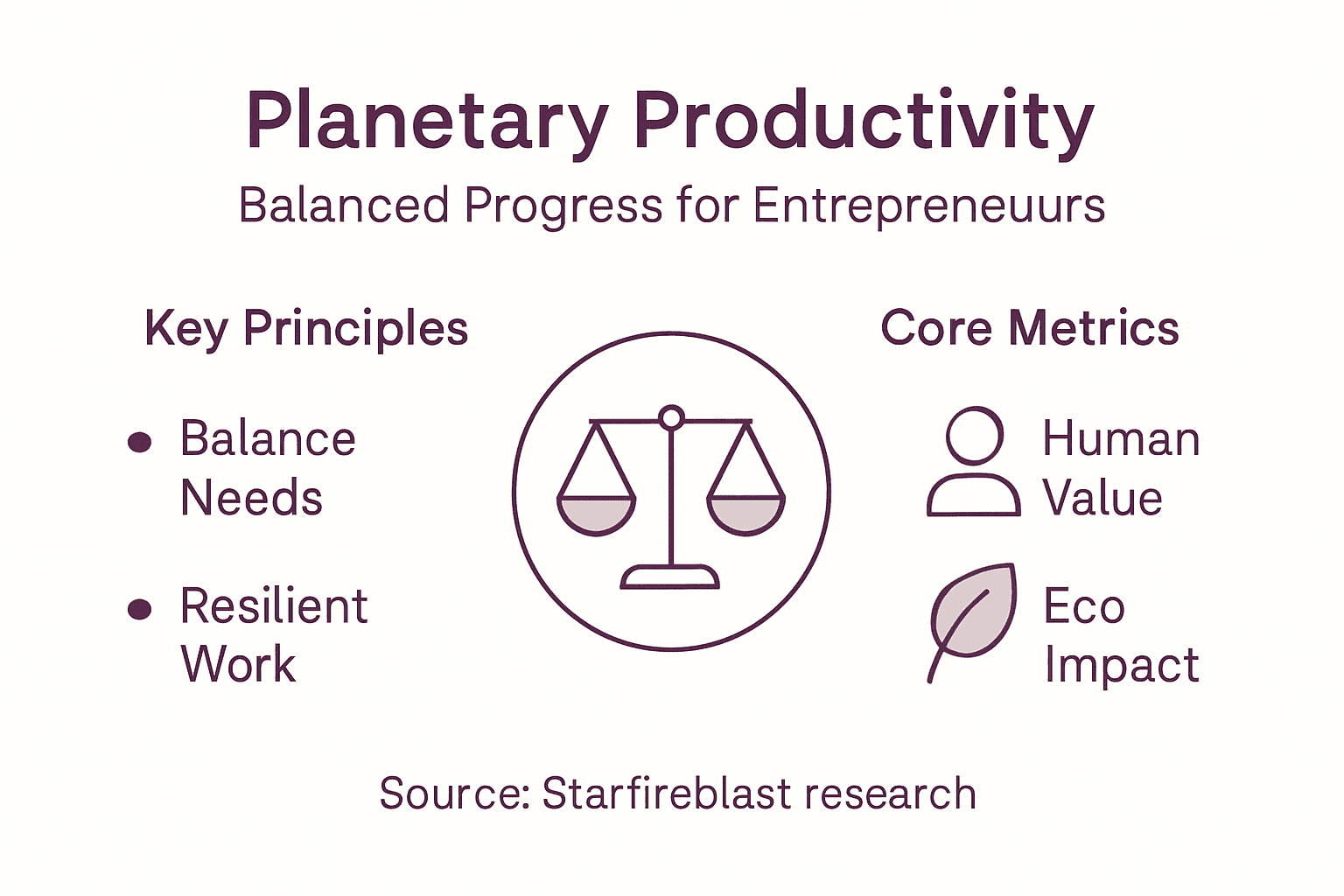
By embracing this integrated approach, entrepreneurs can design business models that generate meaningful economic value while simultaneously supporting human potential and ecological restoration. The goal is creating living economic systems that thrive through mutual support rather than competitive extraction.
Pro tip: Design quarterly impact assessments that measure your organization’s performance across economic, human, and ecological dimensions.
Common Pitfalls and Building Lasting Resilience
Building resilient systems requires more than good intentions – it demands a strategic approach that anticipates potential vulnerabilities and creates adaptive frameworks. Most entrepreneurs unknowingly sabotage their own sustainability efforts by falling into predictable traps that undermine long-term success.
Resilience building principles highlight critical strategies for developing robust organizational approaches. Common pitfalls entrepreneurs must avoid include:
- Assuming linear cause-and-effect relationships
- Neglecting system complexity and interdependencies
- Underestimating slow, cumulative changes
- Failing to create diverse feedback mechanisms
- Centralizing decision-making too rigidly
The fundamental mistake most organizations make is treating resilience as a static condition rather than a dynamic, continuously evolving process. Resilient systems are not fortresses, but living networks that can absorb disruptions and adapt intelligently.
Resilience is not about preventing change, but about becoming flexible enough to dance with uncertainty.
Practical resilience requires developing adaptive capacity – the ability to sense emerging challenges and respond creatively. This means creating organizational structures that encourage experimentation, welcome diverse perspectives, and maintain multiple pathways for information and resource flow.
Entrepreneurs can cultivate resilience by designing intentional redundancies, encouraging cross-functional learning, and maintaining open communication channels that allow rapid sense-making and coordinated response to emerging challenges.
Pro tip: Conduct quarterly scenario planning exercises that challenge your team’s assumptions and explore potential disruption strategies.
Embrace Planetary Productivity with Starfireblast Today
The article highlights the challenge entrepreneurs face in balancing economic growth, human well-being, and ecological sustainability — a complex task that traditional productivity models fail to address. You need a clear framework that integrates human, economic, and ecological balance while avoiding burnout and short-term distractions. Starfireblast is designed exactly for this purpose. It helps you clarify who you are building for and why it matters before scaling your efforts unnecessarily.

Take control of your business journey by applying planetary productivity principles through a platform tailored to your unique needs. With Starfireblast, you gain access to customer understanding, brand clarity, and practical AI-assisted tools to execute meaningful, sustainable action every day. Don’t wait to transition from outdated productivity metrics to a resilient model that supports long-term growth with purpose. Explore how you can build a living, evolving business aligned with core planetary principles now at Starfireblast. Learn more about transforming your work through sustainable progress strategies and unlock your potential today.
Frequently Asked Questions
What is planetary productivity?
Planetary productivity is a framework that integrates human potential, economic viability, and ecological responsibility, aiming for sustainable development beyond traditional productivity metrics.
How does planetary productivity differ from traditional productivity models?
Unlike traditional models that focus solely on financial outputs and efficiency, planetary productivity considers a holistic balance between economic progress, human well-being, and ecological sustainability.
What are some core principles of planetary productivity?
Key principles include recognizing interconnected human and ecological systems, balancing economic progress with environmental resilience, and integrating decision-making that respects planetary constraints.
How can businesses implement planetary productivity in their daily operations?
Businesses can implement planetary productivity by conducting regular environmental impact assessments, designing workflows to minimize waste, and developing metrics that go beyond financial performance, fostering a more sustainable work environment.
Recommended
- 7 Essential Steps for a Resilient Entrepreneur Mindset List – Starfireblast
- Top 8 Starblaze.co Alternatives in 2026 for Creative Teams Seeking Sus – Starfireblast
- Top 8 Starfire.live Alternatives in 2026 for Boosting Your Online Pres – Starfireblast
- Business Positioning Workflow for Sustainable Impact – Starfireblast