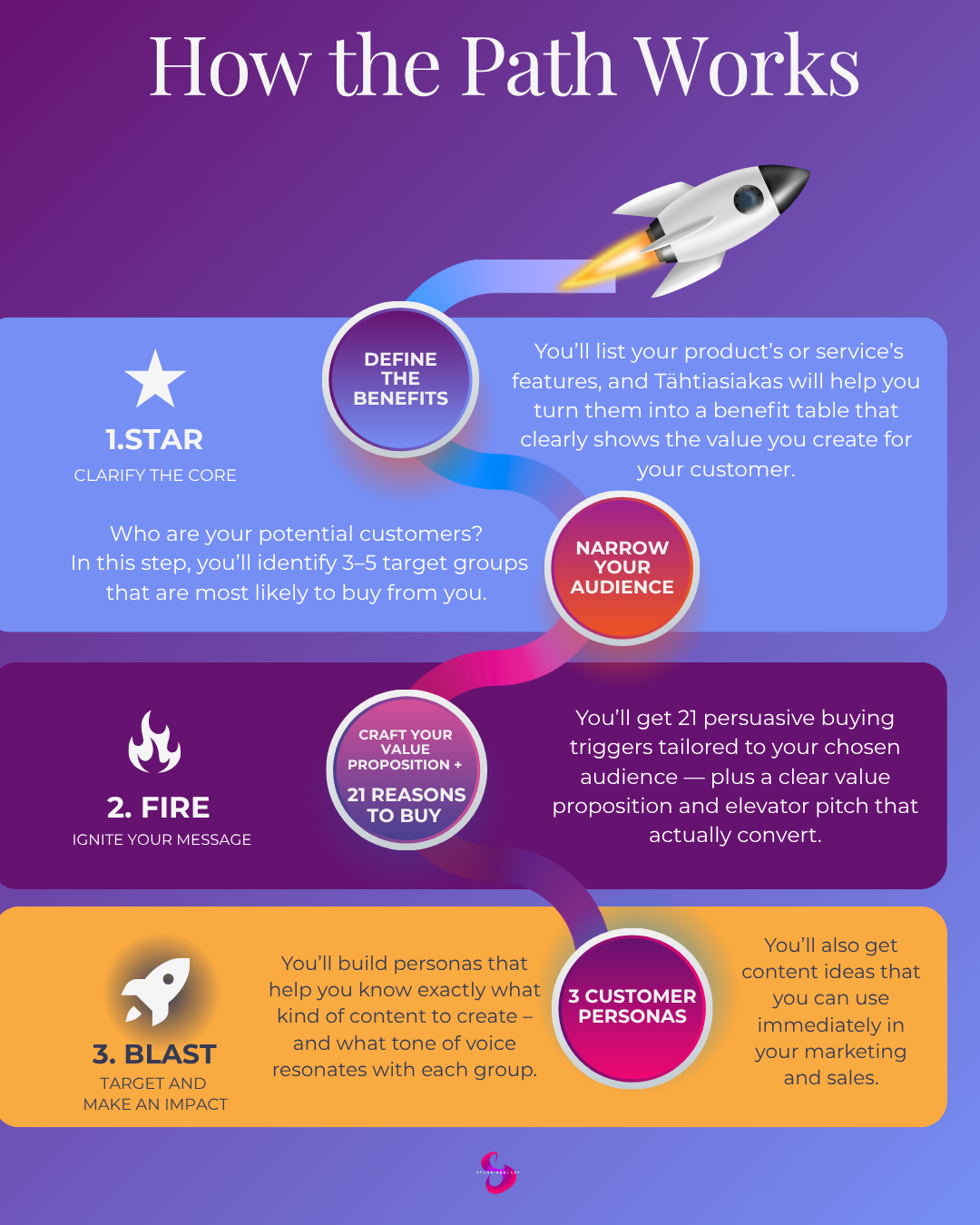
How to Clarify Business Vision: 66% More Customer Growth
Most solo entrepreneurs struggle to balance purpose with sustainable growth. You want to build something meaningful without burning out or compromising your values. This guide provides actionable steps to create a clear business vision that integrates human well-being, economic viability, and ecological responsibility for lasting success.
Table of Contents
- The Importance of a Clear, Sustainable Business Vision
- Prerequisites: What You Need Before Starting to Clarify Your Vision
- Step 1: Define Your Sustainable Vision and Mission
- Step 2: Set SMART Goals Aligned with Your Vision
- Step 3: Integrate Sustainability into Your Vision and Strategy
- Step 4: Conduct Market and Customer Research
- Step 5: Build an Operational Plan With Tools
- Common Mistakes and How to Avoid Them
- Expected Outcomes and Success Metrics
- Summary: Your Path to a Clear, Sustainable Business Vision
- Achieve Clarity and Sustainable Growth with Starfireblast
- How to Clarify Your Business Vision: FAQ
Key Takeaways
| Point | Details |
|---|---|
| Vision clarity drives sustainable growth | Integrating purpose with practical goals creates focused strategy and customer loyalty |
| SMART goals enable measurable progress | Breaking vision into quarterly milestones maintains momentum and flexibility |
| Sustainability integration builds resilience | 66% of consumers prefer sustainable brands, enhancing market position |
| Simple tools prevent overwhelm | Trello or Notion organize vision execution without complexity |
| Regular reviews maintain alignment | Quarterly check-ins ensure vision evolves with your business and values |
The Importance of a Clear, Sustainable Business Vision
You cannot grow sustainably without knowing where you are headed. A clear vision that balances human and ecological values guides every strategic decision you make. It sharpens your focus and prevents you from chasing every opportunity that appears.
Companies that integrate sustainability into their core vision outperform competitors by creating stronger brand identity and customer loyalty. This approach builds trust with customers who increasingly choose purpose-driven businesses. When your vision explicitly includes planetary responsibility, you attract customers willing to invest in meaningful solutions.
Consider these benefits of vision clarity:
- Strategic focus that cuts through noise and distractions
- Differentiated brand identity that resonates with values-aligned customers
- Resilience through balanced growth that sustains human and ecological systems
- Operational efficiency by aligning daily decisions with long-term direction
The data supports this approach. 66% of consumers prefer paying more for sustainable products, giving you competitive advantage when your vision clearly articulates impact. Your sustainable business positioning becomes your market differentiator.
“A vision without sustainability is a plan for short-term gains at long-term cost. True clarity integrates purpose with planetary responsibility.”
Your vision becomes the north star for hiring, partnerships, product development, and customer communication. Without it, you drift toward reactive decisions that drain resources and misalign with your values.
Prerequisites: What You Need Before Starting to Clarify Your Vision
You need foundational elements in place before diving into vision clarification. Starting without preparation leads to vague statements that fail to guide actual decisions. Take time to build the right mindset and gather necessary tools first.
Awareness of sustainability principles, market understanding, and planning tools enhance vision clarification success. You do not need expert-level knowledge, but basic literacy in ecological responsibility and your market landscape makes the process more effective.
Gather these essentials before beginning:
- Basic understanding of sustainability principles relevant to your industry
- Initial market research and customer insights about your target audience
- Simple planning tools like Trello, Notion, or spreadsheets for organization
- Dedicated time blocks over 3 to 6 months for development and refinement
- Willingness to question assumptions and adjust based on learning
Your purpose-driven entrepreneurship checklist helps you assess readiness. You also need realistic expectations about timeline and effort. Vision clarity is not a weekend project.
Pro Tip: Block two hours weekly for vision work rather than trying to complete everything in one marathon session. Consistent focus beats intensive bursts.
The mindset matters as much as the tools. Approach this work with curiosity rather than perfectionism. Your first draft will evolve as you learn and implement. Expect iteration and embrace it as part of the process.
Start by reviewing examples of effective vision statements from businesses similar to yours. Notice how successful companies articulate both purpose and practical direction. This research primes your thinking for the creation phase.
Step 1: Define Your Sustainable Vision and Mission
Your vision statement articulates where you want to be in three to five years. It must inspire while remaining concrete enough to guide decisions. Vague aspirations like “make the world better” do not provide strategic direction.
A clear business vision statement aligning with sustainability improves decision-making and resilience. Your statement should explicitly name the human and ecological values you prioritize alongside economic viability. This specificity prevents sustainability from becoming an afterthought.
Follow this framework for crafting your vision:
- State your three to five year aspiration with specific impact metrics
- Name the audience you serve and the transformation you provide
- Explicitly include ecological and social values you uphold
- Keep it to two or three sentences maximum for clarity and memorability
- Make it inspiring enough to motivate you during difficult periods
Study mission-driven startup examples to see how leading businesses articulate purpose. Notice how effective statements balance ambition with specificity. Your vision should feel aspirational yet achievable with focused effort.
Your mission statement differs from your vision. The mission describes what you do daily to advance toward that vision. It answers how you create value right now. Together, these statements form the foundation for your action planning for sustainable progress.
“Vision without action is merely a dream. Action without vision just passes time. Vision with action can change the world.” Joel A. Barker
Test your vision by sharing it with trusted peers or mentors. Does it clearly communicate your direction? Does it inspire them to support your work? Refine based on feedback until it rings true. Your vision should feel authentic to who you are and what you want to build.
The power of purpose-driven entrepreneurship lies in this clarity. When you know exactly where you are headed and why it matters, every decision becomes easier to evaluate.
Step 2: Set SMART Goals Aligned with Your Vision
Your vision needs operational translation. Grand aspirations mean nothing without concrete milestones that move you forward. This is where SMART goals transform vision into actionable strategy.
Setting SMART goals aligned with clarified vision increases sustainable growth likelihood with measurable milestones. Each goal must be Specific, Measurable, Achievable, Relevant, and Time-bound to create accountability and track progress.
Follow this process for effective goal setting:
- Identify three to five annual objectives that advance your vision
- Break each annual objective into quarterly milestones with specific metrics
- Define the resources and actions required for each milestone
- Assign realistic deadlines based on your capacity and constraints
- Build in buffer time for unexpected challenges or learning curves
Your action planning tips provide frameworks for translating goals into weekly tasks. The key is maintaining line of sight from daily work to long-term vision. Every task should connect to a goal that advances your vision.
Pro Tip: Review goals monthly and adjust quarterly. Rigid adherence to outdated goals wastes resources when circumstances change.
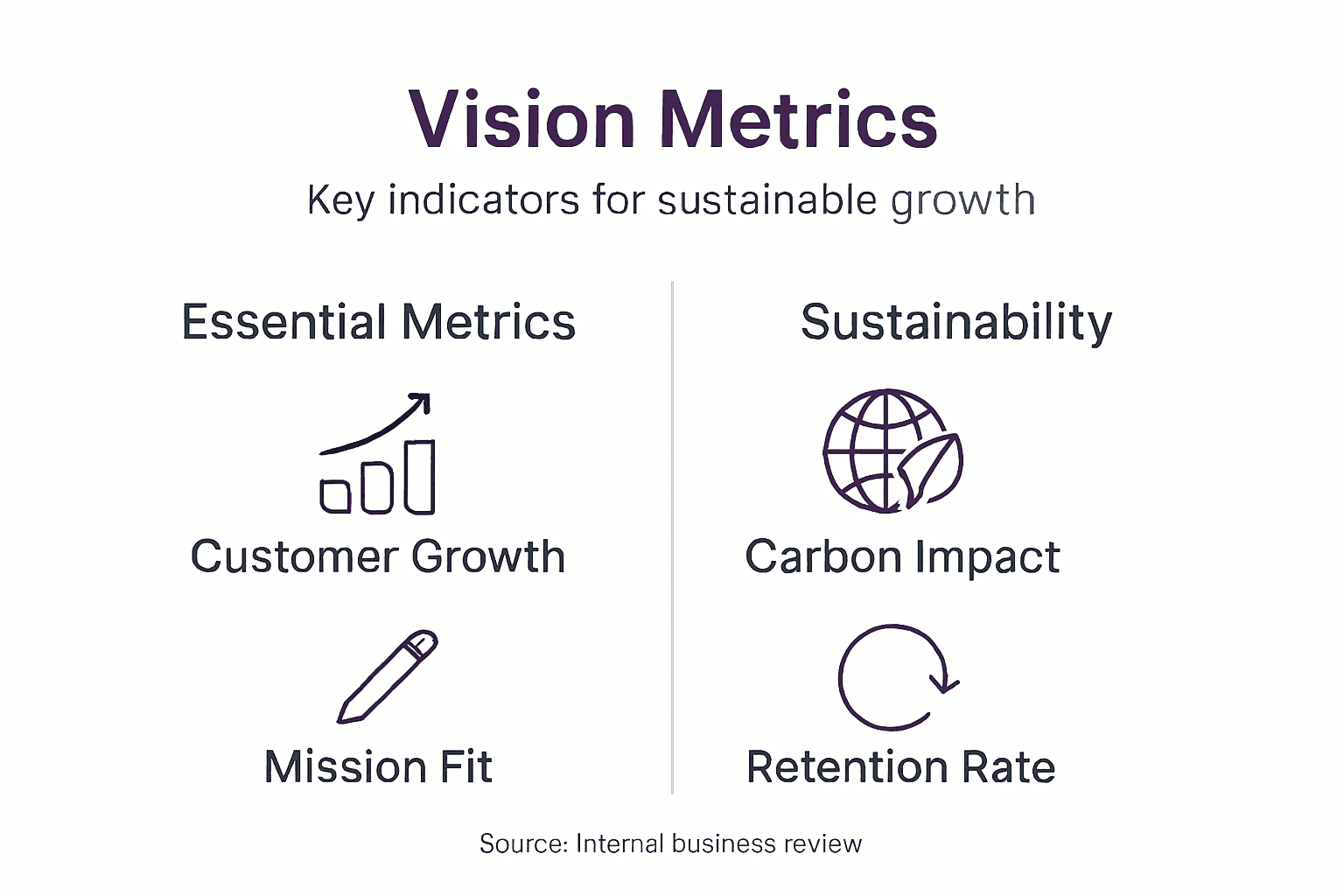
Track progress using simple metrics that matter to your business model. Revenue growth alone does not capture sustainable success. Include metrics for customer satisfaction, ecological impact reduction, and team well-being if you have collaborators.
Quarterly milestones create natural checkpoints for celebration and course correction. When you hit a milestone, acknowledge the progress before moving to the next challenge. This builds momentum and prevents burnout from constant striving without recognition.
Align your sustainable growth metrics with both business viability and planetary responsibility. Measure carbon footprint reduction alongside revenue growth. Track customer retention rates and satisfaction with your values alignment. These combined metrics reveal whether you are achieving true sustainable growth.
Step 3: Integrate Sustainability into Your Vision and Strategy
Sustainability cannot be a separate initiative or marketing add-on. It must weave through every aspect of your business model and daily operations. This integration creates coherence between what you say and what you do.

Avoid treating sustainability as a side project. Integrating sustainability leads to attracting 66% more paying customers and improved brand reputation. When ecological responsibility informs your core strategy, customers recognize authenticity and reward it with loyalty.
Embed sustainability through these approaches:
- Evaluate every business decision through triple bottom line: people, planet, profit
- Choose suppliers and partners who share your ecological values
- Design products or services that minimize environmental impact by default
- Communicate your sustainability practices transparently without greenwashing
- Measure and report on ecological impact alongside financial metrics
The business case for integration grows stronger. 70% of business leaders see climate risks impacting operations by 2027, highlighting the importance of proactive integration. Early adopters gain competitive advantage while laggards face disruption.
| Approach | Traditional Vision | Sustainability-Integrated Vision |
|---|---|---|
| Focus | Profit maximization | Balanced triple bottom line |
| Customer Appeal | Price and features | Values alignment and impact |
| Risk Management | Financial only | Financial plus ecological and social |
| Brand Loyalty | Transactional | Deep values-based connection |
| Resilience | Vulnerable to regulation | Proactive regulatory alignment |
Your business evolution and sustainability journey requires this integration. Separating sustainability from strategy creates internal contradictions that undermine both effectiveness and authenticity. Customers detect this misalignment and lose trust.
Integration means sustainability informs your hiring practices, workspace choices, technology stack, and partnership criteria. Every system and process reflects your commitment to planetary responsibility. This consistency builds the brand strength that attracts loyal customers and talented collaborators.
Step 4: Conduct Market and Customer Research
Your vision needs market validation. You cannot build sustainably without understanding who you serve and how your sustainable approach resonates with them. Research sharpens your vision and prevents costly misalignment.
Identify your target customers and their relationship with sustainability. Not every audience values ecological responsibility equally. Find the segment that actively seeks purpose-driven solutions and aligns with your vision. These customers become your advocates and fuel sustainable growth.
Focus your research on these areas:
- Demographics and psychographics of sustainability-conscious customers in your market
- Pain points and aspirations related to both your solution and values alignment
- Competitive landscape and how others position their sustainable offerings
- Willingness to pay premium prices for verified sustainable practices
- Communication channels and language that resonate with values-driven audiences
Analyze competitors not to copy them but to identify differentiation opportunities. Where do their sustainability claims fall short? What gaps exist in serving customers who want deeper commitment to planetary responsibility? Your customer mapping for sustainability reveals these opportunities.
Use customer feedback to refine your mission and value proposition continuously. Early customers provide invaluable insights into what resonates and what needs clarification. This feedback loop prevents you from building in isolation based on assumptions.
Your research informs not just product development but also messaging and positioning. When you deeply understand your audience’s values and concerns, you communicate in ways that build immediate connection. This research becomes the foundation for all customer-facing work.
Incorporate periodic research reviews into your quarterly vision assessments. Markets evolve and customer priorities shift. Staying current with these changes keeps your vision relevant and your business aligned with actual demand.
Step 5: Build an Operational Plan With Tools
Vision and goals mean nothing without execution systems. You need practical tools and processes that translate strategic clarity into daily action. This operational layer makes your vision real.
Using tools such as Trello or Notion improves visibility and adherence to vision execution through organized, single-page operational plans. These platforms help you track tasks, deadlines, and progress without overwhelming complexity.
Create your operational plan using this structure:
- One page overview linking vision to quarterly goals to weekly priorities
- Task lists organized by project with clear owners and due dates
- Progress tracking with simple status indicators for quick visibility
- Regular review schedules built into your calendar as recurring events
- Resource allocation showing time and budget commitments per initiative
Your sustainable action planning framework connects strategic vision to tactical execution. The operational plan serves as the bridge between aspiration and accomplishment.
| Tool Feature | Trello | Notion | Spreadsheets |
|---|---|---|---|
| Visual Task Management | Excellent kanban boards | Good with databases | Basic with formatting |
| Collaboration | Strong team features | Strong with comments | Limited real-time |
| Customization | Moderate with power-ups | Extensive templates | Highly flexible |
| Learning Curve | Easy to start | Moderate complexity | Familiar to most |
| Cost | Free tier sufficient | Free tier generous | Usually free |
Pro Tip: Start with the simplest tool that meets your needs. Fancy features do not improve execution if they slow you down.
Review your operational plan weekly to adjust priorities based on progress and new information. Monthly reviews assess whether your activities still align with quarterly goals. This rhythm prevents drift and maintains strategic focus.
Your operational plan should feel like a helpful guide rather than a rigid constraint. Build in flexibility for unexpected opportunities or challenges. The plan serves you, not the reverse.
Common Mistakes and How to Avoid Them
Even with clear frameworks, common pitfalls derail vision clarification efforts. Awareness of these mistakes helps you navigate challenges before they become crises. Most errors stem from overcomplication or ignoring capacity limits.
High burnout rates and abandoned plans in solopreneurship often result from ignoring capacity and overcomplicating vision clarification. You cannot execute a vision that demands more than you can sustainably provide. Reality always wins.
Avoid these frequent mistakes:
- Making vision statements so complex they confuse rather than guide decisions
- Setting aggressive goals that ignore your actual time and energy constraints
- Treating sustainability as separate from core business strategy and operations
- Failing to review and update vision as you learn and circumstances change
- Pursuing perfectionism instead of iterative progress with regular refinement
Your personal capacity determines what you can realistically achieve. Tips to avoid burnout include honest assessment of your sustainable work pace. Building a business that exhausts you contradicts the entire purpose of sustainable growth.
Ignoring sustainability integration risks operational failures and inefficiencies. When sustainability exists separately from strategy, you create competing priorities that waste resources. Every decision becomes a negotiation between values and viability instead of an integrated choice.
Pro Tip: Schedule quarterly vision and goal reviews in your calendar now. Treat these sessions as non-negotiable appointments with your future self.
“The cost of unclear vision is not just missed opportunities but wasted effort on activities that do not advance your true purpose.”
Regular reviews prevent these mistakes from compounding. When you catch misalignment early, corrections require less effort. Your mindset for resilience includes embracing course corrections as learning rather than failure.
Simplicity beats sophistication in execution. A clear, simple vision you actually follow outperforms an elegant, complex vision that stays on paper. Strip away anything that does not directly serve clarity and action.
Expected Outcomes and Success Metrics
Set realistic expectations for your vision clarification journey. This work takes time and delivers compounding benefits that build over months and years. Quick fixes do not produce lasting clarity.
Vision clarification typically takes 3 to 6 months and leads to improved strategic focus, resource use, and customer engagement. Your timeline depends on starting clarity and complexity of your business model. Solo entrepreneurs often move faster than teams requiring alignment.
Measure success through these indicators:
- Achievement of SMART goals within quarterly milestone timelines
- Increased customer engagement and retention rates with values-aligned audience
- Higher conversion rates as messaging clarity improves through vision alignment
- Reduced decision-making time as vision provides clear evaluation criteria
- Improved personal satisfaction and reduced stress from strategic clarity
Customer response provides powerful validation. When your vision resonates, customers engage more deeply and advocate more actively. They recognize authenticity and reward it with loyalty and referrals. Your pathway to sustainable growth becomes visible through these customer relationships.
| Success Factor | Traditional Approach | Sustainability-Integrated Approach |
|---|---|---|
| Timeline to Clarity | 2 to 4 months | 3 to 6 months with deeper research |
| Customer Loyalty | Moderate, price-sensitive | High, values-based connection |
| Market Resilience | Vulnerable to disruption | Stronger through differentiation |
| Decision Speed | Slower without clear criteria | Faster with vision as filter |
| Long-term Viability | Uncertain regulatory landscape | Proactive regulatory alignment |
Your outcomes will reflect the depth of integration you achieve. Surface-level sustainability claims produce minimal differentiation. Deep integration that informs every decision creates substantial competitive advantage and customer preference.
Expect iterative improvement rather than perfection. Your first vision draft will evolve as you test it against reality. Each quarter brings new insights that refine your understanding and sharpen your execution. This continuous improvement process is the sustainable approach to business building.
Summary: Your Path to a Clear, Sustainable Business Vision
You now have a comprehensive framework for clarifying your business vision with sustainability at its core. This clarity drives every aspect of sustainable growth from customer acquisition to operational decisions.
Vision clarity provides the foundation for resilient business building. When you know where you are headed and why it matters, distractions lose their power. Your purpose-driven entrepreneurship benefits include this strategic focus that compounds over time.
Key elements of your journey:
- Clear vision and mission statements that explicitly integrate planetary responsibility
- SMART goals broken into quarterly milestones for measurable progress
- Deep sustainability integration that informs strategy and daily operations
- Market research that validates and refines your sustainable positioning
- Simple operational tools that translate vision into consistent action
Pro Tip: Revisit your vision and goals every quarter to maintain relevance as your business and market evolve. Static visions become outdated quickly.
Commit to continuous learning and adjustment. Your business exists in dynamic systems that constantly change. Sustainable success requires adaptive clarity that evolves with new understanding. This flexibility within clear purpose creates both stability and agility.
Start today with the first step that feels most accessible. Define your initial vision draft or set your first SMART goal. Progress compounds from consistent small actions aligned with clear direction. You do not need perfection to begin.
Achieve Clarity and Sustainable Growth with Starfireblast
Ready to transform your business vision into actionable strategy? Starfireblast provides proven frameworks designed specifically for solo entrepreneurs and small teams committed to sustainable growth.
Our platform helps you clarify who you serve, why your work matters, and how to act next without burning out or compromising values. Access practical resources including clarity messaging fixes that convert browsers into customers and customer mapping resources that sharpen your positioning. Get the brand positioning guidance that turns vision into market differentiation.
How to Clarify Your Business Vision: FAQ
What is the ideal timeline for clarifying a sustainable business vision?
Plan for three to six months to develop and refine a clear, sustainable vision with aligned operational goals. This timeline allows for necessary research, stakeholder input, and iterative refinement based on testing. Solo entrepreneurs often move faster than teams requiring broader alignment.
How often should I review and update my business vision?
Review your vision quarterly to assess relevance and alignment with market changes and learning. Annual deep reviews allow for more substantial updates based on accumulated experience. Your vision should evolve as your business matures and external conditions shift.
What tools are best for tracking progress on my vision?
Trello and Notion provide excellent balance of simplicity and functionality for most solo entrepreneurs. Trello excels at visual task management while Notion offers greater customization for complex workflows. Simple spreadsheets work well if you prefer familiar tools and need minimal collaboration features.
How do I ensure my vision balances profitability with ecological values?
Explicitly include triple bottom line metrics in your goal setting: people, planet, and profit. Track ecological impact reduction alongside revenue growth and customer satisfaction. Make sustainability a filter for all strategic decisions rather than a separate consideration evaluated afterward.
Can solo entrepreneurs realistically integrate sustainability without overwhelm?
Yes, by starting with simple, high-impact changes aligned with your business model. Focus on one or two sustainability initiatives per quarter rather than attempting comprehensive transformation immediately. Use your operational planning tools to integrate sustainable practices into existing workflows without adding complexity.
Recommended
- Clarifying Business Purpose: Pathway to Sustainable Growth – Starfireblast
- Brand Positioning Step by Step for Clear Messaging Success – Starfireblast
- Brand Story Development Explained: Clarity That Resonates – Starfireblast
- Action Planning for Entrepreneurs: Achieve Sustainable Progress – Starfireblast