Brand Positioning Step by Step for Clear Messaging Success
Building a brand that truly stands out in Central Europe starts long before your logo or website ever goes live. For solo entrepreneurs and small team leaders, clarifying your mission and connecting with real customers can feel overwhelming when every day brings new operational demands. By focusing on internal clarity and genuine customer understanding, you set a powerful foundation for sustainable brand positioning that grows with your business—without the cycle of burnout or diluted messaging.
Table of Contents
- Step 1: Define Your Purpose With Internal Clarity
- Step 2: Identify Your Real Customer Using Customer StarMap
- Step 3: Craft Positioning Language Your Audience Recognizes
- Step 4: Transform Vague Claims Into Specific Benefits
- Step 5: Put Your Positioning To Work In Everyday Actions
Quick Summary
| Key Point | Explanation |
|---|---|
| 1. Define Your Purpose Clearly | Articulate your core mission and values to establish a strategic direction that resonates with customers. |
| 2. Know Your Customer Deeply | Create detailed customer profiles that reflect emotional needs and motivations for effective engagement. |
| 3. Use Customer-Centric Language | Communicate in terms that resonate with your audience, enhancing relatability and trust in your brand. |
| 4. Make Benefits Specific and Measurable | Provide clear, quantifiable outcomes in your messaging to boost credibility and appeal to customers’ needs. |
| 5. Integrate Positioning into Daily Actions | Ensure your brand’s core messages influence everyday business decisions and interactions for consistency and alignment. |
Step 1: Define your purpose with internal clarity
Defining your purpose is the foundational step in brand positioning that transforms vague intentions into a clear strategic direction. In this stage, you’ll uncover the fundamental reason your business exists beyond making money - the core mission that drives every decision and communication.
To define your purpose with genuine internal clarity, start by asking yourself profound questions that go beyond surface-level business goals. Consider these essential reflection points:
- What specific problem are you solving for your customers?
- Why does this problem matter deeply to you?
- What unique perspective or approach do you bring?
- What would be missing in your customers’ world if your business didn’t exist?
These questions help you move past generic mission statements and tap into the authentic motivation behind your work. The goal is not to craft a perfect paragraph but to articulate a genuine commitment that resonates with both you and your potential customers.
Your purpose is the bridge between your personal passion and your customers’ genuine needs.
Start by writing raw, unfiltered thoughts about why you began this journey. Don’t worry about polish - focus on emotional truth. Your initial draft might feel messy, but it contains the seeds of powerful positioning.
As you explore your purpose, look for the intersection between what you care about, what you’re skilled at, and what customers genuinely need. This triangulation creates a positioning foundation that feels both personally meaningful and commercially viable.
Pro tip: Schedule a dedicated 90-minute session with zero distractions to dive deep into your purpose reflection, treating it as seriously as you would a critical business strategy meeting.
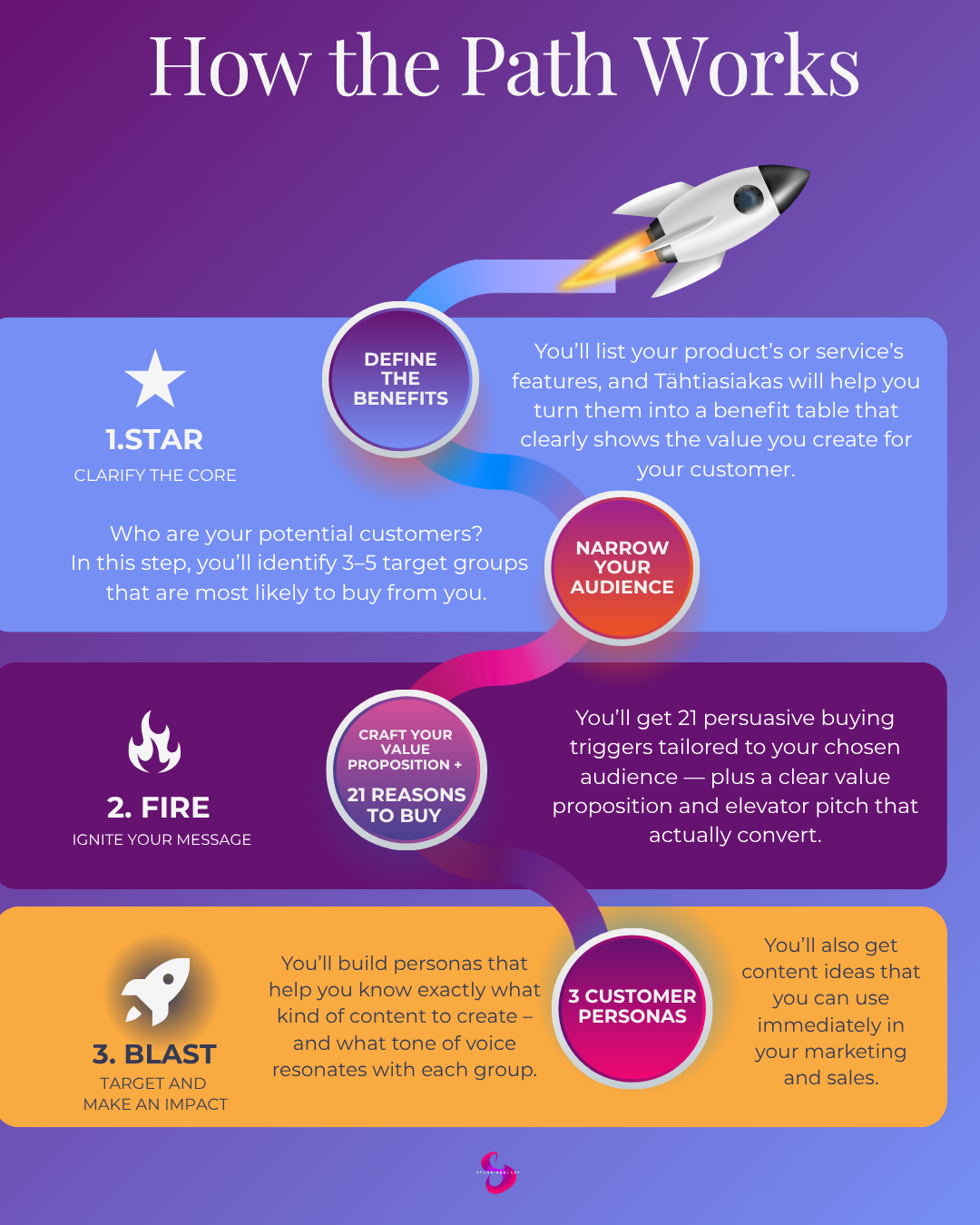
Step 2: Identify your real customer using Customer StarMap
In this crucial step, you’ll move beyond generic demographic descriptions to uncover the nuanced, real human behind your potential customer. Your goal is to develop a deep, multidimensional understanding that goes far beyond surface-level market segmentation.

Traditional customer identification often fails because it treats people as statistical data points. Instead, the Customer StarMap approach recognizes that genuine customer understanding requires exploring both practical needs and emotional landscapes. Customer connections research confirms that truly understanding consumers means mapping their experiential realities across cultural contexts.
To create an authentic customer profile, focus on these critical dimensions:
- Emotional triggers and underlying motivations
- Professional challenges and aspirational goals
- Personal values and belief systems
- Specific pain points that your offering uniquely addresses
- Communication preferences and decision-making patterns
Your ideal customer is a complex human being, not a checkbox on a demographic survey.
Start by developing multiple customer personas that represent different facets of your potential audience. Each persona should feel like a real person with authentic hopes, struggles, and potential interactions with your offering.
Don’t just collect data - create narrative arcs that explain why someone would truly care about what you’re building. This means going beyond demographic statistics and diving into the deeper psychological and emotional landscapes that drive human decision-making.
Pro tip: Conduct at least three in-depth interviews with individuals who represent your target audience, asking open-ended questions that reveal their underlying motivations and unspoken needs.
Step 3: Craft positioning language your audience recognizes
In this critical step, you’ll transform your internal understanding into language that resonates directly with your ideal customers. Your goal is to bridge the gap between your offering’s intrinsic value and how your audience actually experiences their challenges.
Crafting authentic positioning language requires moving beyond corporate jargon and technical descriptions. Speak in the emotional and practical vocabulary of your customers, not the language of your industry or internal teams. This means capturing their specific frustrations, aspirations, and the nuanced ways they describe their problems.
To develop compelling positioning language, consider these strategic approaches:
- Listen to actual customer conversations
- Capture verbatim quotes from interviews and feedback
- Analyze the precise words customers use when discussing their challenges
- Identify the underlying emotions behind their statements
- Match your language to their communication style
Effective positioning speaks to customers as if you’ve been reading their private journal, not their corporate resume.
Transform technical descriptions into human-centered narrative frameworks that explain not just what you do, but why it matters. For instance, instead of saying “We provide cloud infrastructure solutions,” you might say “We help entrepreneurs reclaim their time by making technology invisible and effortless.”
The most powerful positioning language does three things simultaneously: it validates the customer’s experience, offers hope, and creates a clear path forward. This means moving from abstract features to concrete emotional outcomes that your ideal customers deeply desire.
Pro tip: Record and transcribe actual customer conversations, then highlight the exact phrases that reveal their true motivations and emotional triggers.
Step 4: Transform vague claims into specific benefits
In this pivotal stage, you’ll evolve your brand messaging from generic platitudes to concrete, measurable promises that your ideal customers can actually understand and believe. Your mission is to replace empty marketing language with genuine, verifiable value propositions that speak directly to your audience’s most pressing needs.
Sustainability claims research emphasizes the critical importance of transforming broad statements into precise, transparent benefits. This means moving from vague assertions to specific, quantifiable outcomes that demonstrate exactly how you solve your customer’s problems.
To effectively transform your claims, use these strategic conversion techniques:
- Replace generic adjectives with specific metrics
- Quantify your impact wherever possible
- Connect features directly to customer outcomes
- Use real-world examples that illustrate your benefit
- Eliminate industry jargon and corporate speak
Specificity turns invisible promises into tangible solutions customers can trust.
Consider the difference between a vague claim and a specific benefit. Instead of saying “We help businesses grow,” you might say “Our clients increase revenue by an average of 47% within six months by implementing our targeted marketing strategy.”
The most powerful benefit statements combine three critical elements: measurement, timeframe, and emotional resolution. This means showing not just what changes, but how dramatically it changes and why that matters to your customer at a deeper level. Most positioning frameworks fail because they stop at clarity. The real work begins when clarity turns into customer-facing language and action.

Step 5: Put your positioning to work in everyday actions
In this critical stage, you’ll transform your carefully crafted positioning from a theoretical document into a living, breathing guide for every business decision and interaction. Your goal is to create seamless alignment between your stated purpose and daily operational choices.
Brand positioning research reveals that true positioning effectiveness requires consistent implementation across all organizational touchpoints. This means your positioning isn’t just a marketing exercise - it’s a strategic framework that guides everything from customer communication to internal hiring decisions.
To embed your positioning in everyday actions, focus on these key integration strategies:
- Create decision-making checklists aligned with your positioning
- Train team members to understand and articulate your core purpose
- Develop internal communication templates reflecting your positioning language
- Design recruitment processes that screen for value alignment
- Build feedback mechanisms that measure positioning consistency
Your positioning becomes real when it influences actions, not just words.
Start by translating abstract positioning statements into concrete behavioral guidelines. For example, if your positioning emphasizes customer empowerment, this might mean giving frontline employees more autonomy to solve customer problems without excessive bureaucratic approval.
Remember that positioning is a dynamic, living framework. It should evolve as you gain deeper insights about your customers and market, but always maintain its core essence. Regularly review and refresh how your positioning manifests in practical scenarios.
Pro tip: Schedule quarterly positioning alignment workshops where team members can share examples of how they’ve embodied the brand’s purpose in their specific roles.
Here is a summary of each step’s core focus and business impact:
| Step | Main Objective | Business Impact |
|---|---|---|
| Define Purpose | Clarify core mission | Sets strategic direction |
| Identify Customer | Deeply understand real audience | Enhances relevance and fit |
| Craft Language | Align words with customer reality | Builds trust and resonance |
| Specify Benefits | Make claims concrete and measurable | Boosts credibility and persuasion |
| Activate Positioning | Integrate positioning into operations | Ensures consistent brand experience |
Unlock Clear Brand Messaging That Moves Your Business Forward
The article highlights a common challenge entrepreneurs face: transforming vague brand ideas into clear, specific positioning that truly connects with real customers. If you have struggled to define your purpose with clarity or to craft positioning language that resonates emotionally rather than just technically then you know how frustrating it can be to make your brand stand out. The key pain points include understanding your customer’s deeper motivations and translating your business benefits into concrete, believable promises.
At Starfireblast, we understand these struggles because we built a platform designed exactly for this journey. By combining customer understanding and positioning, brand clarity, and AI-assisted tools for practical execution, we help solo entrepreneurs and small teams bridge the gap from internal purpose to everyday action. From the first step of identifying your true audience with tools inspired by the Customer StarMap concept to crafting messaging that feels like it was written with your customer’s own voice, Starfireblast supports you every step of the way.
Discover how to turn your brand positioning into real momentum for growth without burnout or noise. Explore the transformative power of a living, evolving strategy that guides all your decisions over at Starfireblast landing page.
Need clarity and actionable steps today?
Start your brand transformation now with Starfireblast — where purpose drives progress and your message becomes unmistakably clear. Visit https://starfireblast.com to take your next step toward meaningful success.
Frequently Asked Questions
What is the first step in defining my brand’s purpose for effective positioning?
Defining your brand’s purpose starts with clarifying the core mission that drives your business beyond just making money. To begin, take time to ask yourself deep, reflective questions about what problem you are solving for your customers and why that matters to you.
How can I create an authentic customer profile using the Customer StarMap approach?
To create an authentic customer profile, explore dimensions such as emotional triggers, personal values, and specific pain points that your offering addresses. Start by developing multiple customer personas that reflect real people with authentic motivations, and conduct interviews to deepen your understanding.
What should I consider when crafting positioning language that resonates with my audience?
When crafting positioning language, aim to use the vocabulary and emotional context that your customers naturally exhibit. Listen to actual customer conversations and capture their exact phrases to create a narrative that reflects their frustrations and aspirations.
How can I transform vague claims about my business into specific benefits?
Replace vague assertions with concrete, measurable promises that clearly demonstrate how your solution resolves customer problems. For example, instead of saying “we help businesses grow,” try quantifying it, such as stating, “our clients increase revenue by an average of 47% in six months.”
How do I integrate my brand positioning into everyday business operations?
To integrate your brand positioning, create decision-making checklists for your team that reflect your core purpose. Regularly review how your positioning is applied in day-to-day decisions, and hold quarterly workshops to ensure alignment across all levels.
Recommended
- How to Define Brand Strategy for Lasting Impact – Starfireblast
- What Is Personal Branding and Why Clarity Matters – Starfireblast
- Top 8 Starfire.live Alternatives in 2026 for Boosting Your Online Pres – Starfireblast
- 10 Messaging Fixes That Changed Everything – Starfireblast
- Content Marketing for Web Design:… | WebFuZsion Blog | WebFuZsion
- Financial Clarity: Unlocking Small Business Success