What Is Personal Branding and Why Clarity Matters
Standing out in the crowded digital space is not just about boosting visibility on social media. For solo entrepreneurs and creative professionals across Central Europe, success depends on building a meaningful presence that goes deeper than quick self-promotion. Here, personal branding as a strategic process becomes a cornerstone for authentic connections and sustainable business growth, helping you communicate your unique strengths, values, and professional integrity in ways that truly resonate with your audience.
Table of Contents
- Personal Branding Defined Beyond Visibility Tactics
- Core Elements: Clarity, Consistency, Trust
- Common Misconceptions About Personal Branding
- How Values Shape Authentic Brand Perception
- Building Coherence Between Self And Audience
- Risks Of Performative Branding And Alternatives
Key Takeaways
| Point | Details |
|---|---|
| Strategic Personal Branding | Personal branding transcends visibility tactics and focuses on authentic communication of your professional identity. |
| Core Elements of Branding | Clarity, consistency, and trust are essential for building a strong personal brand that resonates meaningfully with your audience. |
| Misconceptions Addressed | Personal branding is not just self-promotion or superficial; it is an ongoing process of developing a genuine professional narrative. |
| Authenticity Over Performance | Authentic branding prioritizes genuine values and transparency over mere appearances, fostering lasting trust and credibility. |
Personal branding defined beyond visibility tactics
Personal branding is far more strategic and nuanced than simply posting content or chasing online visibility. It represents a thoughtful process of communicating your unique professional identity with intention and depth.
At its core, personal branding is about systematically communicating professional value. This means moving beyond surface-level tactics to develop a comprehensive approach that genuinely reflects your skills, values, and professional narrative.
Key components of an authentic personal brand include:
- Consistent representation across professional platforms
- Clear articulation of your unique professional perspective
- Strategic demonstration of expertise and capabilities
- Intentional network development
- Reputation management beyond momentary visibility
The most effective personal brands are built on substance, not just appearance. Strategic efforts to differentiate oneself require deep introspection about your professional identity and the specific value you bring to your field.
This means understanding not just what you do, but why you do it and how that translates into meaningful contribution for others. Personal branding becomes less about self-promotion and more about creating genuine professional connections rooted in authenticity.
Pro tip: Invest more time understanding your professional narrative and less time worrying about follower counts or algorithmic visibility.
Core elements: clarity, consistency, trust
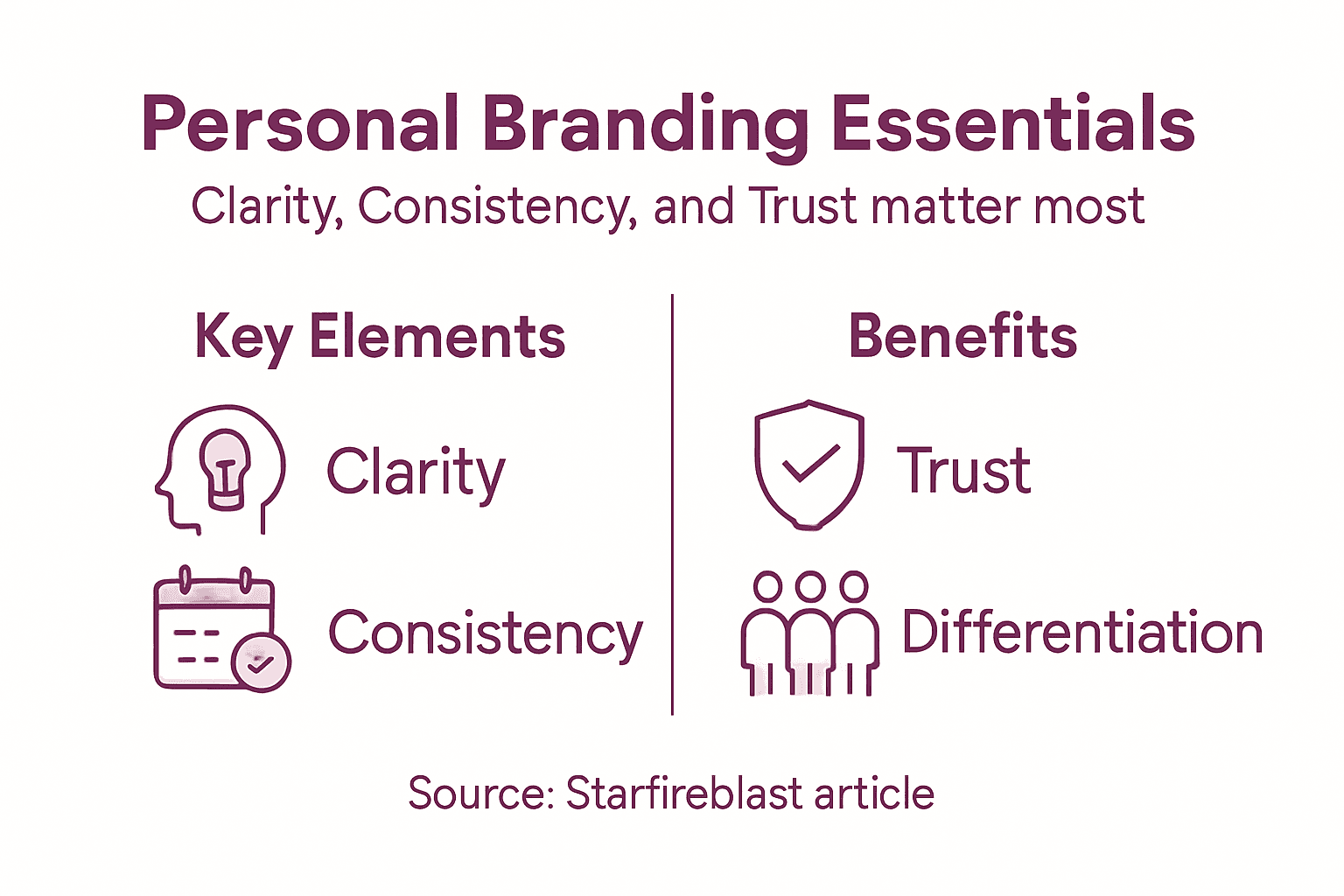
Building a powerful personal brand requires mastering three fundamental elements: clarity, consistency, and trust. These components work together to create a compelling professional narrative that resonates authentically with your audience.

Core branding elements systematically define professional identity, transforming how others perceive and interact with your professional self. Clarity means distilling your unique value proposition into a precise, understandable message that communicates who you are and what you stand for.
Key aspects of these core elements include:
- Clarity: Defining your professional identity with precision
- Consistency: Maintaining uniform messaging across platforms
- Trust: Demonstrating reliability and authenticity
- Alignment: Ensuring your actions reflect your stated values
- Transparency: Being genuine about your capabilities and limitations
Consistency reinforces your brand by creating a predictable and recognizable professional persona. Systematic brand literature highlights the importance of presenting a unified message that builds credibility over time.
Trust emerges from the intersection of clarity and consistency. When your professional narrative remains stable and your actions match your stated values, you create a foundation of reliability that attracts opportunities and meaningful connections.
Compare how clarity, consistency, and trust work together to elevate a personal brand:
| Element | Role in Branding | Effect on Perception |
|---|---|---|
| Clarity | Defines unique message | Enhances understanding |
| Consistency | Maintains uniform narrative | Strengthens credibility |
| Trust | Demonstrates reliability | Fosters meaningful connections |
Pro tip: Conduct a quarterly audit of your professional platforms to ensure your messaging remains clear, consistent, and aligned with your core professional identity.
Common misconceptions about personal branding
Personal branding is often misunderstood as a superficial marketing exercise, but the reality is far more nuanced and meaningful. Deliberate image management goes beyond surface-level tactics, challenging many popular misconceptions about what personal branding truly entails.
Common myths about personal branding include:
- Believing it’s only about creating a flashy online persona
- Assuming personal branding is exclusively for celebrities or influencers
- Thinking it requires constant self-promotion
- Equating social media followers with professional credibility
- Believing personal branding is a one-time effort
Academic research clarifies personal branding complexities, revealing it as a strategic process of authentic professional differentiation. It’s not about manufacturing an artificial image, but about developing a genuine representation of your professional identity, skills, and values.
Professional personal branding is fundamentally about creating a consistent, authentic narrative that reflects your unique capabilities. It requires ongoing reflection, intentional communication, and alignment between your professional actions and your stated values.
Pro tip: Conduct an annual self-assessment to ensure your personal brand genuinely reflects your professional growth and current aspirations.
How values shape authentic brand perception
Authentic personal branding is fundamentally about aligning your professional narrative with your core values. Values guide behavioral communication strategies that differentiate you in meaningful and compelling ways, transforming personal branding from a marketing exercise into a genuine expression of professional identity.
Key dimensions of value-driven brand perception include:
- Demonstrating consistent ethical principles
- Communicating deeper professional motivations
- Revealing personal beliefs that drive professional choices
- Creating meaningful connections beyond transactional interactions
- Developing trust through transparent representation
Authenticity emerges from clear value articulation, signaling integrity and professional commitment. Your values are not just abstract concepts, but active principles that shape how others perceive your professional capabilities and potential.
Professional credibility is built when your actions consistently reflect your stated values. This means going beyond surface-level declarations and integrating your core beliefs into everyday professional decisions, communications, and interactions.
Pro tip: Document your professional values annually and evaluate how your recent work and choices genuinely reflect those core principles.
Building coherence between self and audience
Authentic personal branding requires a deliberate approach to creating meaningful connections with your target audience. Strategic understanding of audience expectations transforms personal communication from a one-way broadcast into a dynamic, interactive dialogue that resonates deeply.
Key strategies for building audience coherence include:
- Understanding your audience’s professional challenges
- Aligning your messaging with their core needs
- Demonstrating genuine empathy and expertise
- Creating content that solves real problems
- Maintaining consistent professional positioning
Continuous communication and feedback loops are critical for refining your brand’s relevance. This means actively listening, adapting your approach, and ensuring your professional narrative remains both authentic and responsive to evolving audience expectations.
Coherence isn’t about changing who you are, but about communicating your unique value in ways that feel relevant and compelling to those you aim to serve. It requires a deep understanding of your professional identity and the specific contexts where your skills and perspectives can make a meaningful difference.
Pro tip: Conduct quarterly audience research to understand how your professional narrative intersects with their changing needs and aspirations.
Risks of performative branding and alternatives
Performative branding represents a dangerous approach that prioritizes appearance over authenticity, creating significant risks for professional reputation and meaningful connection. Crafted personas lacking genuine alignment can rapidly erode trust and credibility in professional environments.
Key risks of performative branding include:
- Potential audience skepticism
- Erosion of long-term professional relationships
- Loss of personal and professional credibility
- Difficulty maintaining constructed narratives
- Increased vulnerability to exposure
Sustainable personal branding emphasizes authentic storytelling that reflects genuine values and consistent professional behavior. This means moving beyond superficial marketing tactics to develop a coherent, value-driven narrative that genuinely represents your professional identity.
The alternative to performative branding is a transparent, intentional approach that prioritizes substance over style. It requires continuous self-reflection, commitment to personal growth, and the courage to present your authentic professional self, complete with nuanced perspectives and genuine expertise.
Here’s a focused look at authentic vs. performative personal branding approaches:
| Approach | Core Attributes | Long-Term Impact | Typical Pitfalls |
|---|---|---|---|
| Authentic Branding | Values-driven, strategic, transparent | Builds trust, lasting reputation | Requires ongoing self-reflection |
| Performative Branding | Image-focused, surface-level, inconsistent | Damages credibility, short-lived success | High risk of audience skepticism |
Pro tip: Regularly audit your professional communications to ensure they reflect your actual skills, experiences, and values rather than an idealized persona.
Elevate Your Personal Brand With Clarity and Purpose
The article highlights the critical importance of clarity, consistency, and authentic communication in building a personal brand that truly reflects your unique professional identity. If you feel overwhelmed by trying to define who you are building for or struggle to translate your core values into a compelling narrative, you are not alone. Many professionals find that without a clear, values-driven strategy, personal branding can quickly become noise instead of meaningful connection.
At Starfireblast, we understand these challenges. Our platform is designed for entrepreneurs and creators who want to break free from performative branding and build real, lasting trust with their audiences. With a focus on brand and strategy clarity and customer understanding and positioning, we help you articulate your professional value with confidence and connect with the right people authentically.
Take control of your personal brand now by visiting Starfireblast. Experience tools that empower you to clarify your mission, communicate your unique story consistently, and grow your business sustainably without chasing hollow visibility. Ready to stop spinning your wheels and start building a brand that matters? Discover how intentional clarity can transform your approach today.
Frequently Asked Questions
What is personal branding?
Personal branding is the strategic process of communicating your unique professional identity, which encompasses your skills, values, and professional narrative.
Why is clarity important in personal branding?
Clarity is crucial because it allows you to define your unique value proposition clearly, making it easier for others to understand who you are and what you stand for.
How can I build trust through my personal brand?
Trust is built through consistency and reliability in your messaging and actions. By aligning your professional narrative with your stated values, you create a foundation of credibility.
What are common misconceptions about personal branding?
Common misconceptions include the belief that personal branding is solely about creating a flashy online presence or that it is only for celebrities and influencers. In reality, it requires ongoing effort and authenticity.
Recommended
- How to Define Brand Strategy for Lasting Impact – Starfireblast
- Authentic Branding: Building Real Connection and Trust – Starfireblast
- 7 Essential Steps for a Resilient Entrepreneur Mindset List – Starfireblast
- I Just Want to Help — But Marketing Feels Gross. Now What? – Starfireblast
- Role of Branding in Web Design Success - ResponsiveWebsiteDesign
- Understanding the Role of Branding in SEO - Paul Baguley
- 7 Smart Brand Building Tips for UK Small Businesses - Kefihub