Authentic Branding: Building Real Connection and Trust
Every creative entrepreneur reaches a crossroads where brand messaging can feel disconnected from real values. This challenge matters since building authentic branding creates genuine trust and attracts the right community rather than chasing empty metrics. Grounded in research, this article breaks down common myths and practical strategies so you can shape a brand narrative that feels true, human, and consistently aligned with your vision.
Table of Contents
- Defining Authentic Branding And Common Myths
- Core Types And Expressions Of Authenticity
- Key Elements That Build Trust And Loyalty
- Practical Benefits And Real-World Examples
- Pitfalls To Avoid When Pursuing Authentic Branding
Key Takeaways
| Point | Details |
|---|---|
| Authenticity Over Perfection | True brand authenticity values transparency and vulnerability over an image of perfection. |
| Types of Authenticity | Understanding indexical, iconic, and existential authenticity helps brands build trust. |
| Trust is Intentional | Trust and loyalty come from consistent ethical behavior and transparent communication. |
| Avoid Common Pitfalls | Brands should steer clear of performative activism and inconsistent messaging to maintain credibility. |
Defining Authentic Branding and Common Myths
Authentic branding represents far more than polished marketing materials or carefully curated social media personas. At its core, brand authenticity is about creating genuine human connections that transcend traditional transactional relationships. Comprehensive literature reviews reveal the complex landscape of what truly defines an authentic brand.
For solo entrepreneurs and creative teams, understanding authentic branding means recognizing several critical distinctions:
- Authenticity is not perfection - It’s about transparency and vulnerability
- Consistency matters more than glamour - Real connections trump polished presentations
- Human elements drive trust - Showing genuine personality resonates more than corporate speak
Most entrepreneurs misunderstand authenticity as simply being loud or oversharing. In reality, human brand research demonstrates that authenticity emerges through strategic openness, honest communication, and alignment between stated values and demonstrated actions.
The myths surrounding authentic branding often prevent meaningful connection. Common misconceptions include believing that authenticity means revealing every personal detail or that it’s only applicable in certain industries. These narrow perspectives miss the nuanced reality that authentic branding is fundamentally about creating trust through consistent, values-driven communication.
Authentic brands distinguish themselves by:
- Demonstrating clear, unambiguous values
- Maintaining transparency during challenges
- Showing genuine care for their community
- Admitting mistakes and learning publicly
- Prioritizing meaningful impact over superficial metrics
The digital landscape has transformed how we perceive authenticity. Today’s consumers can instantly validate claims, making performative branding increasingly ineffective. Successful entrepreneurs recognize that authenticity is an ongoing commitment, not a one-time marketing strategy.
Pro tip: Conduct a quarterly authenticity audit by reviewing your brand’s communications and checking whether your external messaging genuinely reflects your internal values and actions.
Core Types and Expressions of Authenticity
Authenticity is not a monolithic concept but a nuanced framework with multiple dimensions that entrepreneurs can strategically leverage. Higher education research reveals three critical types of authenticity that provide a comprehensive understanding of how brands communicate genuine identity.
These foundational types of authenticity include:
- Indexical Authenticity: Factual, verifiable aspects of brand history and credentials
- Iconic Authenticity: Symbolic representations that capture brand essence and values
- Existential Authenticity: Emotional resonance and lived experience of brand interactions
Each type of authenticity contributes uniquely to building trust and meaningful connections. Conceptual brand research expands on these dimensions, introducing additional nuanced perspectives such as historical, moral, and identity-based authenticity expressions.

Understanding these authenticity types allows entrepreneurs to craft more holistic brand narratives. Indexical authenticity might involve sharing concrete backstories, while iconic authenticity focuses on visual and symbolic representations that capture brand spirit. Existential authenticity goes deeper, creating emotional connections that transcend transactional relationships.
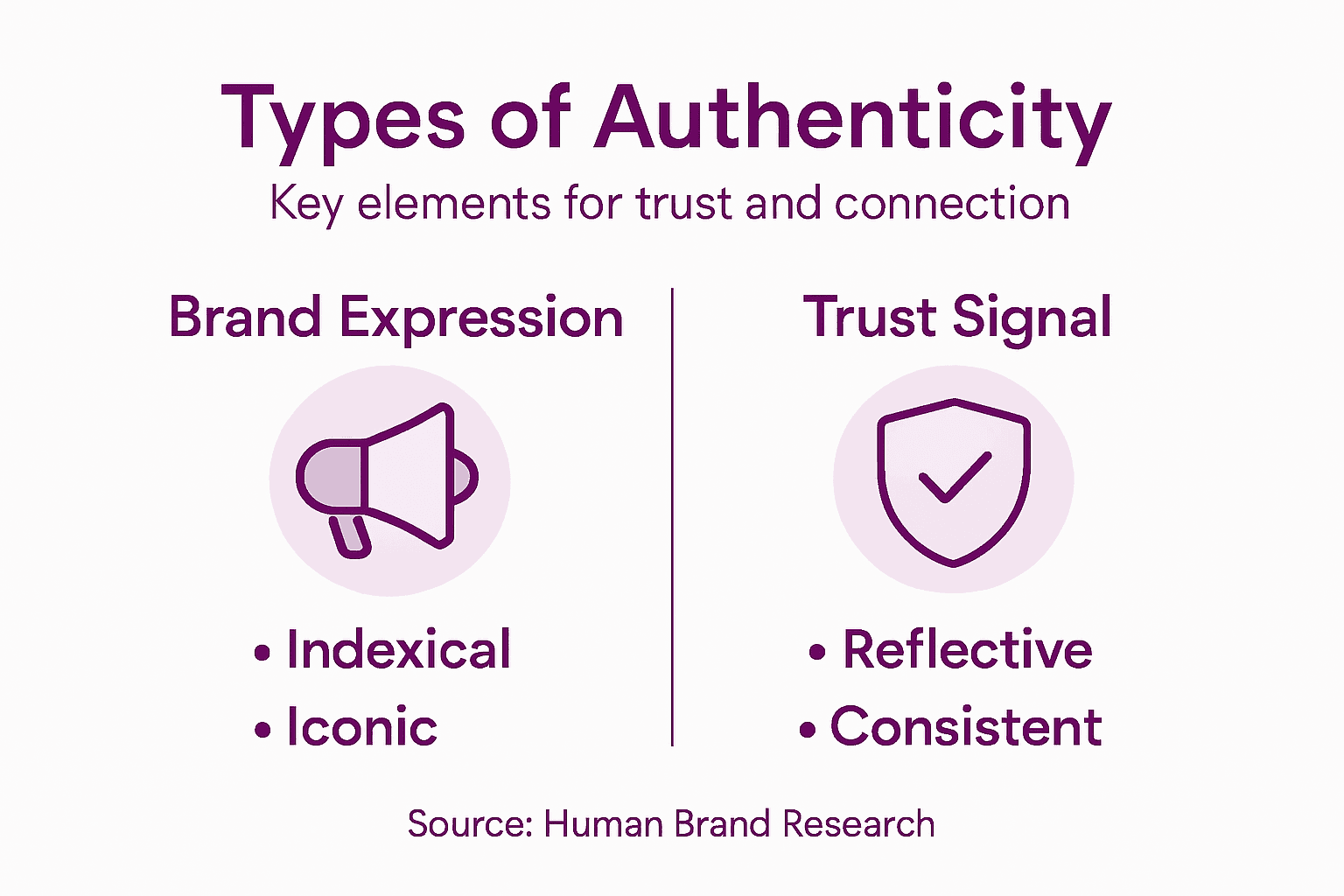
Here’s a comparison of the three core types of authenticity and their practical expressions:
| Authenticity Type | Key Focus | Typical Brand Expression |
|---|---|---|
| Indexical Authenticity | Verifiable facts and history | Sharing brand milestones |
| Iconic Authenticity | Symbols and visual representation | Unique logo or mascot |
| Existential Authenticity | Emotional and lived experiences | Customer testimonials |
The most powerful brands integrate multiple authenticity types seamlessly:
- Demonstrating factual credibility
- Creating memorable symbolic representations
- Generating profound emotional experiences
- Maintaining consistent value alignment
- Communicating transparently across all interactions
Modern consumers are sophisticated. They don’t just consume products; they seek brands that demonstrate genuine commitment to their stated values and mission. This requires moving beyond superficial marketing tactics and embracing a more nuanced, multi-dimensional approach to authenticity.
Authenticity is not about being perfect, but about being genuinely committed to your core values and transparently showing your journey.
Pro tip: Conduct a quarterly authenticity audit by mapping your brand’s communications against these three authenticity dimensions to ensure comprehensive, genuine representation.
Key Elements That Build Trust and Loyalty
Trust and loyalty are not accidents but intentional outcomes of strategic brand behaviors. Authentic brand ethicality research demonstrates that consumers deeply value moral consistency and transparent communication as fundamental trust-building mechanisms.
The core elements that construct trust and loyalty include:
- Consistent Ethical Behavior: Aligning actions with stated values
- Transparent Communication: Sharing both successes and challenges openly
- Predictable Performance: Delivering reliable, high-quality experiences
- Emotional Connection: Creating meaningful relationships beyond transactions
- Vulnerability: Admitting mistakes and showing genuine humanity
These elements are not theoretical concepts but practical strategies for building lasting customer relationships. Empirical studies on brand authenticity reveal that perceived value acts as a critical mediator between brand actions and customer loyalty.
Successful brands understand that trust is a dynamic, ongoing process. Perceived value means consistently demonstrating that your offerings exceed customer expectations while maintaining absolute integrity. This requires more than marketing rhetoric - it demands genuine commitment to your brand’s core promises.
Trust is not built through perfection, but through consistent, transparent, and genuine commitment to your fundamental values.
The psychological mechanics of trust involve multiple interconnected dimensions:
- Demonstrating competence through reliable performance
- Showing genuine care beyond commercial interests
- Maintaining transparency during challenging situations
- Responding authentically to customer feedback
- Creating predictable, positive experiences
Cross-cultural research highlights that while trust manifestations might vary, the underlying principles remain universal. Customers worldwide seek brands that show genuine human qualities: empathy, reliability, and consistent moral behavior.
Pro tip: Create a monthly ‘trust audit’ where you systematically review your brand’s communications, customer interactions, and performance against your stated values and promises.
Practical Benefits and Real-World Examples
Authentic branding translates into measurable business outcomes that extend far beyond marketing rhetoric. Influencer marketing research reveals compelling evidence of how genuine communication drives tangible results across industries.
Practical benefits of authentic branding include:
- Increased Customer Loyalty: Higher retention and repeat purchase rates
- Premium Pricing Power: Customers willing to pay more for trusted brands
- Stronger Emotional Connections: Enhanced brand advocacy and word-of-mouth marketing
- Competitive Differentiation: Standing out in crowded market landscapes
- Reduced Marketing Costs: Organic growth through genuine relationships
Real-world examples demonstrate the transformative power of authenticity. Companies like Patagonia have built entire business models around transparent environmental commitments, showing how genuine values create passionate customer communities.
In the higher education sector, global branding studies highlight how authentic institutional communication dramatically improves student engagement and institutional reputation. Universities that showcase genuine student experiences and transparent outcomes attract more committed students.
Authenticity is not a marketing strategy - it’s a fundamental commitment to genuine human connection.
The psychological and financial impact of authentic branding is profound:
- Creating trust reduces customer acquisition costs
- Genuine communication increases brand resilience
- Transparent practices minimize reputation risks
- Emotional connections drive long-term customer relationships
- Values-driven approaches attract mission-aligned customers
Cross-industry evidence confirms that authenticity is not sector-specific but a universal principle of successful human interactions. Whether in technology, education, retail, or services, brands that prioritize genuine communication consistently outperform their more traditional counterparts.
Pro tip: Develop a quarterly ‘authenticity scorecard’ that objectively measures your brand’s communication against your stated values and actual performance.
Pitfalls to Avoid When Pursuing Authentic Branding
Authentic branding requires more than good intentions. Strategic branding research warns against common mistakes that can rapidly erode brand credibility and consumer trust.
Key pitfalls entrepreneurs must vigilantly avoid include:
- Performative Activism: Making statements without genuine commitment
- Inconsistent Messaging: Saying one thing, doing another
- Overexposure: Sharing too much personal information
- Fabricated Vulnerability: Manufacturing emotional narratives
- Value Misalignment: Contradicting stated principles through actions
Influencer marketing studies reveal that consumers have become exceptionally sophisticated at detecting inauthentic brand communication. Modern audiences can quickly distinguish between genuine engagement and manipulative tactics.
The most dangerous pitfall is treating authenticity as a marketing strategy rather than a fundamental operational philosophy. Brands that view authenticity as a checkbox or temporary campaign inevitably fail. True authenticity requires consistent, long-term commitment to transparency, ethical behavior, and genuine human connection.
Authenticity cannot be manufactured - it must be lived, demonstrated, and continuously earned.
Common red flags that signal potential authenticity failures include:
- Scripted responses to criticism
- Inconsistent brand storytelling
- Lack of genuine customer interaction
- Defensive communication strategies
- Avoiding accountability for mistakes
Successful brands understand that authenticity is not about perfection but about genuine, consistent effort. They recognize that trust is built through sustained, transparent actions that align with stated values.
The table below summarizes common pitfalls in authentic branding and their potential impact:
| Pitfall | Description | Business Consequence |
|---|---|---|
| Performative Activism | Statements without true follow-through | Rapid loss of audience trust |
| Inconsistent Messaging | Contradictory claims or behaviors | Damaged credibility |
| Overexposure | Oversharing personal details | Brand fatigue |
| Fabricated Vulnerability | Insincere emotional narratives | Consumer skepticism |
| Value Misalignment | Actions at odds with stated principles | Negative reputation effects |
Pro tip: Conduct monthly internal reviews comparing your brand’s actual behaviors against your stated mission and values to quickly identify potential authenticity gaps.
Build Authentic Connections That Last
Authentic branding is about more than just words on a page. It requires clear alignment between your values and your actions, transparent communication, and emotional resonance that creates genuine trust. If you struggle with consistent messaging or worry about falling into common pitfalls like performative activism or inconsistent storytelling the insights from this article highlight exactly why a deeper, values-driven approach is essential.
Starfireblast is designed specifically for entrepreneurs and creators who want to move beyond surface-level marketing noise and build real, sustainable connections with their audience. Our platform helps you clarify your ideal customer and build a brand story rooted in your core values while using practical AI-assisted tools to maintain authenticity in every touchpoint. This way you can avoid overexposure and deliver transparent, value-driven communication your community will trust.
Ready to turn your authentic brand vision into tangible growth without burnout or shortcuts?
Discover how Starfireblast empowers your journey to authentic branding
Experience strategic clarity and community-driven growth today and take the next step toward meaningful impact.
Frequently Asked Questions
What is authentic branding?
Authentic branding is the practice of creating genuine human connections through transparency and values-driven communication, rather than relying solely on polished marketing materials.
Why is authenticity important in branding?
Authenticity builds trust and loyalty by demonstrating a brand’s commitment to its stated values and fostering meaningful relationships with customers beyond mere transactions.
What are the key elements that contribute to building trust in a brand?
The key elements include consistent ethical behavior, transparent communication, predictable performance, emotional connections, and vulnerability in admitting mistakes.
How can brands avoid common pitfalls when pursuing authenticity?
Brands should avoid performative activism, inconsistent messaging, oversharing, fabricated vulnerability, and actions that contradict their stated values to maintain credibility and trust.