Action Planning for Entrepreneurs: Achieve Sustainable Progress
Many entrepreneurs in Central Europe struggle with balancing business growth and authentic brand engagement. Defining your ideal customer and aligning your mission is more than just a marketing exercise, it sets the tone for sustainable impact and makes every action meaningful. By focusing on purpose-driven entrepreneurship and leveraging actionable frameworks, you will build clarity and connect deeply with your community while avoiding burnout.
Table of Contents
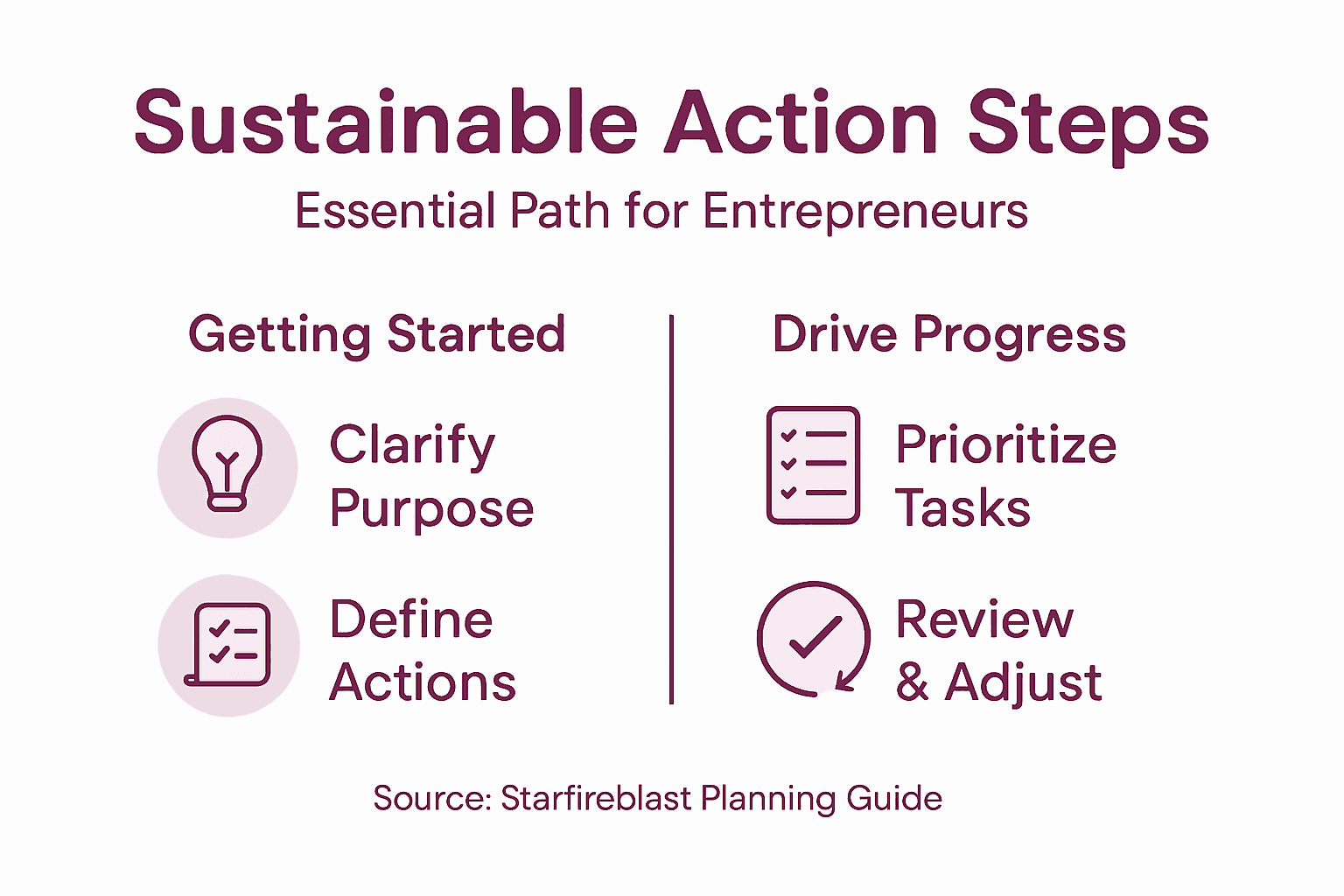
- Step 1: Clarify Your Ideal Customer And Purpose
- Step 2: Define Your Core Brand Actions
- Step 3: Prioritize Tasks For Sustainable Impact
- Step 4: Activate AI Tools For Effective Execution
- Step 5: Review Outcomes And Adjust Your Plan
Quick Summary
| Key Insight | Explanation |
|---|---|
| 1. Identify Your Ideal Customer | Understand your target audience’s demographics and motivations to create meaningful connections and effective solutions. |
| 2. Define Core Brand Actions | Establish specific actions that align with your mission to transform your vision into strategic initiatives that create value. |
| 3. Prioritize Tasks Strategically | Focus on high-impact tasks that align with your mission, ensuring efforts contribute to long-term sustainability and growth. |
| 4. Integrate AI Tools Wisely | Leverage AI technologies to enhance your operational efficiency and decision-making while maintaining human creativity in your business. |
| 5. Regularly Review and Adjust Plans | Continuously assess your progress and make incremental adjustments to remain adaptable and aligned with your entrepreneurial goals. |
Step 1: Clarify your ideal customer and purpose
Understanding your target audience is the foundation of sustainable entrepreneurship. By deeply exploring who you are serving and why your work matters, you can create meaningful connections that transform your business from just another offering to a purposeful solution.
Starting this process requires honest self-reflection and strategic research. Economic factors shape entrepreneurial engagement in Central European markets, making customer clarity crucial. Here are key steps to identifying your ideal customer:
-
Define demographic details
-
Determine age range
-
Identify professional background
-
Understand income levels
-
Map geographic location
-
Explore psychological characteristics
-
Identify core motivations
-
Understand pain points
-
Recognize aspirational goals
-
Determine values and beliefs
To gain precision, create a detailed customer persona that represents your ideal audience. This isn’t about creating a generic profile but developing a nuanced understanding of a real person with specific challenges and dreams.
The most powerful businesses solve specific problems for specific people - not everyone.
Documenting these insights helps you craft messaging that resonates deeply. Purpose-driven entrepreneurship requires knowing exactly who you serve and why.
Pro tip: Regularly revisit and update your customer persona as your understanding evolves and market conditions change.
Step 2: Define your core brand actions
Defining your core brand actions transforms your entrepreneurial vision from abstract concept to concrete strategy. This critical step bridges the gap between your purpose and practical execution.
Entrepreneurial competence frameworks emphasize the importance of acting strategically and creating tangible value. To define your core brand actions effectively, follow these essential steps:
-
Identify primary value propositions
-
Determine unique solutions you offer
-
Articulate specific outcomes for customers
-
Map how your actions solve real problems
-
Connect actions to your core mission
-
Align actions with brand purpose
-
Ensure consistency across all activities
-
Develop clear action statements
-
Create measurable impact goals
-
Design metrics for tracking progress
Successful brand actions require deep understanding of both your capabilities and your audience’s needs. Research on social entrepreneurship suggests that building authentic brand meaning depends on aligning your mission with concrete, executable strategies.
Your brand actions are the tangible manifestations of your entrepreneurial purpose.
By systematically defining these actions, you create a roadmap that guides decision-making and demonstrates your commitment to your stated mission.

Pro tip: Review and refine your core brand actions quarterly to ensure they remain relevant and impactful.
Step 3: Prioritize tasks for sustainable impact
Sustainable entrepreneurship demands strategic task management that goes beyond traditional productivity metrics. Your goal is to create meaningful progress that aligns with your broader mission and long-term vision.
Sustainability missions in entrepreneurial settings underscore the importance of intentional task prioritization. To effectively prioritize tasks for sustainable impact, consider these critical strategies:
-
Evaluate task alignment
-
Connect tasks to core mission
-
Assess long-term value creation
-
Measure potential sustainable impact
-
Eliminate tasks with minimal strategic significance
-
Implement strategic prioritization framework
-
Use impact vs effort matrix
-
Rank tasks by strategic importance
-
Create weighted scoring system
-
Develop quarterly review process
Sustainable task prioritization requires more than checking boxes. It demands a holistic approach that considers not just immediate productivity, but the broader ecosystem of your entrepreneurial journey.
Meaningful progress is about choosing the right tasks, not just completing more tasks.
By carefully selecting and focusing on high-impact activities, you transform task management from a mechanical process into a strategic tool for sustainable growth.
Pro tip: Schedule a monthly “impact audit” to reassess and realign your task priorities with your evolving entrepreneurial mission.
Step 4: Activate AI tools for effective execution
Transforming your entrepreneurial vision requires strategic integration of artificial intelligence tools that amplify your capabilities without replacing human creativity. AI becomes a powerful ally when thoughtfully activated to support your unique mission.
AI innovation ecosystems for entrepreneurs provide unprecedented opportunities for small businesses to leverage advanced technologies. To effectively activate AI tools, consider these strategic approaches:
-
Assess AI capability gaps
-
Identify repetitive tasks
-
Analyze decision-making bottlenecks
-
Map potential AI intervention points
-
Evaluate existing technological infrastructure
-
Select targeted AI applications
-
Choose tools aligned with specific objectives
-
Prioritize user-friendly interfaces
-
Consider scalability and integration potential
-
Validate data privacy and security features
Entrepreneurial AI capabilities can significantly enhance venture success by improving decision making and competitive advantage. The key is finding AI tools that complement your unique entrepreneurial approach.
AI should enhance your human capabilities, not replace your creative vision.
Successful AI integration means viewing these tools as collaborative partners that extend your strategic thinking and operational efficiency.
Pro tip: Start with one AI tool addressing your most challenging operational bottleneck and gradually expand your technological ecosystem.
Step 5: Review outcomes and adjust your plan
Successful entrepreneurship is not about perfect execution but continuous learning and strategic adaptation. Your ability to critically assess progress and recalibrate your approach determines long-term sustainability and growth.
SME performance and strategic adaptation requires a systematic approach to reviewing outcomes. To effectively evaluate and adjust your entrepreneurial plan, implement these comprehensive review strategies:
-
Conduct comprehensive performance assessment
-
Compare actual results against initial goals
-
Analyze key performance indicators
-
Identify unexpected challenges
-
Recognize unexpected opportunities
-
Measure progress objectively
-
Develop responsive adjustment mechanisms
-
Create flexible milestone tracking
-
Establish quarterly review checkpoints
-
Design adaptive strategy templates
-
Build contingency planning frameworks
-
Implement iterative improvement processes
Entrepreneurship survey insights highlight the importance of dynamic strategy refinement across Central European entrepreneurial ecosystems.
True entrepreneurial resilience lies in your capacity to learn, adapt, and pivot.
Effective plan adjustment is not about radical changes but thoughtful, incremental improvements that align with your core mission and evolving market dynamics.
Pro tip: Schedule a dedicated quarterly “strategy reset” where you critically assess your progress with radical honesty and openness to change.
Compare traditional vs. sustainable entrepreneurship approaches:
| Approach | Decision Focus | Task Management Style |
|---|---|---|
| Traditional | Short-term profit | Task completion obsessed |
| Sustainable | Long-term mission | Impact-driven selection |
Here’s a summary of how each entrepreneurial step contributes to sustainable business growth:
| Step | Core Focus | Key Benefit | Example Activity |
|---|---|---|---|
| Clarify Customer | Identify ideal audience | Increases targeting accuracy | Build customer personas |
| Brand Actions | Define core business moves | Enhances brand consistency | Map value propositions |
| Prioritize Tasks | Strategic task selection | Improves long-term impact | Use scoring frameworks |
| AI Activation | Implement AI tools | Boosts efficiency | Automate reporting |
| Review & Adjust | Ongoing evaluation | Maintains adaptability | Quarterly strategy reset |
Achieve Sustainable Entrepreneurial Success with Purpose and Precision
The journey to sustainable entrepreneurship demands clarity about who you serve, focused brand actions, strategic task prioritization, and smart integration of AI tools — just as outlined in the article “Action Planning for Entrepreneurs: Achieve Sustainable Progress.” Many entrepreneurs struggle with turning vision into meaningful, manageable steps that create lasting impact rather than temporary wins. If you share this challenge, you understand how essential it is to build a plan that aligns with your mission and adapts as you grow.
Explore how Starfireblast can empower you to clarify your ideal customer, define your brand strategy, and activate AI tools for effective everyday execution. Our platform is built for entrepreneurs who want to create sustainable progress without burnout or distraction. Discover a community-driven approach that values planetary productivity, blending human well-being, economic viability, and ecological responsibility.
Ready to transform your ideas into meaningful action today Visit Starfireblast and start building a living, evolving business that truly matters. Learn more about how to clarify your customer and purpose, and harness AI-assisted tools for everyday execution to keep you moving forward with confidence and impact.
Frequently Asked Questions
How can I clarify my ideal customer for sustainable entrepreneurship?
To clarify your ideal customer, start by defining their demographic details such as age, income level, and professional background. Create a detailed customer persona that represents your audience, allowing you to tailor marketing messages that resonate deeply within 30 days.
What steps should I take to define my brand actions?
Define your core brand actions by identifying your primary value propositions and understanding how your actions solve specific customer problems. Write clear action statements and set measurable impact goals to guide your entrepreneurial efforts in the next quarter.
How do I prioritize tasks effectively for sustainable impact?
To prioritize tasks effectively, evaluate each task’s alignment with your core mission and assess its long-term value creation. Use an impact versus effort matrix to rank tasks by their strategic importance, aiming to complete the most impactful ones each month.
What AI tools can support my entrepreneurial execution?
Identify repetitive tasks and decision-making bottlenecks within your operations to find AI tools that can help. Choose user-friendly applications that align with your objectives, aiming to implement one new AI tool within the next 60 days.
How can I review outcomes and adjust my entrepreneurial plan?
Conduct a comprehensive performance assessment by comparing actual results to your initial goals. Schedule quarterly review checkpoints to critically evaluate progress and make necessary adjustments, focusing on small, incremental improvements.
What is the difference between traditional and sustainable entrepreneurship approaches?
Traditional entrepreneurship focuses on short-term profits and task completion, while sustainable entrepreneurship emphasizes long-term missions and impact-driven task selection. Shift your approach to prioritize meaningful progress aligned with your broader business objectives.
Recommended
- Business Evolution Explained: Sustainable Growth for Entrepreneurs – Starfireblast
- 7 Steps to a Purpose-Driven Entrepreneurship Checklist – Starfireblast
- 7 Essential Steps for a Resilient Entrepreneur Mindset List – Starfireblast
- Purpose-Driven Entrepreneurship: Building Impactful Businesses – Starfireblast