Step by Step Branding Process for Entrepreneurs
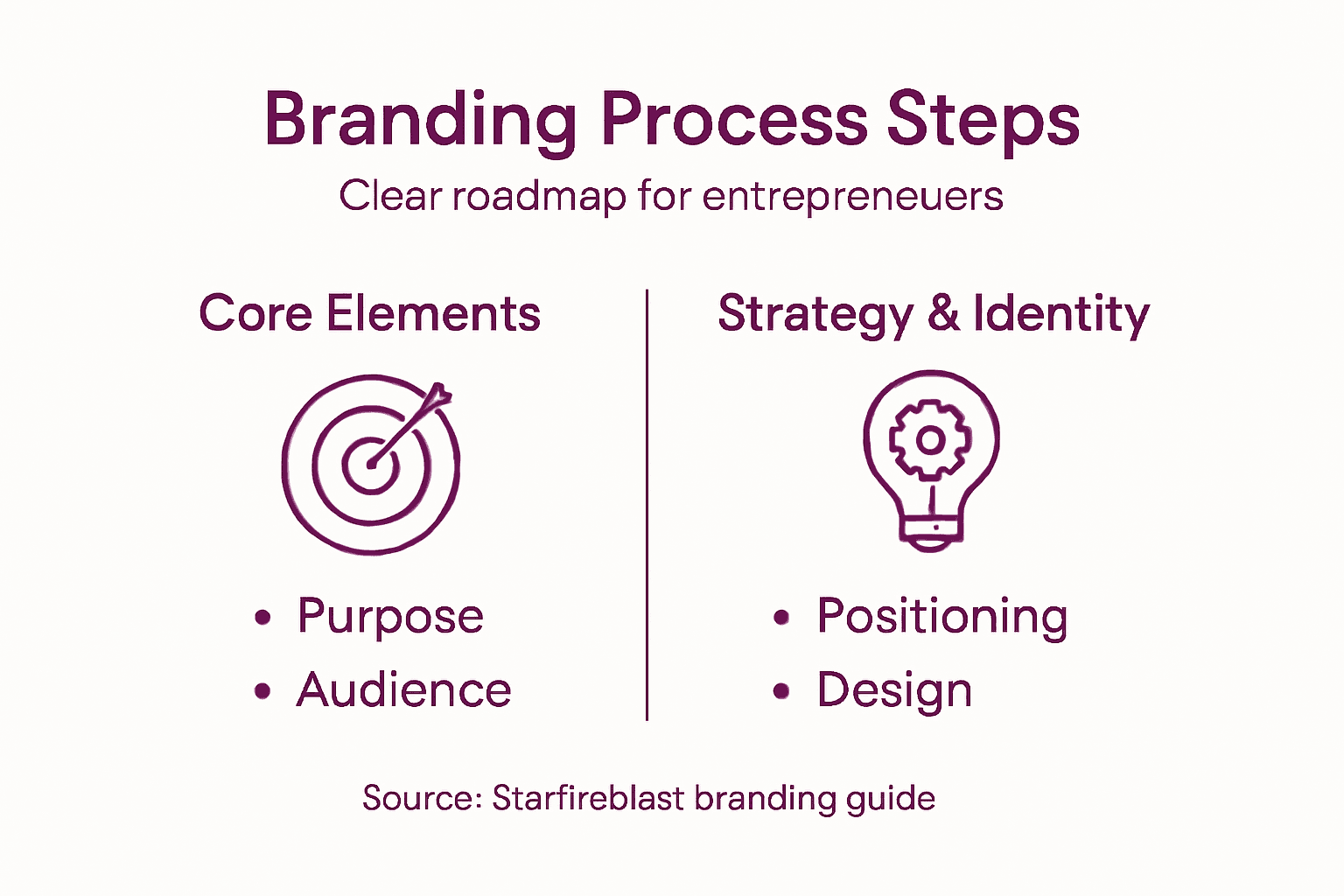
Building a purpose-driven brand can feel overwhelming when you are balancing creativity and well-being. Solo entrepreneurs and small teams across Central Europe often crave structure without losing their unique voice. A clear, step-by-step branding process helps you create a business that matters, starting with a foundational narrative that inspires trust and genuine connection. This article guides you in aligning your brand purpose, audience, positioning, identity and feedback for lasting impact.
Table of Contents
- Step 1: Define Your Brand’s Core Purpose
- Step 2: Identify Your Ideal Audience
- Step 3: Craft Your Unique Positioning
- Step 4: Design Your Visual And Verbal Identity
- Step 5: Validate Your Brand With Real Feedback
Quick Summary
| Main Takeaway | Clarification |
|---|---|
| 1. Define your brand’s core purpose | Establish a clear purpose to inspire consumer trust and guide strategic decisions. This should connect emotionally with your audience, focusing on meaningful impact rather than just profit. |
| 2. Identify your ideal audience | Develop deep audience personas by considering their psychological traits, challenges, and motivations. This helps target marketing efforts effectively and build loyalty. |
| 3. Craft your unique positioning | Differentiate your brand by articulating a unique value proposition that resonates with your audience’s needs and preferences, ensuring you stand out in the market. |
| 4. Design a cohesive brand identity | Create visual and verbal elements that represent your brand consistently across all platforms, enhancing recognition and creating memorable experiences for your audience. |
| 5. Validate your brand with feedback | Use both qualitative and quantitative methods to gather authentic consumer insights, helping refine your branding strategy and align it with market expectations. |
Step 1: Define your brand’s core purpose
Defining your brand’s core purpose transforms your entrepreneurial journey from merely generating revenue to creating meaningful impact. This critical step helps you establish a foundational narrative that goes beyond profit and connects deeply with your target audience.
To uncover your brand’s authentic purpose, start by exploring the fundamental questions that drive your business:
- What problem are you genuinely passionate about solving?
- How does your work improve people’s lives?
- What unique perspective or approach do you bring to your industry?
Research shows that brands with clear purposes inspire greater consumer trust and internal motivation. Your purpose should feel like a compelling north star that guides strategic decisions and resonates emotionally with your audience.
A powerful brand purpose transcends transactions and creates genuine human connection.
To crystallize your purpose, consider conducting a reflective exercise:
- Write down your personal motivations for starting this business
- Identify the specific change you want to create in the world
- Connect your individual values with your business objectives
- Craft a concise purpose statement that feels authentic and inspiring
Remember that your brand purpose is not a marketing slogan but a genuine commitment to making a meaningful difference.
Pro tip: Revisit and refine your brand purpose periodically to ensure it remains aligned with your evolving vision and market needs.
Step 2: Identify your ideal audience
Identifying your ideal audience is a crucial step in building a purpose-driven brand that resonates authentically with the right people. This process goes beyond basic demographic research and requires deep understanding of the individuals who will most passionately connect with your mission.
To effectively map your target audience, consider exploring these critical dimensions:
- Psychological characteristics and core values
- Professional challenges and aspirations
- Personal motivations and emotional triggers
- Specific needs your brand can uniquely address
Start by creating detailed audience personas that capture more than surface-level details. These personas should reflect genuine human complexity, representing the real people behind the statistics.
Understanding your audience means seeing them as complete humans, not just potential customers.
Your audience identification process should include:
- Conduct deep research through surveys and interviews
- Analyze existing customer data and interaction patterns
- Map out detailed persona profiles
- Validate assumptions through direct feedback
Remember that audience understanding is an ongoing journey - your insights will continually evolve as your brand grows.
Pro tip: Schedule periodic audience research sessions to ensure your understanding remains current and nuanced.
Step 3: Craft your unique positioning
Crafting your unique positioning is the strategic process of defining how your brand stands distinctly apart in a crowded marketplace. This crucial step transforms your brand from being just another option to becoming the compelling solution your ideal audience seeks.
To develop a powerful brand positioning strategy, entrepreneurs must dive deep into understanding their unique value proposition. This involves critically analyzing:
- Your most distinctive strengths
- The specific problems you solve uniquely
- Why customers should choose you over alternatives
- The emotional and practical benefits you deliver
Successful positioning requires moving beyond generic claims and uncovering the authentic narrative that resonates with your target audience. Your positioning should feel like a precise arrow targeting the exact intersection of your capabilities and your customers’ deepest needs.
A remarkable positioning statement captures your brand’s essence in a way that feels both inevitable and inspiring.
Your positioning crafting process should include:
- Conduct comprehensive competitor analysis
- Identify your brand’s most unique capabilities
- Articulate your value from the customer’s perspective
- Distill your positioning into a clear, memorable statement
Remember that positioning is not a one-time exercise but an evolving strategic conversation with your market.
Pro tip: Test your positioning statement with actual customers to ensure it genuinely resonates and feels authentic.
Step 4: Design your visual and verbal identity
Designing your brand’s visual and verbal identity transforms abstract concepts into a tangible, memorable experience that communicates your unique essence. This critical step bridges the gap between your strategic positioning and how your audience will perceive and connect with your brand.
Your brand identity encompasses two fundamental dimensions:
-
Visual Elements
- Color palette that reflects your brand’s personality
- Typography that communicates your brand’s tone
- Logo design representing your core values
- Consistent visual style across all platforms
-
Verbal Elements
- Distinctive brand voice and communication style
- Key messaging that resonates with your audience
- Storytelling approach that feels authentic
- Language that reflects your brand’s unique perspective
Your brand identity is the visual and verbal DNA that makes you unmistakably you.
To develop a cohesive identity, follow these strategic steps:
- Create a comprehensive brand style guide
- Define your brand’s personality archetypes
- Develop consistent visual and verbal guidelines
- Test your identity with your target audience
Remember that consistency is the cornerstone of memorable branding. Every visual and verbal touchpoint should feel like a natural extension of your brand’s core identity.

Pro tip: Develop a mood board that captures your brand’s visual and emotional essence before finalizing your design elements.
Step 5: Validate your brand with real feedback
Validating your brand through authentic feedback is the critical bridge between your strategic vision and real-world perception. This step transforms your branding from an internal concept to a living, responsive narrative that resonates with your actual audience.
To conduct meaningful brand validation research, entrepreneurs need a multifaceted approach that captures genuine insights:
-
Qualitative feedback methods
- In-depth interviews
- Focus group discussions
- One-on-one customer conversations
-
Quantitative validation techniques
- Online surveys
- Net Promoter Score assessments
- Sentiment analysis
- Comparative perception studies
Authentic feedback is the compass that guides your brand’s true north.
Your comprehensive validation process should include:
- Develop targeted feedback questions
- Select diverse participant groups
- Create safe, unbiased feedback environments
- Analyze responses systematically
- Iterate your brand positioning
Remember that feedback is a conversation, not a verdict. Each insight offers an opportunity to refine and strengthen your brand’s connection.
Compare qualitative and quantitative brand validation methods:
| Method Type | Example Approach | Insight Provided |
|---|---|---|
| Qualitative | In-depth interviews | Reveals emotional responses |
| Qualitative | Focus group discussions | Uncovers nuanced opinions |
| Quantitative | Online surveys | Measures satisfaction rates |
| Quantitative | Net Promoter Score | Gauges advocacy likelihood |
Here’s how each branding step contributes to long-term business success:
| Step | Business Outcome | Strategic Value |
|---|---|---|
| Core Purpose | Drives team motivation | Builds trust with customers |
| Ideal Audience | Boosts marketing effectiveness | Enhances customer loyalty |
| Unique Positioning | Differentiates brand in market | Increases perceived value |
| Visual & Verbal Identity | Improves brand recall | Creates consistent customer experience |
| Brand Validation | Refines brand strategy | Strengthens market fit |
Pro tip: Create a structured feedback template that allows both numerical ratings and open-ended responses to capture nuanced insights.
Bring Your Brand to Life with Purpose and Clarity
Building a brand that truly connects starts with defining your core purpose and understanding your ideal audience. The article highlights challenges like crafting authentic positioning and validating your brand with real feedback. These are critical steps that often leave entrepreneurs feeling overwhelmed or unsure how to align their vision with market demands.
Starfireblast offers a unique solution designed for entrepreneurs who want more than just generic branding advice. Our platform helps you clarify who you are building for, why it matters, and how to take meaningful action before scaling. By combining deep customer understanding, strategic brand clarity, and practical AI-assisted tools, Starfireblast empowers you to create a living brand with authentic impact.
Ready to move beyond theory and build a brand that truly resonates? Start your journey with Starfireblast and discover how purpose-driven branding creates lasting value. Visit Starfireblast to learn how we support entrepreneurs in every step from defining purpose to executing with confidence. Don’t wait to turn insights into sustainable action that grows your business without burning out. Explore more at Starfireblast and begin crafting a brand story that stands out.
Frequently Asked Questions
What are the first steps in the branding process for entrepreneurs?
Defining your brand’s core purpose is the first step in the branding process. Start by identifying what problem you are passionate about solving and how your business improves people’s lives.
How can I identify my ideal audience?
To identify your ideal audience, create detailed audience personas that represent the individuals who connect with your mission. Conduct research through surveys and interviews to understand their psychological characteristics, challenges, and needs.
What should I include in my unique positioning statement?
Your unique positioning statement should articulate your brand’s distinctive strengths, the specific problems you solve uniquely, and the emotional benefits you provide. Craft a clear and memorable statement that encapsulates your brand’s essence.
How do I design a cohesive visual and verbal identity?
Design a cohesive visual and verbal identity by creating a brand style guide that includes your color palette, typography, logo design, and messaging. Ensure all visual and verbal elements consistently reflect your brand’s personality and core values.
What methods can I use to validate my brand with real feedback?
Use both qualitative methods, like in-depth interviews, and quantitative techniques, such as online surveys, to validate your brand. Develop targeted questions and gather insights from diverse participant groups to refine your brand strategy effectively.
How often should I revisit my brand purpose or positioning?
You should periodically revisit and refine your brand purpose or positioning to ensure it aligns with your evolving vision and market needs. Aim to conduct this review at least once a year or whenever significant changes occur in your business.