Creating Community-Driven Brands for Sustainable Impact
Building a community-driven brand can feel overwhelming when everyone is searching for real connection in the crowded European market. Sustainable brand builders across Central Europe know that authenticity and shared mission are more than buzzwords. Defining your audience’s purpose and values is the foundation for meaningful growth rooted in trust and collaboration. This guide offers clear steps for aligning your brand with what matters most to your community and unlocking genuine engagement.
Table of Contents
- Step 1: Define Audience Purpose And Values
- Step 2: Clarify Brand Positioning And Strategy
- Step 3: Engage Initial Community And Gather Feedback
- Step 4: Co-Create Offerings With Community Input
- Step 5: Verify Alignment And Optimize For Sustainable Growth
Quick Summary
| Key Insight | Explanation |
|---|---|
| 1. Define Audience Values | Understanding your audience’s core motivations fosters trust and enhances brand loyalty through shared ideals. |
| 2. Distinct Brand Positioning | Crafting a unique brand narrative differentiates your brand, making it more relatable in a competitive market. |
| 3. Engage the Community Actively | Establishing two-way communication encourages community involvement and strengthens relationships among members. |
| 4. Foster Co-Creation | Collaborating with community members in developing offerings allows brands to meet real needs and drive innovation. |
| 5. Ensure Continuous Alignment | Regularly reviewing mission alignment helps maintain sustained growth and keeps the brand relevant to community expectations. |
Step 1: Define audience purpose and values
Defining your audience’s purpose and values forms the critical foundation for creating a meaningful, community-driven brand. This step helps you understand who you’re serving and why your mission matters beyond mere transactions.
To effectively define your audience’s purpose, start by mapping their core motivations and aspirations. Purpose-driven branding transforms consumer practices through genuine connection and shared values. The process involves several key components:
- Identify the deeper problems your audience wants to solve
- Understand their fundamental beliefs and worldview
- Recognize the change they want to create in their lives or community
- Explore the emotional and rational drivers behind their choices
Begin by conducting targeted research that goes beyond demographic data. You want to uncover the underlying human narrative that connects potential community members. Consider methods like:
- In-depth interviews with ideal audience members
- Surveys exploring motivational psychology
- Analyzing online community discussions
- Reviewing customer feedback and testimonials
Authenticity emerges when your brand’s purpose genuinely aligns with your audience’s core values.
Consumer-brand congruence creates powerful community engagement by establishing trust and shared mission. This means your brand’s purpose cannot be manufactured — it must be a sincere reflection of real human aspirations.
Pro tip: Create a one-page “purpose statement” that clearly articulates the intersection between your brand’s mission and your audience’s deepest motivations.
Step 2: Clarify brand positioning and strategy
Clarifying your brand positioning is about creating a distinctive and compelling narrative that sets you apart in a crowded marketplace. This step will help you develop a unique strategic approach that resonates authentically with your target audience.
Brand positioning establishes a unique competitive proposition by differentiating your mission and values. To craft an effective positioning strategy, consider these critical elements:
- Identify your brand’s distinctive strengths
- Understand your audience’s core unmet needs
- Define what makes your approach fundamentally different
- Articulate the specific value you deliver
Your positioning requires deep introspection and strategic thinking. Start by mapping out:
- Your brand’s core mission and purpose
- Unique capabilities that solve audience problems
- Emotional and rational benefits you provide
- The transformative experience you offer
Strategic positioning transforms your brand from a commodity into a meaningful movement.
The goal is to create a compelling narrative that goes beyond features and speaks directly to your audience’s aspirations. This means moving past superficial marketing tactics and connecting with genuine human motivations.
Successful positioning requires consistent internal alignment. Everyone representing your brand must understand and embody the core strategic message, ensuring authentic external communication.
Pro tip: Create a concise “brand positioning statement” that distills your unique value proposition into a single, powerful sentence that everyone in your organization can easily understand and communicate.
Step 3: Engage initial community and gather feedback
Engaging your initial community is about creating meaningful connections and establishing a two-way dialogue that transforms passive observers into active participants. This step focuses on building genuine relationships and creating channels for authentic community interaction.
Community engagement enables transformative stakeholder connections by developing inclusive platforms for dialogue and collaborative learning. To effectively engage your initial community, consider these strategic approaches:
- Create multiple feedback channels
- Design low-barrier participation opportunities
- Demonstrate active listening and responsiveness
- Reward and recognize community contributions
Your engagement strategy should include systematic methods for gathering insights:
- Host open online discussion forums
- Conduct targeted surveys with meaningful questions
- Organize virtual or in-person listening sessions
- Develop collaborative feedback mechanisms
True community engagement transforms participants from passive recipients to active co-creators.
Early interactions are critical for establishing trust. Empirical studies highlight the importance of active community participation in creating sustainable and impactful initiatives. This means moving beyond transactional exchanges and creating genuine opportunities for meaningful dialogue.

Successful community engagement requires transparent communication and a genuine commitment to incorporating community perspectives. Your approach should signal that you value their input and see them as essential partners in your mission.
Pro tip: Create a dedicated feedback dashboard where community members can track how their input directly influences your brand’s evolution and strategic decisions.
Step 4: Co-create offerings with community input
Co-creating offerings transforms your brand from a traditional provider into a collaborative platform where community members become active partners in product and service development. This step focuses on building participatory design processes that center your community’s real needs and aspirations.
Community collaboration supports innovative offerings by integrating diverse perspectives into development strategies. To effectively co-create, consider these fundamental principles:
- Establish transparent communication channels
- Create safe spaces for genuine dialogue
- Provide multiple participation methods
- Recognize and credit community contributions
Your co-creation process should include structured engagement techniques:
- Host collaborative design workshops
- Develop iterative prototyping sessions
- Implement community voting mechanisms
- Create dedicated feedback platforms
Meaningful co-creation transforms consumers from passive recipients to active innovators.
Inclusive participation requires intentional design. Systematic reviews highlight collaborative development strategies that prioritize agency and shared decision-making. This means moving beyond superficial consultations and creating genuine opportunities for meaningful contribution.
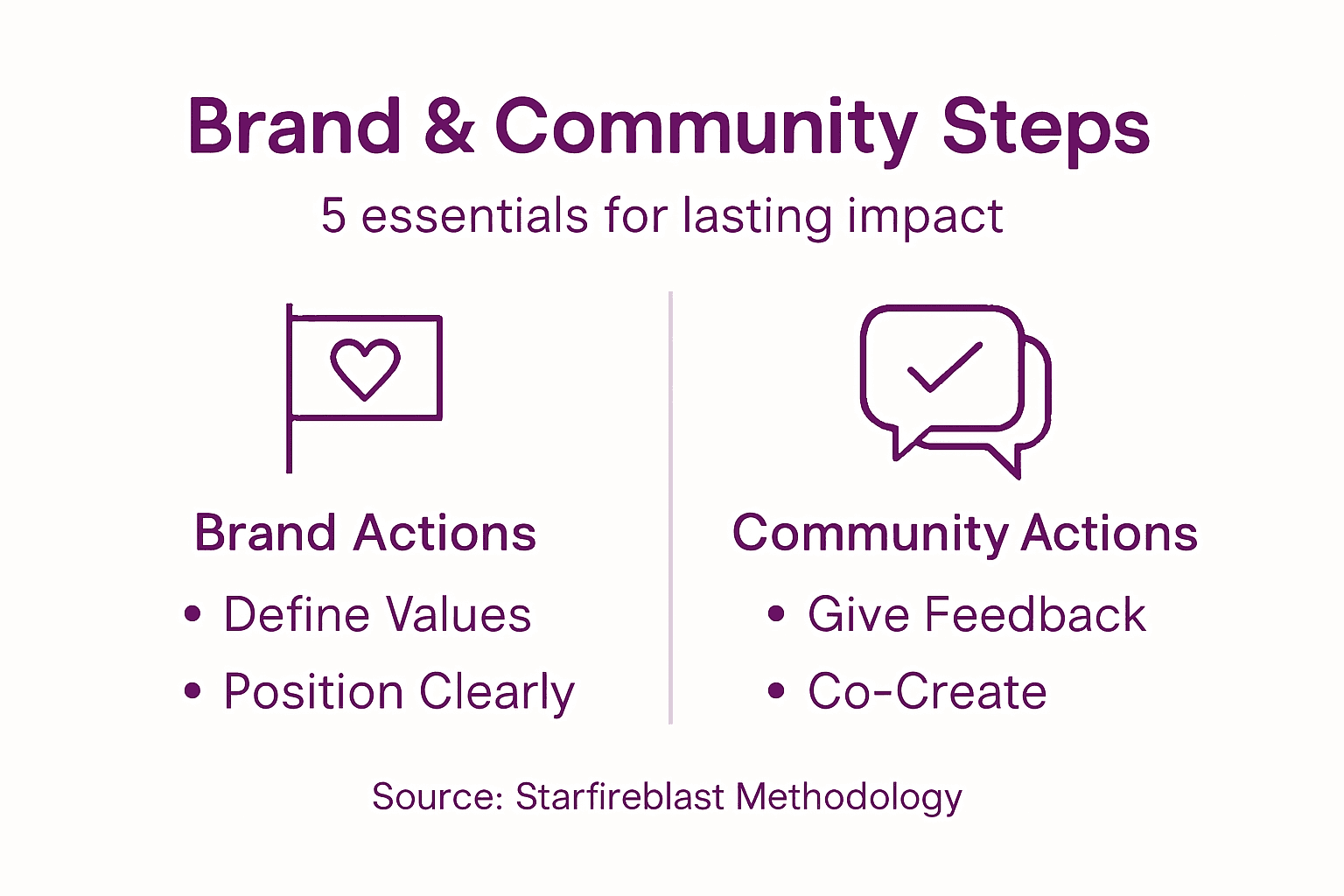
Successful co-creation demands authentic power sharing. Your approach should demonstrate that community input isn’t just welcome — it’s essential to your brand’s evolution and strategic direction.
Pro tip: Develop a transparent “contribution impact tracker” that visibly demonstrates how specific community suggestions have directly influenced your offerings.
Step 5: Verify alignment and optimize for sustainable growth
Verifying alignment and optimizing for sustainable growth transforms your community-driven brand from an initial concept into a resilient, purpose-driven initiative. This step focuses on systematically evaluating your strategic direction and ensuring continuous improvement aligned with your core mission.
Strategic alignment supports sustainable organizational development by connecting your brand’s objectives with broader societal and environmental goals. To effectively verify and optimize your approach, consider these critical evaluation strategies:
- Conduct periodic mission and impact assessments
- Map your initiatives against sustainability frameworks
- Track key performance indicators beyond financial metrics
- Create mechanisms for continuous community feedback
Your optimization process should include structured verification techniques:
- Develop comprehensive impact measurement tools
- Establish regular community alignment surveys
- Create transparent reporting mechanisms
- Design adaptive strategy adjustment protocols
Sustainable growth emerges from consistent alignment between purpose, practice, and community expectations.
Holistic performance tracking requires nuanced approaches. Regional alignment strategies demonstrate long-term organizational responsiveness by integrating multiple stakeholder perspectives and maintaining flexible strategic frameworks.
Successful sustainable optimization demands transparent evolutionary processes. Your brand should demonstrate a genuine commitment to learning, adapting, and growing in direct response to community needs and emerging societal challenges.
Pro tip: Implement a quarterly “mission alignment review” that systematically evaluates your brand’s activities against its original purpose and community expectations.
Compare two community-building mindsets:
| Approach | Brand-Led | Community-Led |
|---|---|---|
| Decision Control | Centralized by brand | Shared with members |
| Feedback Priority | Periodic collection | Continuous integration |
| Innovation Style | Proprietary solutions | Collaborative creation |
| Trust Building | Through messaging | Through actions |
Here’s how the five steps connect to build a community-driven brand:
| Step | Core Focus | Key Outcome | Example Tool |
|---|---|---|---|
| Define audience purpose | Uncover motivations and values | Foundation for trust | Motivational interviews |
| Clarify brand positioning | Articulate unique value | Distinctive market identity | Positioning statement |
| Engage initial community | Foster active participation | Two-way dialogue | Feedback dashboard |
| Co-create with community | Enable shared innovation | Collaborative offerings | Design workshops |
| Verify and optimize | Sustain alignment | Long-term impact | Impact measurement tools |
Build a Community-Driven Brand That Lasts
Creating a brand that truly connects with your audience means defining purpose, clarifying positioning, engaging your community, and co-creating meaningful offerings. If you struggle with transforming passive customers into active partners or aligning your mission with real sustainable impact, you are not alone. This article highlights the importance of authentic engagement and continuous optimization to build lasting trust and shared growth.
At Starfireblast, we help entrepreneurs and creators like you navigate these exact challenges. Our platform offers clarity in customer understanding and brand strategy, combined with practical AI-assisted tools to support everyday execution—all centered on community-driven growth rather than ad-driven scale. Whether you want to define your audience’s core motivations or build collaborative feedback loops, Starfireblast empowers you to take those vital next steps before scaling.
Explore how you can turn your vision into a living, evolving brand without burning out, gaming algorithms, or outsourcing meaning to others. Start your purposeful journey now by visiting Starfireblast. To dive deeper into positioning and strategic clarity, check out our guidance on brand and strategy clarity.
Build with intention. Grow with trust.
Ready to create a community-driven brand that makes sustainable impact?
Discover how Starfireblast can help you clarify who you are building for and why it matters. Visit Starfireblast and take the first step toward meaningful, purpose-driven growth today.
Frequently Asked Questions
How can I define my audience’s purpose and values for my community-driven brand?
To define your audience’s purpose and values, conduct in-depth interviews and surveys to uncover their core motivations and beliefs. Start by identifying the deeper problems they seek to solve and the change they want to create in their lives or community. Aim to complete this research within a month to establish a solid foundation for your brand.
What steps should I take to clarify my brand positioning in a crowded market?
Clarifying your brand positioning involves identifying your unique strengths and the specific value you deliver. Create a brand positioning statement that succinctly captures how your mission and approach differ from competitors. Focus on completing this within 30 days to establish a clear narrative and a compelling market identity.
How can I effectively engage my initial community to foster participation?
To engage your initial community, create multiple feedback channels and design opportunities for low-barrier participation. Organize open online discussions or virtual listening sessions to encourage active involvement. Set a goal to implement these engaging strategies within the first month of your community’s launch.
What are some effective methods for co-creating offerings with community input?
Implement structured engagement techniques such as collaborative design workshops and community voting mechanisms to co-create offerings. Ensure that you recognize and credit community contributions to enhance participation. Aim to initiate at least one co-creation session within 60 days of gathering initial feedback.
How do I verify alignment and optimize for sustainable growth in my community-driven brand?
To verify alignment and optimize growth, conduct regular mission assessments and track performance indicators beyond financial metrics. Establish transparent reporting mechanisms to communicate progress and allow for community feedback. Plan to implement these evaluation strategies quarterly to ensure ongoing alignment with your brand’s purpose.
Recommended
- How to Define Brand Strategy for Lasting Impact – Starfireblast
- Authentic Branding: Building Real Connection and Trust – Starfireblast
- 7 Essential Steps for a Resilient Entrepreneur Mindset List – Starfireblast
- Choice is Power: How Your Everyday Decisions Can Tackle Climate Change – Starfireblast
- Understanding the Role of Branding in Team Building - Blog
- 7 Essential Ways to Market Your Brand Effectively Online - Paul Baguley