Clarify your brand values for authentic, sustainable growth
TL;DR:
- Clear brand values drive customer trust, loyalty, and organic growth through consistent behavior.
- Authentic values are discovered in past decisions and must be integrated into daily operations.
- Regularly auditing and aligning actions with values prevents credibility gaps and sustains trust.
Most entrepreneurs treat brand values as a marketing exercise. They are not. 73% of consumers buy or advocate for brands based on beliefs and values, which means your values are a direct driver of purchase decisions, referrals, and long-term loyalty. Yet many founders and creators struggle to articulate what their values actually are beyond vague words like “integrity” or “innovation.” This article explains why clarifying brand values matters, how to surface them from your real history, how to avoid the most common credibility traps, and how to put them into consistent daily practice.
Table of Contents
- Why clarifying brand values fuels meaningful growth
- How to identify authentic brand values (not invent them)
- Avoid the value-action gap: Structural authenticity in the AI era
- Bringing brand values to life through daily action
- What most entrepreneurs miss about brand values
- Ready to clarify and live your brand values?
- Frequently asked questions
Key Takeaways
| Point | Details |
|---|---|
| Values drive trust | Most consumers choose brands based on core beliefs, so clarity boosts loyalty and growth. |
| Authenticity is essential | Values must reflect real actions and history—performative claims damage credibility. |
| Alignment beats aspiration | Structural alignment between values, actions, and communication builds resilience and prevents public backlash. |
| Consistency and review matter | Regular value audits help adapt to market change while keeping your brand’s core true. |
Why clarifying brand values fuels meaningful growth
Brand values are not a decorative layer on top of your business. They are the operating logic that shapes decisions, attracts the right customers, and signals to the market who you are and what you stand for. When those values are unclear, both internally and externally, the business drifts.
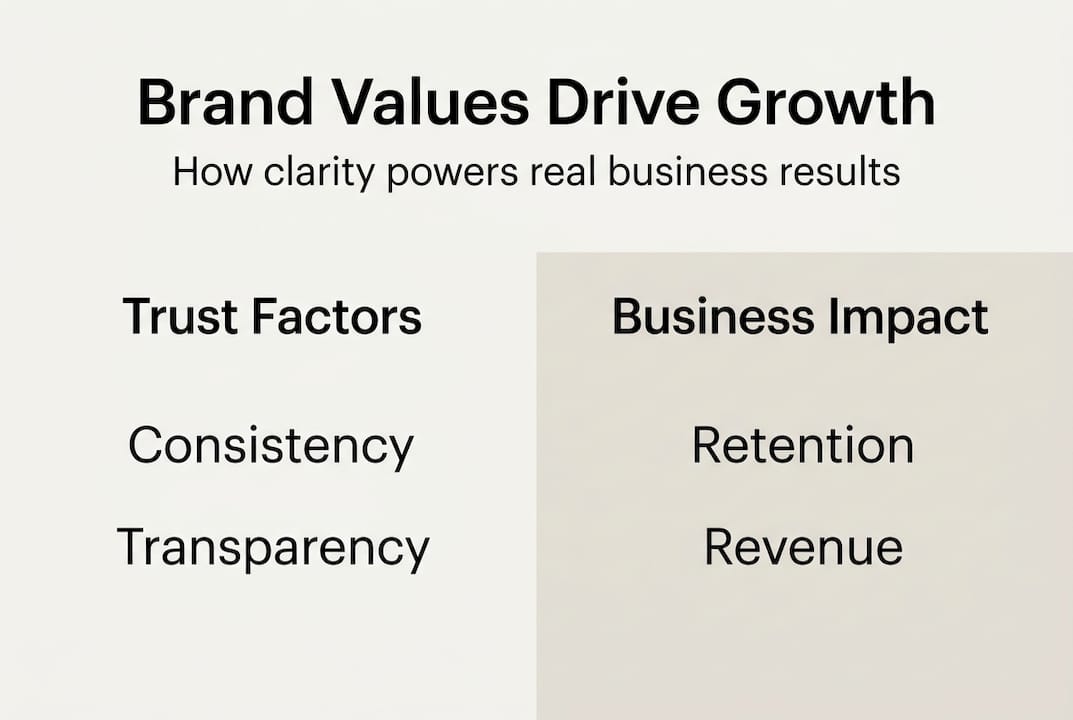
The role of values in branding goes beyond messaging. Clear values create a consistent customer experience, reduce decision fatigue for the founder, and give teams a shared frame for judgment. When a customer interacts with your brand three times and gets three different impressions, the problem is usually a values gap, not a design or copy problem.
The data is direct. 73% of consumers make brand choices based on values alignment. This is not a soft metric. It translates to conversion rates, retention, and word-of-mouth referrals. A customer who believes in what you stand for does not need to be convinced to buy again. They also tell others. That is organic growth with no ad spend required.
The contrast between brands with clear values and those without is significant. Consider the following comparison:
| Factor | Ambiguous brand values | Clear core brand values |
|---|---|---|
| Customer trust | Low, inconsistent | High, repeatable |
| Word-of-mouth | Rare, accidental | Common, intentional |
| Team alignment | Frequent confusion | Shared decision-making |
| Pricing power | Competes on price | Commands premium |
| Crisis resilience | Vulnerable | More stable |
| Marketing efficiency | High cost, low signal | Lower cost, stronger signal |
The trust boost from values is also cumulative. Each customer interaction that confirms your stated values adds to a credibility account. Over time, that account becomes a competitive moat that is hard for others to replicate, because it is built on real behavior, not positioning.
“Brands with clear, consistent values do not just earn customers. They earn advocates. And advocates do the marketing for you.”
The immediate business benefits of clarified values include:
- Alignment: Your team makes faster, better decisions without constant founder input
- Resilience: When market conditions shift, clear values give you a stable reference point
- Differentiation: In a crowded market, values-driven positioning stands out where features and price cannot
- Recruitment: People who share your values self-select into your ecosystem
- Filter clarity: You can say no to clients, partners, and opportunities that do not fit, without second-guessing
- Message consistency: Every piece of content, from social posts to sales calls, carries the same signal
These are not abstract benefits. They are operational advantages that directly affect revenue, retention, and the sustainability of your business model.
How to identify authentic brand values (not invent them)
The most common mistake founders make is treating values as a brainstorm exercise. They gather the team, pull up a whiteboard, and vote on inspiring words. The result is a list that sounds good but bears no relationship to how the business actually operates. That list will fail every time real pressure arrives.
Core values are discovered, not invented. They exist in the decisions you have already made, the clients you have turned away, the shortcuts you refused to take, and the principles you held even when it cost you something. Your job is to surface them, name them clearly, and then verify them against your actual track record.
There is a useful framework for organizing values once you find them. It uses three categories:
| Value type | Meaning | Business impact |
|---|---|---|
| Table-stakes values | Standards every business in your category must meet (ethics, reliability) | Required for market entry, not differentiating |
| Aspirational values | Internal goals you are actively working toward | Motivate internal growth, not public-facing claims |
| Core sacrificial pillars | Values you would lose customers or revenue to protect | True differentiators, the basis of trust |
The core sacrificial pillars are the ones that matter most for positioning. They are the values you have actually paid a price for. If you cannot name a time when a value cost you something, it is probably aspirational, not core.
Use this brand clarity guide to work through the process step by step. Here is a structured approach to uncovering your true brand values:
- Review your last 20 significant decisions. Look for patterns in what you prioritized, what you sacrificed, and what you protected.
- Identify your refusal points. List the clients, partnerships, or projects you declined. What principle drove each refusal?
- Ask your best customers why they stay. Their language often names your values more accurately than you can yourself.
- Test each candidate value against a hard scenario. Would you hold this value if it cost you 20% of revenue? If no, it is aspirational, not core.
- Sort values into the three-tier framework. Table-stakes, aspirational, and core sacrificial pillars.
- Write a one-sentence description for each core value. The description should include what the value means in practice, not just what it sounds like.
Exploring personal branding clarity can also help solo entrepreneurs separate their personal identity from their brand identity, a distinction that often gets blurred early in the building process.
Pro Tip: Use real stories as evidence for your values. For each core value, write down one specific moment when that value shaped a decision. If you cannot find a story, the value is probably not core yet.
Avoid the value-action gap: Structural authenticity in the AI era
Once you have identified your authentic values, the next challenge is keeping them alive through consistent action. This is where most brands fail, not at the identification stage, but at the execution stage. The gap between stated values and actual behavior is called the value-action gap, and it is now more visible than ever.

Aspirational values create a credibility gap when they are presented as current reality rather than future goals. Customers and AI-powered monitoring tools can detect inconsistencies between what a brand says and what it does. Social media archives every misstep. Search engines index contradictions. Audiences cross-reference claims against behavior at a speed that was not possible five years ago.
Performative authenticity backfires in predictable ways. When a brand claims values it does not structurally support, the public response is often sharper than silence would have been. The brand looks dishonest rather than merely quiet. Structural authenticity means your values are visible in your pricing, your hiring, your supplier choices, your customer policies, and your internal culture, not just in your marketing copy.
“Authenticity is not a communication style. It is a structural property of the relationship between what you say and what you do.”
Check your brand against this list of value-action gap symptoms:
- Your values statement uses words your team cannot define in daily terms
- Customers frequently complain about experiences that contradict your stated values
- You avoid discussing certain business practices publicly because they conflict with your positioning
- Your values change based on audience or sales context
- New team members behave inconsistently with what you claim to stand for
- You feel uncomfortable when someone asks you to prove a stated value
Linking authentic branding to your operational systems is the solution. That means writing your values into contracts, onboarding processes, pricing policies, and communication standards. Values that only live in a document on your website are decorative. Values that shape how you respond to a difficult client email are structural.
Use this brand clarity checklist to audit your current alignment before it becomes a trust problem.
Pro Tip: Run a quarterly values audit. Set a recurring calendar event every three months to review one recent customer complaint, one internal team decision, and one public-facing piece of content. Ask whether each one reflects your stated core values. Adjust policies before the gap becomes visible to your audience.
Bringing brand values to life through daily action
Understanding your values and living them are two different things. The bridge between them is operational structure. Values become real when they are embedded in the routines, decisions, and communication patterns of your business, not just stated in an “about” page.
Structural alignment across values, actions, and communication is what makes a brand sustainable over time. This is not about perfection. It is about creating systems that make value-consistent behavior the default, not the exception.
Use this numbered process to embed your values into core business operations:
- Translate each core value into a behavior standard. For example, if “transparency” is a core value, define what transparency looks like in client reporting, pricing, and mistake handling.
- Add values criteria to your hiring process. Include at least one scenario-based question per core value. Evaluate candidates on evidence, not declarations.
- Write values into your service delivery standards. Define what a values-consistent client experience looks like at each stage of your process.
- Integrate values into onboarding for new clients and collaborators. Share your values early, explain what they mean in practice, and invite alignment before the work begins.
- Use values as a filter for content and communication. Before publishing, ask whether the content reflects your stated values in tone, substance, and intent.
Learning how to clarify brand purpose is a practical first step before embedding values into operations. Purpose and values work together. Purpose answers “why we exist.” Values answer “how we behave.”
Simple daily rituals that reinforce your brand values include:
- Morning decision filter: Before making any significant choice, ask which core value applies
- End-of-week reflection: Note one moment where you acted in alignment with a value, and one where you did not
- Client communication review: Read your last three client messages and check for values consistency in tone and substance
- Content audit: Once a month, review your five most recent posts against your values statement
- Team check-in prompt: Open weekly meetings with a values-based scenario question to build shared judgment
For brand clarity for solo entrepreneurs, the daily practice of values alignment is even more important because there is no team to distribute the load. Every solo decision is a brand signal.
Understanding why clarity matters in business helps reinforce why this daily practice is worth the discipline. Clarity at the values level cascades into faster decisions, clearer messaging, and more consistent customer experiences across every touchpoint.
Pro Tip: Collect feedback from both customers and collaborators every quarter using a short, direct survey. Ask them to describe your brand in three words and rate specific interactions. Compare their language to your values statement. The gap between what you intend and what they experience is your most actionable data.
What most entrepreneurs miss about brand values
Most entrepreneurs approach brand values as a one-time task. They define the values once, put them on a slide or a website, and consider the work complete. That approach treats values as a fixed artifact rather than a living system.
Values must evolve. Quarterly reviews retain core stability while allowing the expression of those values to adapt to new circumstances, new markets, and new team dynamics. A value like “community” means something different for a solo creator with 200 newsletter subscribers than it does for a team of eight with a growing platform. The core does not change. The practice of it does.
The AI era adds a new layer of accountability. Automated tools now track brand consistency across platforms, over time, and against competitive benchmarks. This means inconsistency that once faded quietly into the past is now indexed and searchable. The risk is not just public backlash. It is the quiet erosion of trust that happens when curious customers do their research and find contradictions you thought no one would notice.
Exploring AI in branding strategy shows how these tools can work in your favor when your brand is structurally aligned. They surface patterns, flag inconsistencies before they compound, and help you maintain clarity at scale without additional overhead.
The hard-won truth is this: mission statements are rarely what customers remember. What they remember is whether you returned a difficult email professionally, whether you honored a commitment when it was inconvenient, and whether the experience matched the promise. Micro-decisions, repeated consistently, build the actual brand. Values that live only in documents are expensive decoration. Values that shape the small daily choices are what create trust that lasts.
Ready to clarify and live your brand values?
Brand values work requires ongoing attention. For purpose-driven entrepreneurs and creators, having structured support makes the difference between values that guide decisions and values that collect dust.
Starfireblast is built for founders and creators who want to build with clarity before scaling with noise. The platform provides brand clarity support through guides, practical frameworks, and AI-assisted tools designed for the realities of solo and small-team business. Whether you are surfacing your core values for the first time or auditing an existing brand for alignment, the resources at Starfireblast are structured to help you act with intention at every stage of your business.
Frequently asked questions
Why can’t I just choose aspirational brand values?
Aspirational values create a credibility gap when they do not reflect your current behaviors, eroding trust with customers and partners who notice the disconnect. Authentic values must be grounded in what you already demonstrate, not only what you hope to become.
How often should I review my brand values?
Review your brand values quarterly to ensure they remain relevant and authentic as your business evolves. Quarterly reviews help you retain your core while adapting how those values are expressed in practice.
What’s the risk of performative authenticity?
Performative authenticity backfires when values are stated but not structurally supported, often resulting in public backlash and lasting brand damage that is difficult to reverse.
Can AI really detect contradictions in brand values?
Yes. AI and sophisticated consumers can quickly identify gaps between stated values and actual brand behavior across platforms, which directly hurts credibility and long-term trust.