Why clarity matters in business: key to growth, alignment
TL;DR:
- Clarity in business means shared understanding of purpose, roles, and next actions.
- High-clarity environments boost team performance by up to 30%.
- Ongoing review and adaptation of clarity are essential for sustainable growth.
Teams that operate without clear direction can leave up to 30% performance gains on the table. That is not a small number. For solo entrepreneurs and small teams, that gap shows up as wasted hours, misaligned decisions, and growth that stalls without an obvious reason. Most founders assume the problem is strategy, marketing, or funding. Often, it is none of those. It is clarity. This article breaks down what business clarity actually means, what research says about its impact, where it goes wrong, and how you can build it into your daily operations without overcomplicating the process.
Table of Contents
- What clarity really means in business
- The proven benefits of clarity for entrepreneurs and teams
- The risks of too little—or too much—clarity
- Practical steps to build and sustain clarity in your business
- Our take: Clarity is a growth engine—if you balance it right
- Level up your business clarity with expert support
- Frequently asked questions
Key Takeaways
| Point | Details |
|---|---|
| Clarity accelerates growth | Entrepreneurs and teams with clear goals and roles perform up to 30% better and adapt faster. |
| Balance clarity with flexibility | Too much or too little clarity can hurt adaptability—maintain clarity while staying open to change. |
| Actionable frameworks work best | Assess, communicate, feedback, and regularly revisit your strategy to keep clarity strong. |
| Community and feedback improve clarity | Sharing your vision and seeking external perspectives helps refine and align business clarity. |
What clarity really means in business
Clarity in business is not the same as having a vision board or a five-year plan. It is the state where every person involved, including you, knows what the business does, who it serves, why those choices were made, and what the next action is. Simple. Actionable. Understood by all.
Vision is directional. Planning is structural. Clarity is operational. You can have a bold vision and a detailed plan and still operate in confusion if the day-to-day decisions are not grounded in shared understanding. Brand clarity for solo entrepreneurs often starts with this exact distinction: knowing your vision is not the same as being able to act on it consistently.
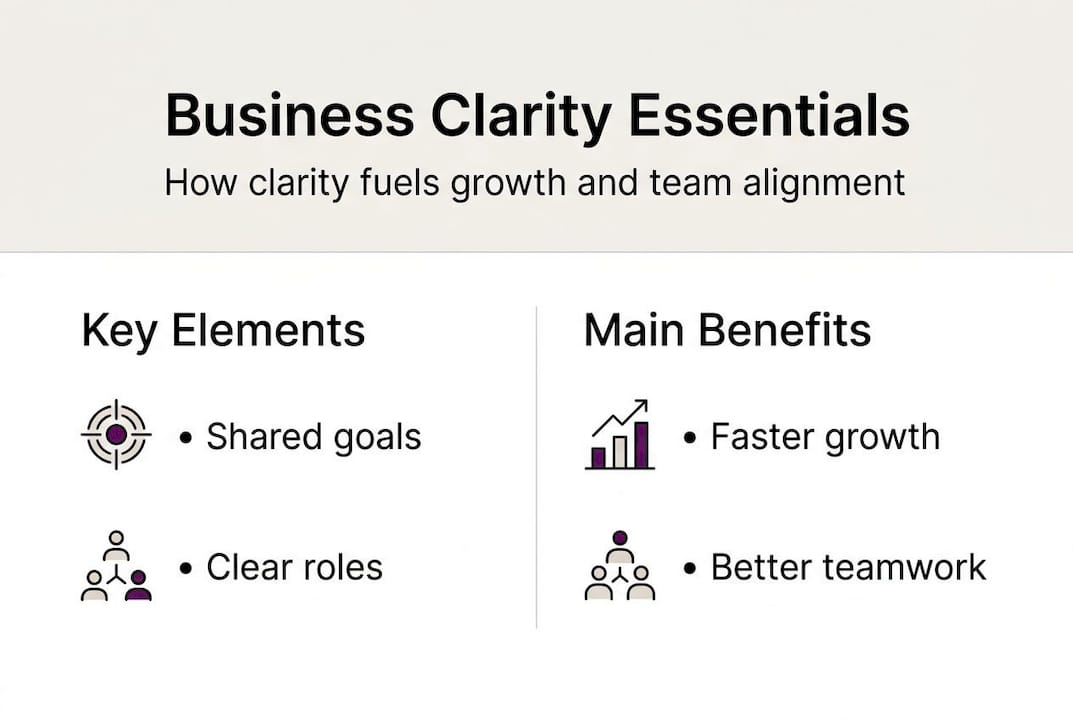
When clarity is present, decision speed increases. Founders stop second-guessing every move. Teams stop waiting for approval on things that should be obvious. As noted in research on founder decision-making, clarity eliminates drag in scaling and helps leaders make better decisions faster.
Signs of clarity in a business:
- Every team member can explain the core offer in one sentence
- Priorities do not shift week to week without a documented reason
- New opportunities are evaluated against a clear filter, not gut feeling
- Customer feedback aligns with what the business intended to communicate
- Decisions get made at the right level without constant escalation
Signs of confusion:
- Frequent pivots with no documented rationale
- Inconsistent messaging across platforms or team members
- High meeting volume with low decision output
- Customers describe the business differently than the founder does
“Clarity is not about having all the answers. It is about knowing which questions actually matter right now.”
Pro Tip: Ask three people on your team, or three recent customers, to describe what your business does in one sentence. If the answers vary significantly, you have a clarity gap worth addressing before scaling anything.
Understanding how clarity improves conversions is one practical way to see this in action. Messaging clarity alone can move revenue numbers without changing the product.
The proven benefits of clarity for entrepreneurs and teams
The research on clarity is direct. High-clarity environments boost team performance by up to 30%. That figure comes from empirical data on how role clarity and shared direction reduce friction, miscommunication, and duplicated effort.

For entrepreneurs specifically, clarity creates a filter for saying no. When you know exactly what your business is optimizing for, every new opportunity, partnership, or feature request gets evaluated against that filter. Without it, everything looks equally important. That is how founders burn out.
Businesses with focused plans containing fewer than 20 core elements have a 68% higher success rate than those with over-complicated strategies. Simplicity is not laziness. It is a performance decision.
Key benefits of high clarity:
- Faster onboarding for new team members or collaborators
- Reduced time spent in alignment meetings
- Higher customer trust because messaging is consistent
- Better boundary-setting for founders and teams
- Stronger community referrals because people can describe you accurately
The table below shows the difference in outcomes between high-clarity and low-clarity business environments:
| Factor | High-clarity environment | Low-clarity environment |
|---|---|---|
| Decision speed | Fast, delegated | Slow, centralized |
| Team performance | Up to 30% higher | Inconsistent, reactive |
| Customer messaging | Consistent, trusted | Mixed, confusing |
| Founder stress | Lower, focused | Higher, scattered |
| Growth sustainability | Steady, planned | Volatile, opportunistic |
| Onboarding time | Shorter | Longer |
For creators and solo founders, clarifying your business vision is often the single highest-leverage activity before any marketing investment. And brand clarity trust statistics confirm that audiences trust businesses that communicate consistently, which directly affects conversion and retention.
The risks of too little—or too much—clarity
Clarity drives results, but like any strength, it can be overdone or neglected. Let’s look at where businesses go wrong and how to avoid those traps.
Nokia is the most cited example of rigid clarity causing failure. The company was exceptionally clear about being a hardware business. That clarity became a wall. When the smartphone era demanded software-first thinking, Nokia’s internal clarity blocked adaptation. The result is well documented. Nokia’s hardware focus lacked the software adaptability needed to compete, and the company lost its dominant market position within a few years.
LEGO faced the opposite problem. In the early 2000s, the company expanded into clothing, theme parks, and media with no clear filter for what fit the brand. Direction was unclear. Profitability collapsed. The turnaround came when leadership refocused on a clear core: building sets and play systems. LEGO’s clarity restoration reversed near-bankruptcy and made the company one of the world’s most profitable toy brands.
Signs of too-rigid clarity:
- Declining to explore adjacent opportunities that align with customer needs
- Dismissing team feedback that challenges current direction
- Treating the strategy document as fixed rather than living
- Losing talent because the business feels stuck
Signs of too-lax clarity:
- Frequent strategy changes without data to support them
- No consistent answer to “who is this for?”
- Resource spread across too many initiatives
- Team confusion about what success looks like
Pro Tip: Treat your clarity like a compass, not a contract. It should guide direction without locking you into a path that new information has already made obsolete. Review it quarterly, not annually.
For practical guidance on balancing priorities for growth, the key is building review cycles into your operations so clarity stays current without requiring a full strategic overhaul every time the market shifts.
Practical steps to build and sustain clarity in your business
Knowing what clarity is and is not sets the stage for building it. But what tangible steps can you take in your own business?
Here is a five-step framework that works for solo founders and small teams:
- Clarify your vision. Write one sentence that describes what your business does, for whom, and what outcome it creates. If you cannot write it in one sentence, it is not clear yet.
- Define roles. Every person involved should know exactly what they own and what decisions they can make without checking in. Ambiguity here creates daily friction.
- Communicate expectations. Share the vision and roles explicitly. Do not assume people absorbed them from a meeting or a document they skimmed.
- Create feedback loops. Build in regular, short check-ins where team members or collaborators can flag misalignment early. Weekly async updates work well for small teams.
- Review and adapt regularly. Schedule a quarterly clarity review. Ask: is our direction still accurate? Are roles still the right fit? What has changed that we have not yet addressed?
As clear founders make better decisions faster, this framework is not about adding process for its own sake. It is about removing the invisible drag that slows everything down.
Quick clarity self-audit checklist:
- Can you state your core offer in one sentence?
- Do your team members agree on the top three priorities this quarter?
- Is your customer feedback consistent with your intended positioning?
- Have you reviewed your strategy in the last 90 days?
- Do you have a documented filter for evaluating new opportunities?
Pro Tip: Community feedback is one of the most underused clarity tools. Share your one-sentence vision with a trusted peer group or customer community and ask if it resonates. External reflection often surfaces gaps that internal review misses.
For a structured starting point, the guide for purpose-driven entrepreneurs walks through positioning and direction in a practical sequence. A clarity checklist is also available to make the self-audit process faster.
Our take: Clarity is a growth engine—if you balance it right
Conventional advice says get clear first, then scale. That is correct, but incomplete. The part most founders miss is that clarity requires ongoing recalibration. It is not a one-time exercise.
The businesses that sustain growth are not the ones with the most detailed strategy documents. They are the ones with honest feedback cultures, where clarity gets tested against real outcomes regularly. When new data arrives, those businesses update their direction without drama.
Most clarity initiatives fail because they stop at the document stage. The vision gets written, shared once, and filed. Six months later, the team is operating on assumptions that no longer match the stated direction. The fix is not more documentation. It is more conversation.
Founders who treat clarity as a living practice, not a completed task, build businesses that adapt without losing identity. Branding clarity insights show that the clearest brands are not the most rigid ones. They are the most consistently honest about who they are and who they are not.
Balance clarity with adaptability. That combination is what actually drives sustainable growth.
Level up your business clarity with expert support
If the steps above feel like the right direction but you want a structured process to get there faster, there are resources built specifically for this.
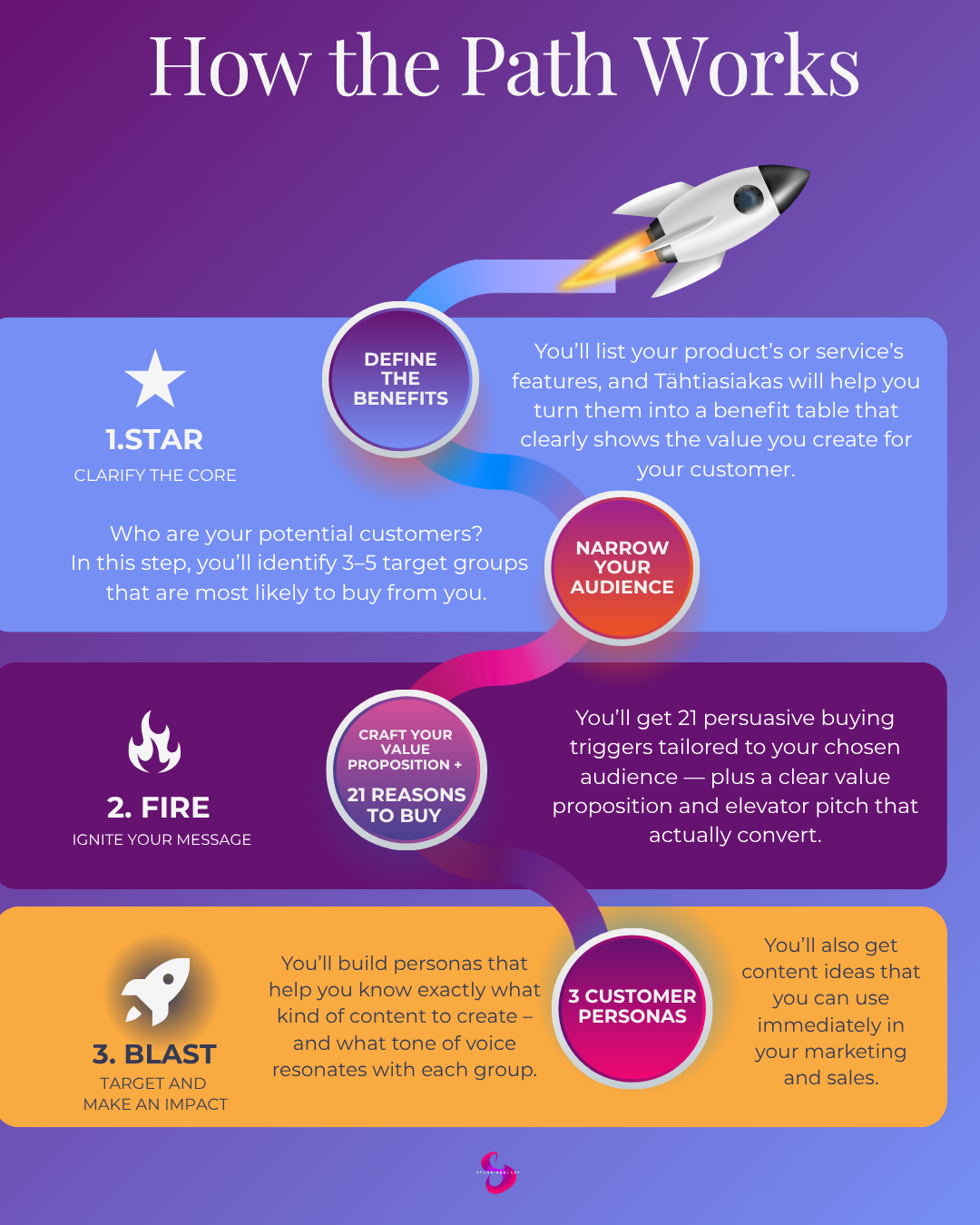
The Customer StarMap™ workshop is designed to help entrepreneurs and creators build the kind of clarity that actually sticks. It covers customer understanding, positioning, and direction in a focused, practical format. No fluff. No generic frameworks. Just a clear path from confusion to confident action. For more clarity resources across strategy, branding, and community-driven growth, the full platform is available to explore at your own pace.
Frequently asked questions
How does business clarity impact team performance?
High-clarity environments improve team alignment and reduce wasted effort, with research showing performance gains of up to 30% compared to low-clarity settings.
What’s the difference between clarity and focus in business?
Clarity defines direction and shared expectations across the business; focus is sustained attention on execution. Without clarity, focused effort can move fast in the wrong direction.
Can too much clarity make a business inflexible?
Yes. Nokia’s rigid hardware clarity prevented the company from adapting to software-driven market shifts, which contributed directly to its decline.
How can entrepreneurs regularly check the clarity of their business strategy?
Schedule quarterly reviews, collect honest team and customer feedback, and use a structured checklist to assess whether current goals still reflect actual direction.
What real businesses improved results by increasing clarity?
LEGO restored profitability after near-bankruptcy by refocusing on a clear core product strategy, eventually becoming one of the world’s most profitable toy companies.
Recommended
- Brand clarity guide for purpose-driven entrepreneurs 2026 – Starfireblast
- Brand clarity explained: guide for solo entrepreneurs 2026 – Starfireblast
- Brand clarity checklist for purpose-driven entrepreneurs – Starfireblast
- Role of brand clarity: 73% trust boost for creators – Starfireblast
- From headache to high‑performer: how a website makeover sparks new growth - Gregg King SEO
- Why centralize schedule management for greater efficiency