Brand clarity checklist for purpose-driven entrepreneurs
Brand confusion is expensive. When your messaging pulls in three directions and your visuals say something different from your values, potential customers quietly walk away. 23% higher conversion rates are on the table for brands with clear messaging, yet most purpose-driven entrepreneurs skip the foundational work and jump straight to tactics. This checklist-based approach gives you a structured path through the real phases of brand clarity, so you can scale your impact without losing your purpose or burning out in the process.
Table of Contents
- Brand clarity checklist: Core phases explained
- Define your brand purpose, values, and societal mission
- Market intelligence, customer insights, and competitive analysis
- Brand messaging, voice, and visual identity: Consistency and resonance
- Measurement, governance, and evolution: Sustaining clarity as you scale
- Summary checklist: Compare and prioritize
- Next steps: From clarity to impact
- Frequently asked questions
Key Takeaways
| Point | Details |
|---|---|
| Strategy comes first | Building your brand starts with purpose and strategy, before visuals or tactics. |
| Operational integration | Integrate purpose and values into daily operations to prevent drift and purpose-washing. |
| Quarterly audit | Review your checklist every quarter to maintain alignment, clarity, and impact. |
| Authentic differentiation | Focus on provable benefits and emotional resonance to stand out and retain trust. |
| Measurable impact | Track clarity’s effect on loyalty, conversion, and revenue for sustainable growth. |
Brand clarity checklist: Core phases explained
Setting the foundation means understanding what a complete brand clarity process actually looks like. Most entrepreneurs treat branding as a logo project. It is not. Brand strategy checklists typically include 7 to 10 core phases, and skipping even one creates gaps that compound over time.
Here are the core phases every purpose-driven entrepreneur needs:
- Business alignment: Confirm your business model, goals, and team are pointed in the same direction before anything else.
- Brand audit: Assess what currently exists, what is working, and what is creating confusion.
- Market intelligence: Research your competitive landscape and identify white space.
- Customer insights: Understand your audience’s real motivations, not just demographics.
- Purpose and values: Define why you exist and how that shows up in daily decisions.
- Positioning: Articulate your unique place in the market with a clear, provable statement.
- Architecture and naming: Organize your offerings so they make sense together.
- Messaging and voice: Create guidelines that keep communication consistent across every channel.
- Visual identity: Build a visual system that reflects your strategy, not the other way around.
- Customer journey alignment: Map how your brand shows up at every touchpoint.
- Rollout: Plan how you introduce or refresh your brand internally and externally.
- Measurement: Track whether your clarity is actually driving loyalty, trust, and growth.
For a deeper orientation to this process, the brand clarity guide on Starfireblast walks through each phase with context specific to mission-led founders.
| Phase | Key actions | Purpose |
|---|---|---|
| Business alignment | Audit goals, team, model | Ensure internal coherence |
| Brand audit | Review all assets and messaging | Identify gaps and contradictions |
| Market intelligence | Competitor analysis, trend mapping | Find your uncontested space |
| Customer insights | Interviews, surveys, behavior data | Ground strategy in real needs |
| Purpose and values | Draft statements, test with team | Anchor every decision |
| Positioning | Write positioning statement | Clarify your market role |
| Messaging and voice | Build guidelines, tone examples | Create consistency |
| Visual identity | Design system, usage rules | Reflect strategy visually |
| Measurement | Set KPIs, quarterly reviews | Track and sustain clarity |
Define your brand purpose, values, and societal mission
With the phases mapped, now focus on the foundation: authentic purpose and lived values. This is where most purpose-driven brands either build something real or accidentally create purpose-washing, which is when mission language is used in marketing but not reflected in actual operations.
Purpose-driven brand checklists emphasize defining purpose beyond revenue and integrating mission into operations, not just messaging. That distinction matters enormously. Your purpose statement should answer three questions: Who are you serving? What problem are you solving? And what does the world look like when you succeed?
Here is how to make values real rather than decorative:
- Write each value as a behavior, not a noun. “We listen before we advise” is more useful than “Integrity.”
- Test each value against a recent hard decision. Did it actually guide the choice?
- Validate with clients and frontline team members, not just leadership.
- Check whether your brand mission shows up in hiring, pricing, and partnerships.
“Purpose without operational integration is just marketing copy. The brands that build lasting loyalty are the ones where employees and customers can both point to the same values in action.” — Brand purpose practitioner perspective
Pro Tip: Run a simple values audit. Ask three long-term clients and two frontline team members to describe your brand in their own words. If their answers do not reflect your stated values, you have a gap worth closing before you scale anything. Explore more on about brand purpose and core values in branding for practical frameworks.
The brand strategy components that endure are always rooted in this kind of honest internal work.
Market intelligence, customer insights, and competitive analysis
Once your purpose is set, clarify who you serve and how you stand out with customer-centric research. This phase is where strategy gets grounded in reality rather than assumption.
The brand strategy process involves auditing current state for inconsistencies, conducting market analysis and customer interviews, and crafting positioning statements. Here is a practical sequence:
- Audit your current brand for inconsistencies across website, social, proposals, and onboarding materials.
- Interview five to eight current customers about why they chose you, what almost stopped them, and what they tell others about you.
- Map three to five competitors across positioning, messaging tone, and target audience.
- Identify the gap where your purpose and your customers’ unmet needs overlap.
- Write a positioning statement using this formula: For [target audience] who [need], [brand name] is the [category] that [benefit] because [proof].
For a structured approach to this work, the brand strategy framework on Starfireblast is built specifically for solo founders and small teams.
Pro Tip: Look up Blue Ocean Strategy. Instead of competing on the same dimensions as everyone else, ask what your market over-delivers on (and could reduce) and what it ignores entirely (and you could create). This often reveals positioning that is both authentic and uncontested. The audience research essentials from HubSpot offer solid supplementary frameworks here.
Brand messaging, voice, and visual identity: Consistency and resonance
With research-backed positioning, it is time to make your brand consistent and memorable through messaging and design. This is where many entrepreneurs finally feel the work click into place, because strategy starts showing up visually and verbally.

Strategy before visuals is the expert consensus: avoid logo-first mistakes, favor niche targeting over broad appeal, use provable differentiators, and schedule quarterly reviews. The table below shows why the order matters.
| Logo-first approach | Strategy-led branding |
|---|---|
| Visual identity drives decisions | Purpose and positioning drive visuals |
| Messaging is retrofitted to design | Messaging is built from customer insights |
| Inconsistency across channels | Governance ensures consistency |
| Rebrand needed within 2 years | Brand evolves without losing identity |
| Broad, generic appeal | Specific, resonant niche positioning |
For your messaging system, build these elements:
- Core message: One sentence that captures your positioning for any audience.
- Audience-specific messages: Variations tailored to different segments without contradicting the core.
- Brand voice guidelines: Describe your tone with three to four adjectives and give examples of on-brand versus off-brand language.
- Visual governance: Document how your logo, colors, and typography are used, and who approves exceptions.
Quarterly team training on brand guidelines prevents the slow drift that happens when new hires or contractors interpret the brand on their own. The brand clarity impact research shows this consistency directly correlates with trust. For solo entrepreneurs, the clarity guide for solo entrepreneurs and values-driven branding resources offer practical starting points. The brand positioning guide from Spellbrand is also worth bookmarking for this phase.
Measurement, governance, and evolution: Sustaining clarity as you scale
After creating consistent messaging, sustain clarity with measurement and adaptation strategies. Brand clarity is not a one-time project. It is an ongoing practice.
Consistent branding links to 20% revenue growth, and aligned teams boost loyalty by 18%. Quarterly reviews are what prevent the slow drift that erodes those gains. Brand debt from improvised standards, message drift during scaling, and over-complex positioning are the most common edge cases that derail growing brands.
Here is a quarterly governance sequence:
- Audit brand touchpoints for consistency: website, email, social, proposals, and client communications.
- Review customer feedback for language that signals confusion or misalignment.
- Check team alignment by asking new hires to describe the brand without prompting.
- Assess whether your positioning still fits the market and your current customer base.
- Document any changes and update your brand guidelines accordingly.
Key metrics to track:
- Customer loyalty and repeat purchase rate
- Net Promoter Score as a trust proxy
- Conversion rate from first touch to sale
- Employee engagement scores
- Crisis resilience: how quickly your community rallies when something goes wrong
Assign clear brand ownership. Someone on your team needs to be responsible for consistency, even if that person is you. Community-driven branding is one of the most effective ways to build resilience into your brand over time, because your audience becomes a co-author of your story. For structured review methods, quarterly clarity reviews offer a practical external framework.
Summary checklist: Compare and prioritize
Pulling all the steps together, here is your actionable checklist for brand clarity and sustainable growth.
Purpose-driven brands achieve 3x customer loyalty, 2x employee engagement, and 50% higher revenue growth compared to brands without clear positioning. The gap between clarity and confusion is not abstract. It shows up in your numbers.
| Metric | Brands with clarity | Brands without clarity |
|---|---|---|
| Conversion rate | 23% higher | Baseline |
| Customer loyalty | 3x | 1x |
| Employee engagement | 2x | 1x |
| Revenue growth | 50% higher | Baseline |
| Crisis resilience | High | Low |
Your priority actions, in order:
- Complete a brand audit before changing anything visual or tactical.
- Write your purpose statement and test it with real customers and team members.
- Build your positioning statement using the formula from Section 4.
- Create a one-page messaging guide with voice, tone, and core message.
- Schedule your first quarterly review before you launch or relaunch anything.
- Assign brand ownership so clarity does not erode as you grow.
For solo founders and creators, the personal branding clarity resource on Starfireblast adapts this full checklist to individual brand contexts.
Next steps: From clarity to impact
You now have a complete framework. The harder question is: where do you actually start when you are running a business at the same time?
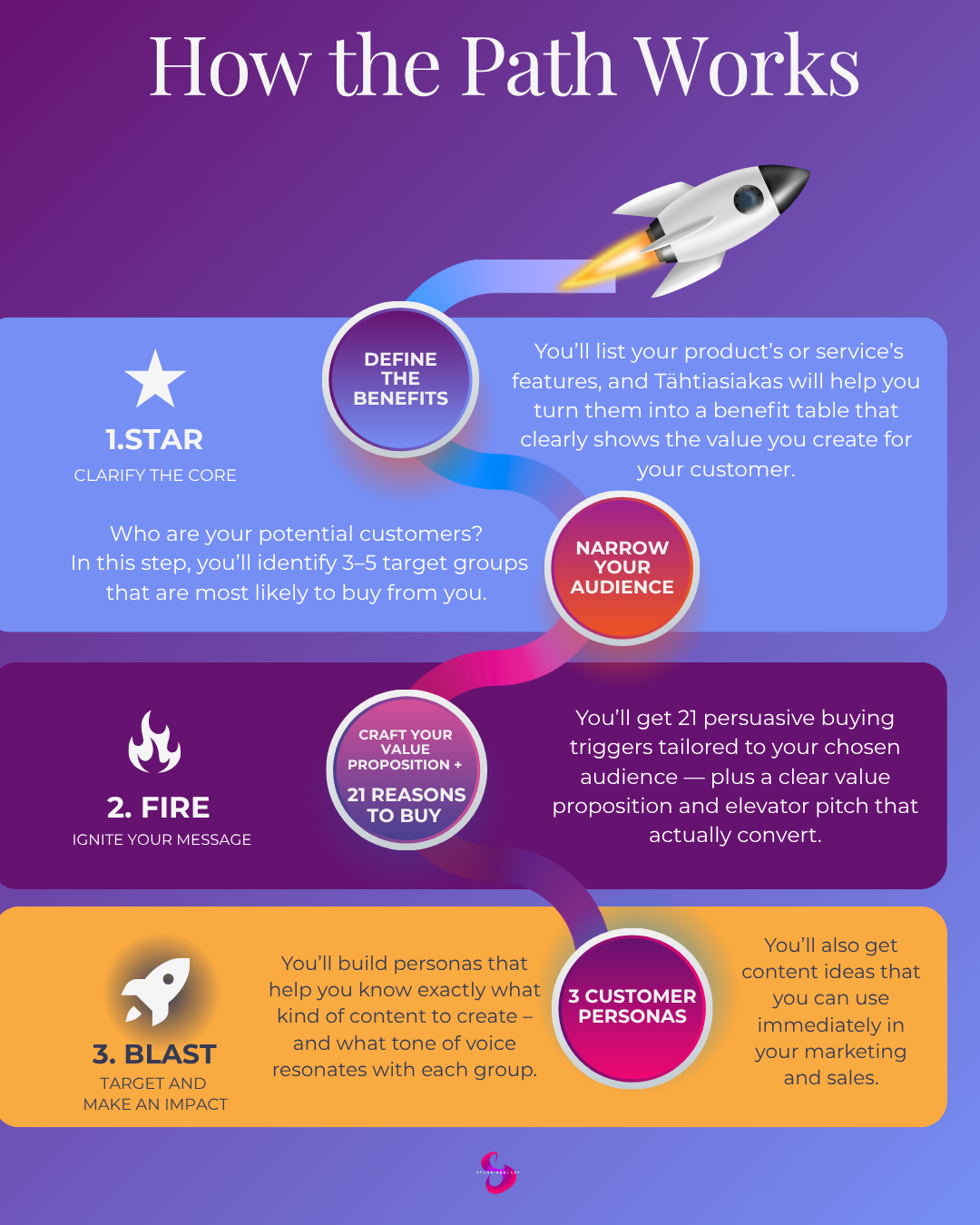
The Customer StarMap Power Workshop on Starfireblast is built for exactly this moment. It is an AI-assisted workshop that helps you map who you are building for, what they actually need, and how your brand positions itself to serve them, before you touch marketing, sales, or tools. It takes the checklist from this article and turns it into a live working session with structured outputs you can use immediately. The Starfireblast platform is designed for solo entrepreneurs and small teams who want to build with purpose, not just produce more content.
Frequently asked questions
Why is brand clarity important for purpose-driven entrepreneurs?
Purpose-driven brands achieve 3x customer loyalty, which means clarity is not just a marketing asset. It is a direct driver of resilience, conversion, and long-term ecological and human impact.
What’s the biggest mistake in building brand clarity?
Starting with visuals or tactics instead of strategy is the most common error. Strategy should come first, and visuals should reflect it, not define it.
How often should I review my brand clarity checklist?
Quarterly reviews are the recommended cadence to prevent drift, maintain team alignment, and keep your positioning relevant as your market evolves.
Can I use the checklist for personal branding?
Yes. The checklist adapts well to personal brands. The solo entrepreneur clarity guide on Starfireblast applies every phase to individual brand contexts.
What metrics best reflect brand clarity success?
Customer loyalty, trust scores, employee engagement, and conversion rates are the most direct indicators. Clear messaging links to 23% higher conversions and aligned teams boost loyalty by 18%.