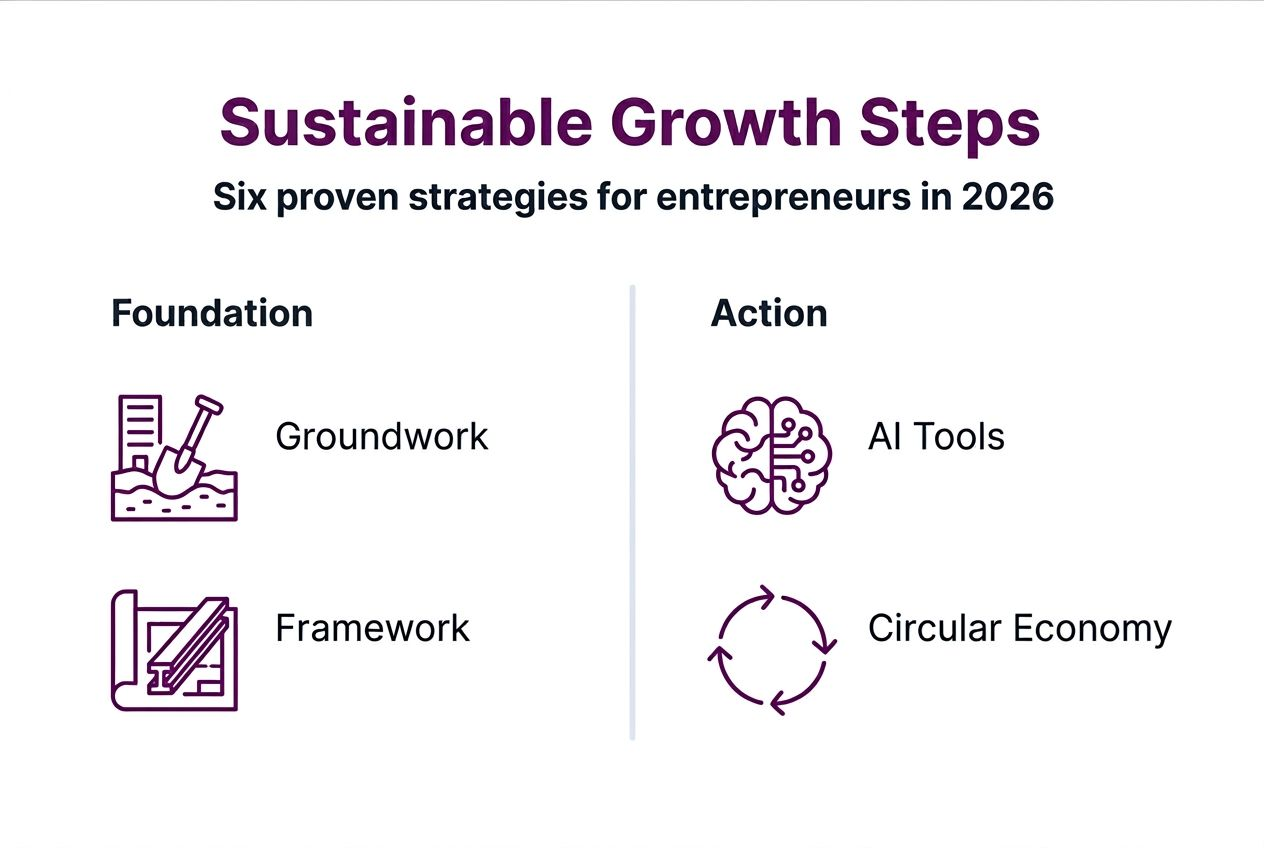
Sustainable growth strategies for entrepreneurs in 2026
Growing a business that respects both people and planet feels impossible when you’re juggling profit margins and ecological values. Entrepreneurs in Central Europe face unique challenges balancing expansion with community impact and environmental responsibility. This guide delivers proven, actionable strategies to accelerate sustainable growth without burning out, tailored specifically for the region’s regulatory landscape and market opportunities in 2026.
Table of Contents
- Prerequisites: What You Need Before Starting
- Step 1: Build A Structured Growth Framework
- Step 2: Leverage AI-Assisted Practical Tools
- Step 3: Implement Circular Economy Practices
- Step 4: Understand Regional Regulatory Landscape
- Step 5: Foster Community-Driven Growth
- Step 6: Measure And Optimize Sustainable Growth
- Common Mistakes And How To Avoid Them
- Expected Results And Outcomes
- Safety And Ethical Considerations
- Discover Support For Sustainable Growth With Starfireblast
- FAQ
Key takeaways
| Point | Details |
|---|---|
| Strong regional opportunities | Central Europe’s economy grows twice as fast as EU average through 2026, creating ideal conditions for sustainable ventures. |
| Structured frameworks accelerate profit | Entrepreneurs using structured growth achieve profitability 25% faster than those scaling haphazardly. |
| AI reduces founder burnout | Implementing AI automation cuts burnout risk by 25% for solo entrepreneurs and small teams. |
| Circular practices cut costs | SMEs applying circular economy principles reduce raw material costs up to 30% within three years. |
| Community beats ads | Community-driven growth delivers 15-25% higher retention over 12 months compared to paid advertising. |
Prerequisites: what you need before starting
Before diving into growth tactics, you need solid groundwork. Central Europe offers exceptional opportunities in 2026. Central and Eastern Europe economies grow at roughly twice the pace of the EU average between 2025 and 2026, driven by resilient consumption and investment.
Yet opportunity alone won’t sustain your business. You must navigate regional regulations carefully. Neglecting compliance causes a 12% drop in small business survival rates within three years across Central Europe. Understanding your regulatory environment protects your venture from costly missteps.
Digital infrastructure matters just as much. AI tools automate up to 80% of workloads, freeing you to focus on strategy and human connection. Without these tools, you’ll struggle to scale sustainably while maintaining your well-being.
Your foundational values are equally critical. Sustainability can’t be bolted on later. Integrate ecological and community priorities into your business evolution from day one to ensure every growth decision aligns with your mission.
Essential prerequisites include:
- Familiarity with Central European economic forecasts and sector trends
- Knowledge of regulatory compliance requirements for SMEs in your country
- Access to digital tools for customer insight, marketing, and automation
- Clear commitment to ecological responsibility and community values
- Financial runway to implement changes over 12 to 24 months
With these foundations in place, you’re ready to build a disciplined growth system.
Step 1: build a structured growth framework
Random experimentation wastes resources and accelerates burnout. A phased, repeatable framework gives you clarity and control. Structured growth strategies help entrepreneurs achieve profitability 25% faster compared to unstructured scaling.
Start by defining sustainability and profitability KPIs that reflect both economic goals and ecological impact. This dual tracking ensures you’re growing responsibly, not just quickly. Design your framework in phases: validate, stabilize, scale.
Here’s how to build your framework:
- Validate your offering. Test with 10 to 20 early customers to confirm demand and refine your value proposition.
- Set dual KPIs. Track revenue, customer acquisition cost, carbon footprint, waste reduction, and community engagement metrics.
- Stabilize operations. Establish repeatable systems for delivery, customer support, and feedback loops before expanding.
- Scale incrementally. Grow in phases tied to hitting specific KPI thresholds, not arbitrary timelines.
- Review quarterly. Assess progress, adjust KPIs, and course-correct based on real data and market shifts.
For example, a Polish sustainable packaging startup validated its model with 15 local businesses, stabilized operations over six months, then scaled regionally. By tracking both revenue growth and material waste reduction, they hit profitability 30% faster than competitors who lacked structured frameworks.
Pro Tip: Schedule monthly KPI reviews with a peer or advisor. Fresh perspectives catch blind spots and keep you accountable to both profit and planet.
This structured approach prevents premature scaling and aligns every decision with your action planning for sustainable progress.
Step 2: leverage AI-assisted practical tools
You can’t achieve sustainable growth by working yourself to exhaustion. Digital tools, especially AI-powered ones, multiply your capacity without expanding your team. Implementing AI automation reduces burnout risk by 25% among solo entrepreneurs and small teams.

AI excels at repetitive, data-heavy tasks: customer segmentation, email marketing optimization, social media scheduling, and workflow management. By automating these, you reclaim time for high-value activities like strategic planning, community building, and creative problem-solving.
The key is starting small. Choose one workflow bottleneck, introduce an AI tool, measure the impact, then expand gradually. Overloading yourself with new tech creates stress instead of relief.
Benefits of AI for sustainable entrepreneurs:
- Deeper customer insights. AI analyzes feedback and behavior patterns faster than manual reviews, revealing what truly matters to your audience.
- Optimized marketing spend. Smart targeting reduces wasted ad dollars, aligning with lean, community-focused growth.
- Time savings. Automating admin and content tasks frees 10 to 15 hours weekly for strategic work.
- Reduced decision fatigue. AI handles routine choices, preserving mental energy for mission-critical decisions.
- Scalable personalization. Deliver tailored experiences without hiring large teams, maintaining authentic connection as you grow.
For instance, a Czech creator used AI to automate email sequences and customer onboarding, cutting admin time by 60%. This allowed her to focus on planetary productivity, designing workshops that balanced profit with ecological education.
Pro Tip: Test AI tools with a 30-day pilot on one specific task. Track time saved and quality of output before committing to broader adoption.
Smart tool use transforms how you work, enabling sustainable growth without sacrificing your health or values. Explore AI tools that automate 80% of workloads to find solutions tailored to your needs.
Step 3: implement circular economy practices
The circular economy isn’t just ethical; it’s profitable. By reusing materials, reducing waste, and designing for longevity, you cut costs while minimizing environmental harm. SMEs applying circular economy principles reduce raw material costs by up to 30% within three years.
Circular practices involve rethinking your entire supply chain. Instead of the traditional take, make, dispose model, you design systems where materials circulate: products are repaired, refurbished, or recycled back into production. This approach reduces dependency on virgin resources, lowers expenses, and differentiates your brand.
Central European sectors leading circular adoption include plastics, packaging, and electronics. Hungarian electronics refurbishers, for example, extend product life cycles by 50%, slashing waste and attracting eco-conscious customers willing to pay premium prices.
Here’s a cost and impact comparison:
| Metric | Traditional Linear Model | Circular Economy Model | Improvement |
|---|---|---|---|
| Raw material cost | $50,000/year | $35,000/year | 30% reduction |
| Waste disposal | $8,000/year | $2,000/year | 75% reduction |
| Customer retention | 60% | 78% | 18% increase |
| Carbon footprint | 100 tons CO2/year | 65 tons CO2/year | 35% reduction |
Steps to integrate circular practices:
- Audit your supply chain. Identify where materials are wasted or discarded unnecessarily.
- Design for durability. Create products that last longer and can be easily repaired or upgraded.
- Partner with recyclers. Establish take-back programs to reclaim materials from used products.
- Communicate transparently. Share your circular efforts with customers to build trust and loyalty.
- Track metrics. Measure waste reduction, cost savings, and environmental impact to demonstrate value.
A Slovakian packaging company switched to biodegradable materials and introduced a return program, cutting waste by 60% and attracting mission-driven clients who valued sustainability.
Circular economy practices align profit with planet, proving that ecological responsibility drives competitive advantage.
Step 4: understand regional regulatory landscape
Ignoring regulations is a fast track to failure. Central Europe’s regulatory environment is complex, shaped by both EU directives and national laws. Neglecting compliance leads to a 12% drop in small business survival rates within three years.
Key regulations include EU sustainability reporting standards, waste management laws, and carbon reduction targets. In 2026, stricter enforcement means even small businesses face audits and penalties for non-compliance. Understanding these rules protects your business and opens funding opportunities tied to green initiatives.
Staying compliant requires ongoing education. Regulatory frameworks evolve as climate policies tighten. Subscribing to updates from national trade associations and EU sustainability portals keeps you informed.
Must-know regulations and compliance tips:
- EU Taxonomy for Sustainable Activities. Defines criteria for green investments; aligning with it improves access to funding.
- Circular Economy Action Plan. Sets waste reduction and recycling targets affecting product design and packaging.
- Carbon Border Adjustment Mechanism. Impacts import costs for high-carbon goods; plan supply chains accordingly.
- Corporate Sustainability Reporting Directive. Expands reporting requirements; prepare transparent impact documentation.
- National environmental permits. Vary by country; consult local authorities early to avoid delays.
Resources for staying compliant include climate policy databases, government business support offices, and industry networks that share best practices.
“Neglecting regional regulatory compliance leads to an average 12% drop in small business survival rates within three years in Central Europe.” Annual sustainable growth strategy 2025
Compliance isn’t bureaucratic busywork. It’s a strategic advantage that signals credibility, unlocks green financing, and safeguards your venture’s longevity.
Step 5: foster community-driven growth
Paid ads might deliver quick visibility, but community-driven growth builds lasting value. Community engagement produces 15-25% higher customer retention over one year, creating a loyal base that fuels sustainable revenue.
Community growth prioritizes authentic relationships over transactional interactions. Instead of interrupting people with ads, you invite them into a shared mission. This approach aligns perfectly with sustainability values: it’s human-centered, resource-efficient, and rooted in trust.
Here’s how community and ad-driven strategies compare:
| Factor | Community-Driven Growth | Ad-Driven Growth |
|---|---|---|
| Customer retention | 70-80% after 12 months | 45-55% after 12 months |
| Acquisition cost | Low to moderate (time investment) | High (ongoing ad spend) |
| Brand loyalty | Strong, values-aligned | Transactional, price-sensitive |
| Sustainability alignment | High (authentic engagement) | Low (often extractive tactics) |
| Scalability | Organic, compounding | Linear, ad-budget dependent |
Practical tactics to build customer communities:
- Host regular virtual meetups. Create spaces for customers to connect, share experiences, and co-create solutions.
- Launch a private community platform. Use forums, Slack channels, or Circle to facilitate ongoing dialogue.
- Showcase customer stories. Highlight how customers apply your offerings to achieve their goals, building social proof.
- Involve customers in product development. Solicit feedback early and often, making them co-owners of your evolution.
- Create shareable rituals. Develop traditions, challenges, or events that reinforce belonging and shared identity.
A Romanian wellness brand grew to 2,000 members by hosting monthly wellness challenges and spotlighting member transformations. Retention soared to 82%, and word-of-mouth referrals replaced paid ads entirely.
Creating community-driven brands isn’t about manipulating loyalty. It’s about building genuine connection that aligns with your mission and sustains long-term growth.
Step 6: measure and optimize sustainable growth
You can’t improve what you don’t measure. Tracking the right KPIs reveals whether your strategies are working and where to adjust. Entrepreneurs integrating sustainability metrics achieve 18% higher profitability within two years.
Common KPIs for sustainable business performance include:
- Financial metrics. Revenue growth, profit margin, customer lifetime value, and customer acquisition cost.
- Ecological metrics. Carbon footprint, waste reduction, energy efficiency, and sustainable material usage.
- Community metrics. Customer retention rate, Net Promoter Score, engagement frequency, and referral rates.
- Operational metrics. Productivity per hour, founder work-life balance score, and team satisfaction.
The link between sustainability tracking and profitability is clear. When you monitor ecological impact alongside revenue, you identify cost-saving opportunities, attract values-aligned customers, and access green financing. This dual focus creates a virtuous cycle: better sustainability drives better business results.
Iterative optimization means regularly reviewing data, testing adjustments, and learning from outcomes. Set quarterly review cycles to assess KPI trends, compare against benchmarks, and recalibrate strategies. This disciplined process keeps you aligned with both your business vision and sustainability goals.
For example, a Bulgarian software company tracked carbon per transaction and discovered server inefficiencies. Optimizing infrastructure cut emissions by 40% and reduced hosting costs by 25%, directly boosting profitability.
Regularly updating measurement systems ensures accuracy as your business evolves. What matters at 10 customers differs from 1,000 customers. Stay flexible, add new metrics as needed, and retire those that no longer provide insights.
Measurement transforms vague intentions into concrete progress, empowering you to grow sustainably with confidence.
Common mistakes and how to avoid them
Even with the best strategies, pitfalls await. Recognizing common errors helps you sidestep costly detours. Rushing to scale without validating community impact causes a 30% higher failure rate among early-stage sustainable businesses.
Premature scaling is the biggest mistake. Entrepreneurs, eager to grow, expand before validating product-market fit or community resonance. This burns cash and erodes trust. Validate thoroughly with a small, engaged group before scaling operations.
Regulatory non-compliance is another frequent error. Assuming regulations don’t apply to small businesses or delaying compliance until later jeopardizes survival. Address regulatory requirements from day one to avoid penalties and protect your reputation.
Burnout from inadequate digital tools plagues solo entrepreneurs. Trying to do everything manually or resisting automation leads to exhaustion and poor decision-making. Adopt AI and workflow tools early to maintain energy and focus.
Favoring paid ads over authentic community engagement is a short-term trap. Ads can generate leads, but they rarely build loyalty. Sustainable businesses thrive on community trust, not endless ad spend.
Common mistakes to avoid:
- Scaling before product-market fit. Validate demand and community impact with 20 to 50 customers first.
- Ignoring local regulations. Budget time and resources for compliance from the start.
- Manual overload. Implement automation tools to prevent burnout and inefficiency.
- Ad dependency. Prioritize organic community growth over transactional ad strategies.
- Neglecting feedback loops. Regularly collect and act on customer and stakeholder input.
Pro Tip: Use phased growth milestones tied to validation metrics. Don’t move to the next phase until you’ve hit predefined KPIs, ensuring you scale responsibly.
Avoiding these mistakes strengthens business resilience and positions you for sustainable success.
Expected results and outcomes
What can you realistically expect from applying these strategies? Data from Central Europe provides clear benchmarks. SMEs using circular economy principles reduce costs by up to 30% within three years, while community-driven growth increases retention by 15-25% within 12 months.
Financial outcomes include 18% to 30% cost reductions from circular practices and AI automation. Integrating sustainability metrics drives 18% higher profitability within two years as efficiency gains compound and values-aligned customers choose your brand.
Customer engagement improves significantly. Community-focused strategies yield retention rates of 70% to 80% within 12 months, compared to 45% to 55% for ad-driven approaches. Higher retention translates to increased lifetime value and stable revenue.
Sustainability impact metrics align with EU standards, enhancing credibility and opening funding doors. Expect 30% to 40% reductions in carbon footprint and waste within two to three years, depending on your sector and starting baseline.
Here’s a summary of key outcomes:
| Metric | Baseline | 12 Months | 24-36 Months |
|---|---|---|---|
| Profitability increase | 0% | 10-15% | 18-30% |
| Customer retention | 50-60% | 70-80% | 75-85% |
| Cost reduction (materials) | 0% | 10-15% | 20-30% |
| Carbon footprint reduction | 0% | 15-20% | 30-40% |
| Founder burnout risk | High | Moderate | Low |
Timeline expectations matter. Sustainable growth is incremental, not explosive. Expect meaningful progress within 12 months, with compounding benefits accelerating in years two and three. Patience and discipline are essential.
Use these outcomes as motivation to maintain your commitment. The path isn’t always easy, but the results, financial viability combined with ecological and community impact, justify the effort. Explore growth strategies for a sustainable brand to deepen your approach.
Safety and ethical considerations
Growth without ethics is hollow. As you scale, you must safeguard the well-being of people, communities, and ecosystems. Ethical entrepreneurship in Central Europe requires attention to resource management, labor conditions, and socio-political sensitivities.
Ethical resource use means minimizing environmental footprint at every stage. Source materials responsibly, reduce waste, and prioritize renewable energy where feasible. Your growth shouldn’t deplete resources faster than nature can regenerate them.
Fair labor conditions are non-negotiable. As you expand, ensure wages, hours, and working environments meet or exceed regional standards. Exploitation undermines the sustainability mission and damages your reputation irreparably.
Navigating socio-political risks is critical in Central Europe’s diverse landscape. Cultural sensitivities, regional histories, and political climates vary widely. Engage local communities respectfully, listen to their concerns, and adapt your approach to honor their values.
Best practices for safety and ethics:
- Conduct regular ethical audits. Review supply chains, labor practices, and environmental impact annually.
- Engage stakeholders transparently. Share your challenges and progress openly with customers, employees, and partners.
- Prioritize local sourcing. Support regional suppliers to reduce carbon emissions and strengthen community ties.
- Establish whistleblower channels. Create safe ways for team members to report ethical concerns without retaliation.
- Commit to continuous improvement. Ethics aren’t static; refine your practices as you learn and grow.
“Ethical business practices build long-term trust and brand loyalty, proving that sustainability and profitability are not mutually exclusive but mutually reinforcing.”
Ethics aren’t a constraint on growth. They’re the foundation that makes sustainable success possible, ensuring your business contributes positively to the world while thriving economically.
Discover support for sustainable growth with Starfireblast
You’ve learned the strategies, now it’s time to implement them with confidence. Starfireblast offers AI-powered resources designed specifically for entrepreneurs committed to sustainable, community-driven growth.
Our Customer StarMap™ workshop helps you clarify exactly who you’re building for and why it matters, before you scale marketing or tools. This clarity prevents wasted effort and aligns every decision with your mission.
We also provide practical frameworks for action planning that reduce burnout and keep you focused on what truly moves the needle. Our tools combine customer understanding, brand clarity, and AI-assisted execution, empowering you to grow without sacrificing your values or well-being.
Join a community of purpose-driven entrepreneurs building living, evolving businesses rooted in planetary productivity. Explore our workshops and articles to turn your sustainable growth vision into reality.
FAQ
What are sustainable growth strategies?
Sustainable growth strategies balance ecological responsibility, community engagement, and economic viability. They involve actionable plans integrating green innovation, circular economy practices, and scalable frameworks that support long-term success.
How can AI tools reduce burnout for solo entrepreneurs?
AI automates repetitive tasks like email marketing, customer segmentation, and scheduling, freeing time and reducing mental load. Efficient tools prevent overwork by handling routine decisions, allowing you to focus on strategy and creativity.
Why is community-driven growth more effective than paid ads?
Community growth yields 15-25% higher retention rates because it creates authentic engagement aligned with sustainability goals. Customers become loyal advocates, reducing acquisition costs and building long-term revenue stability.
What are the key regulations for sustainable businesses in Central Europe?
Key regulations include EU sustainability directives, circular economy targets, and national environmental laws. Compliance reduces risks, supports business longevity, and opens access to green funding. Check climate policy resources for detailed updates.
Recommended
- Business Evolution Explained: Sustainable Growth for Entrepreneurs – Starfireblast
- 7 Growth Strategies for Creators to Build Sustainable Brands – Starfireblast
- Action Planning for Entrepreneurs: Achieve Sustainable Progress – Starfireblast
- Founder Vision Drives 40% More Community Growth in 2026 – Starfireblast
- 7 Insights on Sustainable Business Cards: What Matters vs. Marketing – BcardsCreation