What is purpose-driven business: build impact and growth
Purpose-driven businesses integrate social, environmental, and economic goals authentically into core operations, not as afterthoughts. This approach delivers 37% faster growth while creating positive ecological and social outcomes. Solo entrepreneurs and small teams can adopt these principles at their scale to build resilient, meaningful companies without burnout or superficial tactics. This guide clarifies what purpose-driven business means and how to achieve it sustainably.
Table of Contents
- Understanding Purpose-Driven Business: Definition And Core Components
- Why Purpose-Driven Businesses Matter: Benefits To People, Planet, And Profit
- Common Misconceptions About Purpose-Driven Business
- How To Strategically Embed Purpose: Frameworks And Operational Pathways
- Balancing Impact, Personal Sustainability, And Growth For Solo Entrepreneurs And Small Teams
- Practical Steps To Build A Purpose-Driven Business
- Summary And Next Actions
- Take Your Purpose-Driven Business Further With Starfireblast
- Frequently Asked Questions About Purpose-Driven Business
Key takeaways
| Point | Details |
|---|---|
| Purpose-driven businesses integrate impact deeply | They embed social and environmental goals into operations, not just add corporate social responsibility programs. |
| They achieve measurably faster growth | Purpose-driven brands grow 37% faster while strengthening culture and delivering ecological benefits. |
| Common myths block adoption | Many believe purpose sacrifices profit or only works for large corporations, but evidence shows the opposite. |
| Strategic frameworks enable authentic integration | Purpose logic, identity, and strategy provide practical pathways for solo entrepreneurs to embed impact. |
| Small teams can balance impact with sustainability | Mission-aligned practices reduce burnout and support long-term resilience without algorithm gaming. |
Understanding purpose-driven business: definition and core components
A purpose-driven business integrates social, environmental, and economic objectives as core strategic priorities, not peripheral activities. Unlike traditional corporate social responsibility that treats impact as separate from business operations, purpose-driven businesses embed environmental, social, and governance principles holistically into decision-making frameworks.
This integration means evaluating every major choice through multiple lenses simultaneously. When considering a supplier, you assess cost, quality, environmental practices, and labor conditions together. When designing products, you balance customer needs with ecological footprint and social benefit.
ESG principles matter beyond compliance because they create accountability structures. Environmental factors address resource use and climate impact. Social components cover labor practices, community relationships, and equity. Governance establishes transparent decision-making that balances stakeholder interests, not just shareholder returns.
Solo entrepreneurs and small teams can adopt these principles by starting with clarity about why purpose matters and scaling frameworks to their capacity. You do not need corporate bureaucracy to make ethical choices or measure impact.
Three core components structure purpose-driven business:
- Purpose logic: The fundamental reason your business exists beyond profit, articulated clearly to guide strategy
- Purpose identity: Internal culture and values that align team members with mission and create authentic commitment
- Purpose strategy: Operational systems that translate purpose into products, processes, and stakeholder relationships
These components work together to ensure purpose is not just stated but lived. European governance frameworks show how embedding these elements creates accountability and prevents purpose from becoming empty marketing.
Why purpose-driven businesses matter: benefits to people, planet, and profit
Purpose-driven models deliver measurable advantages that strengthen business performance while creating positive impact. Purpose-driven brands grow 37% faster than competitors while improving employee engagement and environmental outcomes.

This growth comes from multiple reinforcing factors. Customers increasingly choose brands aligned with their values, creating loyalty that transcends price competition. Employees stay longer and contribute more when they believe their work matters, reducing turnover costs and strengthening institutional knowledge.
The people benefits extend internally and externally:
- Enhanced employee engagement and retention through mission alignment
- Stronger team motivation when daily work connects to meaningful outcomes
- Deeper customer relationships built on shared values and trust
- Positive community impact that builds reputation and goodwill
Ecological benefits include reduced resource consumption, lower carbon footprints, and regenerative practices that improve environmental conditions. These outcomes often reduce costs through efficiency while meeting growing regulatory and market expectations.
Profit benefits emerge from competitive differentiation. When customers perceive authentic commitment to impact, they pay premium prices and refer others. When employees believe in the mission, productivity rises and recruitment costs fall. When communities recognize genuine contribution, barriers lower and opportunities expand.
Small teams gain particular advantages because authenticity scales naturally at smaller sizes. You can make decisions quickly, communicate purpose directly to customers, and adjust strategies based on immediate feedback. Building impactful businesses becomes more manageable when you control all touchpoints.
The financial case proves compelling. Purpose-driven businesses access impact investment capital, attract top talent willing to accept lower salaries for meaningful work, and build brand equity that protects against commodity competition. These advantages compound over time, creating sustainable competitive moats.
Common misconceptions about purpose-driven business
Several persistent myths prevent entrepreneurs from adopting purpose-driven models despite their proven benefits. Addressing these misconceptions clarifies what authentic integration requires and what it delivers.
Myth: Purpose-driven businesses sacrifice profitability. Purpose-driven businesses outperform financially long-term by aligning profit with societal goals. They create value for multiple stakeholders simultaneously, which builds resilience and opens revenue streams competitors miss. The perception of sacrifice comes from short-term thinking that ignores compounding advantages.
Misconception: Purpose-driven is just better marketing for CSR. Traditional CSR adds charitable activities separate from core business. Authentic purpose integration means social and environmental considerations shape product design, supply chains, hiring, and strategy from the start. Marketing communicates this integration but does not create it.
Risk: Greenwashing undermines trust. Companies that claim purpose without demonstrating measurable impact face backlash when gaps emerge. Authentic integration requires clear measurement of social and environmental outcomes to verify claims and build credibility. Transparency about both successes and challenges maintains trust.
Myth: Only large corporations can be purpose-driven. Small teams actually implement purpose more easily because they control decisions directly and communicate authentically without layers of approval. You do not need massive resources to clarify business purpose and align operations accordingly. Scale your impact ambitions to your capacity.
Misconception: Purpose means ignoring profitability. Sustainable impact requires sustainable business. You cannot create long-term social or environmental benefit if your company fails financially. Purpose-driven models balance stakeholder needs, including the need for revenue that funds operations and growth. The goal is optimizing for multiple outcomes, not sacrificing business viability.
Transparency and continuous verification prevent these pitfalls. Publish impact metrics regularly. Acknowledge shortcomings and share improvement plans. Invite stakeholder feedback and demonstrate responsiveness. This openness builds trust that superficial claims never achieve.
How to strategically embed purpose: frameworks and operational pathways
Structured frameworks transform purpose from aspiration into operational reality. The three essentials framework outlines purpose logic, purpose identity, and purpose strategy as foundational components for embedding authentic purpose.
Purpose logic answers why your business exists beyond profit. It articulates the specific problem you solve and the positive change you create. This clarity guides strategic decisions by providing a filter for opportunities and a North Star during uncertainty.
Purpose identity builds internal culture where team members understand and embody purpose daily. It translates logic into values, norms, and behaviors that make purpose tangible in how people work together and serve customers.
Purpose strategy establishes how purpose manifests in products, processes, and relationships. It creates operational pathways that turn intention into measurable impact.
Five operational pathways implement these components:
- Governance structures that give purpose authority in decision-making, such as stakeholder boards or impact committees
- Product and service design that solves customer needs while delivering social or environmental benefits
- Supply chain management that prioritizes ethical sourcing and sustainable partnerships
- Stakeholder engagement that involves customers, employees, and communities in shaping direction
- Impact measurement systems that track outcomes, verify claims, and guide continuous improvement
Measurement and verification maintain authenticity. Define clear metrics for social and environmental outcomes. Track them consistently. Report results transparently, including shortcomings. Use data to refine strategies and demonstrate accountability.
Pro Tip: Start small with one pathway before expanding. Choose the area where your purpose aligns most naturally with business operations, implement it thoroughly, and build from there. Superficial implementation across all pathways creates vulnerability to criticism and dilutes impact.
The table below compares superficial CSR, marketing-only purpose, and authentic integration:
| Approach | Purpose Role | Integration Depth | Measurement | Stakeholder Impact |
|---|---|---|---|---|
| Superficial CSR | Peripheral charity | Separate from core business | Limited or absent | Minimal, often transactional |
| Marketing-only | Brand messaging | Communication layer only | Inconsistent | Creates skepticism |
| Authentic integration | Core strategy | Embedded in operations | Rigorous and transparent | Substantial and sustained |
Authentic integration requires governance changes, operational adjustments, and cultural alignment. This depth takes time but creates defensible competitive advantages. The purpose-driven entrepreneurship checklist provides practical steps to begin this journey systematically.
Balancing impact, personal sustainability, and growth for solo entrepreneurs and small teams
Solo entrepreneurs and small teams face unique challenges balancing purpose-driven ambitions with limited resources and personal well-being. Mission-aligned culture reduces burnout by connecting daily effort to meaningful outcomes, but only when you set realistic expectations.
Authenticity requires acknowledging capacity constraints. You cannot solve every problem or serve every stakeholder perfectly. Choosing specific impact areas where you can deliver measurable results prevents the overwhelm that leads to burnout or shallow commitments.
Avoid algorithm gaming and superficial marketing tactics that promise quick growth. These approaches undermine authenticity and rarely deliver sustainable results. They also drain energy chasing metrics that do not reflect real customer value or genuine impact.
Instead, focus on these sustainable practices:
- Set impact goals matching your actual capacity and resources
- Build systems that deliver consistent quality without constant personal intervention
- Communicate authentically about both achievements and limitations
- Prioritize customer relationships over vanity metrics
- Integrate rest and reflection into your workflow as strategic necessities
Sustainable growth strategies prioritize long-term resilience over short-term spikes. This means investing in foundations like clear positioning, strong customer relationships, and operational efficiency before scaling marketing or expanding offerings. Creative entrepreneurship tips for solopreneurs emphasize working from strengths and building incrementally.
Pro Tip: Block weekly time for strategic reflection separate from execution. Use this space to assess whether your activities align with stated purpose and whether your workload supports personal sustainability. Adjust before exhaustion forces change.
Mission alignment protects against burnout when you design your business around your values and energy patterns. If environmental impact matters to you, integrate sustainable practices that also simplify operations. If community connection energizes you, build customer engagement that fuels rather than drains you.
The goal is building a business that supports your well-being while creating positive impact, not sacrificing yourself for a cause. Planetary productivity includes your own thriving as essential, not optional.
Practical steps to build a purpose-driven business
Transforming purpose into practice requires systematic action. These steps provide a roadmap for solo entrepreneurs and small teams starting or evolving purpose-driven businesses.
-
Clarify your core purpose and alignment. Define the specific positive change you create and how it connects to your products or services. Write a clear purpose statement that guides decisions and communicates value. Test alignment by evaluating current offerings against this purpose and identifying gaps. The purpose-driven entrepreneurship checklist helps structure this process.
-
Build transparent branding and traceability. Communicate your purpose authentically through every customer touchpoint. Show how your products or services deliver on promises with specific examples and evidence. Create traceability that lets customers verify claims, whether through supply chain transparency, impact reports, or customer stories. Clarifying business purpose strengthens this foundation.
-
Engage stakeholders meaningfully. Involve customers, community members, and partners in shaping your direction. Ask what impact matters most to them and how you can serve better. Create feedback loops that inform strategy and demonstrate responsiveness. Creating community-driven brands builds lasting relationships that support sustainable growth.
-
Implement measurable impact activities. Choose 2-3 social or environmental outcomes you can reasonably influence. Define metrics that track progress. Establish baseline measurements and monitoring systems. Start small with activities you can execute well before expanding scope. Quality of impact matters more than quantity of initiatives.
-
Adjust strategies based on feedback and measurement. Review impact data regularly to identify what works and what needs improvement. Share results transparently with stakeholders and invite input on priorities. Refine approaches based on evidence and learning. This iteration demonstrates commitment and builds credibility.
Resources that support implementation include the small business content strategy guide for authentic communication and the purpose-driven entrepreneurship checklist for systematic planning.
Common challenges include overcommitting to impact goals beyond capacity, neglecting financial sustainability while pursuing purpose, and inconsistent measurement that undermines credibility. Avoid these by starting with realistic scope, integrating financial planning with impact planning, and establishing simple tracking systems from the beginning.
Summary and next actions
Purpose-driven business integrates social, environmental, and economic goals into core operations through authentic ESG principles and strategic frameworks. This approach delivers 37% faster growth while strengthening culture and creating measurable positive impact.
Key benefits include enhanced employee engagement, stronger customer loyalty, competitive differentiation, and improved financial performance. Small teams can adopt these principles at their scale without sacrificing profitability or personal sustainability.
Strategic frameworks of purpose logic, identity, and strategy provide operational pathways through governance, product design, supply chains, stakeholder engagement, and impact measurement. Authentic integration requires transparency, continuous verification, and realistic scope.
Measurable, transparent, and authentic practices prevent greenwashing and build trust. Starting small with one pathway and expanding systematically creates sustainable implementation.
Immediate next steps include:
- Define your core purpose and how it aligns with current offerings
- Choose 1-2 measurable impact areas where you can demonstrate results
- Establish simple tracking systems for social or environmental outcomes
- Communicate purpose authentically through customer touchpoints
- Review the action planning sustainable progress guide for implementation support
Begin with clarity, build with authenticity, and measure with rigor to create lasting impact alongside sustainable growth.
Take your purpose-driven business further with Starfireblast
Building a purpose-driven business requires clarity about who you serve and why it matters before scaling operations. Starfireblast helps entrepreneurs transform purpose into measurable action through practical tools and strategic frameworks.
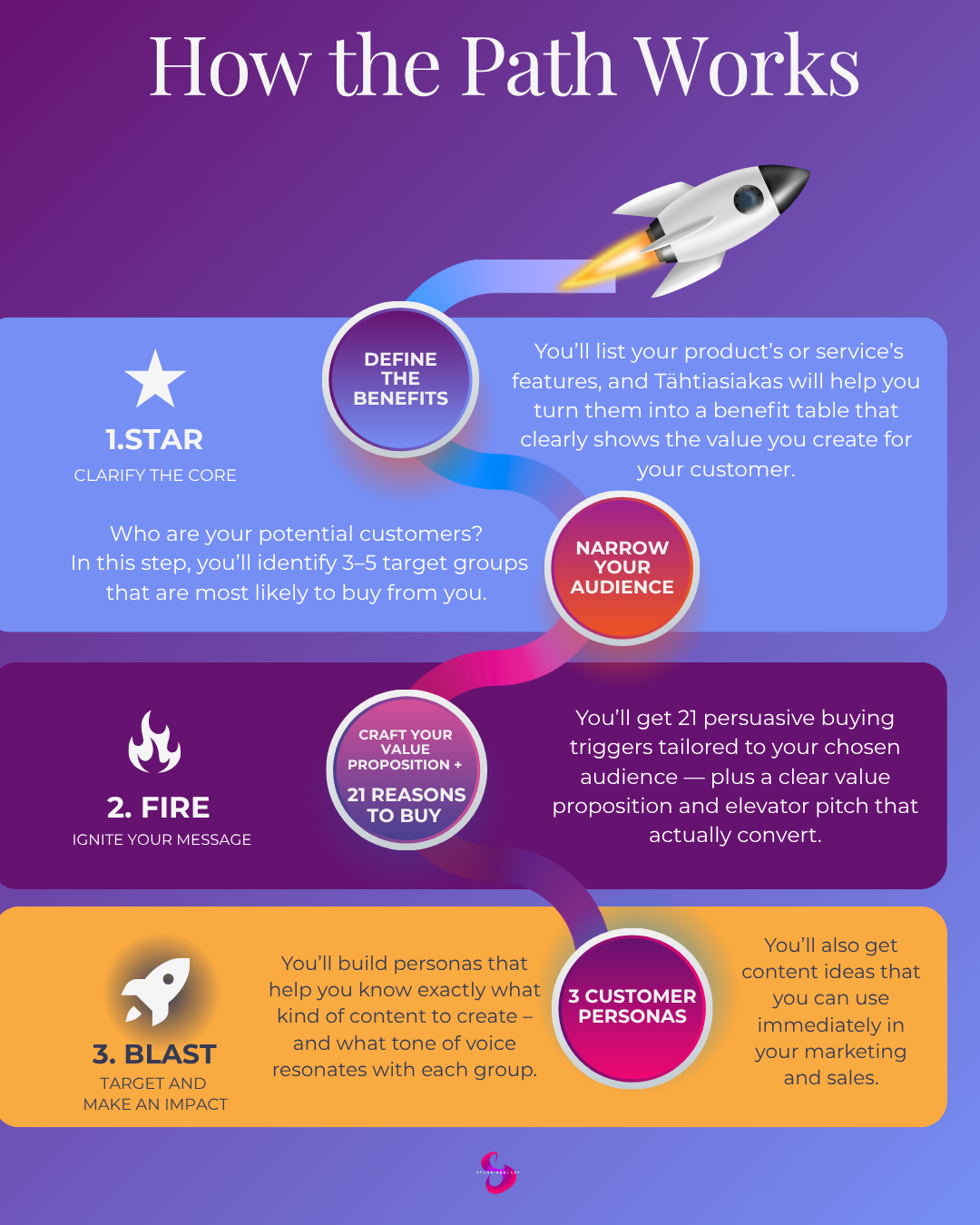
The Customer StarMap™ AI Power Workshop combines AI insights with purpose-driven strategy to clarify customer needs and align offerings with authentic impact. This foundation ensures growth supports rather than undermines your mission.
Explore resources like the 7 steps purpose-driven entrepreneurship checklist for systematic guidance on embedding purpose operationally. These tools help solo entrepreneurs and small teams build sustainable businesses that prioritize human well-being and ecological responsibility without burnout.
Starfireblast empowers you to turn ideas into meaningful action, clarify who you serve, and build community-driven growth instead of chasing algorithms. Start with purpose, scale with intention, and create lasting impact.
Frequently asked questions about purpose-driven business
What makes a business truly purpose-driven versus CSR?
Purpose-driven businesses integrate social and environmental goals into core strategy, operations, and decision-making from the start. CSR typically adds charitable activities or sustainability programs separate from core business. Authentic purpose shapes product design, supply chains, hiring, and governance, not just philanthropy or marketing.
Can solo entrepreneurs realistically adopt purpose-driven models?
Yes, small teams often implement purpose more easily than large corporations because they control decisions directly and communicate authentically. Start by clarifying core purpose, choosing 1-2 measurable impact areas matching your capacity, and building transparent practices. Scale ambitions to available resources while maintaining quality over quantity.
How do I measure social and environmental impact effectively?
Define 2-3 specific outcomes you can reasonably influence, such as carbon reduction, local employment, or waste diversion. Establish baseline measurements and simple tracking systems. Report results transparently including shortcomings. Use data to refine strategies and demonstrate accountability. Start with metrics you can track consistently rather than comprehensive frameworks you cannot maintain.
Is purpose-driven business profitable long-term?
Purpose-driven businesses outperform financially by creating value for multiple stakeholders simultaneously. They achieve 37% faster growth, stronger customer loyalty, better employee retention, and competitive differentiation. These advantages compound over time, building sustainable business models that balance profit with positive impact. Financial sustainability enables continued social and environmental contribution.
What are quick practical first steps for beginners?
Start by writing a clear purpose statement defining the positive change you create. Evaluate current offerings against this purpose to identify alignment gaps. Choose one operational area where purpose fits naturally and implement thoroughly. The purpose-driven entrepreneurship steps provide systematic guidance. Focus on authentic integration in one area before expanding scope.
Recommended
- Purpose-Driven Entrepreneurship: Building Impactful Businesses – Starfireblast
- Why Purpose Matters in Branding for Entrepreneurs – Starfireblast
- 7 Steps to a Purpose-Driven Entrepreneurship Checklist – Starfireblast
- Clarifying Business Purpose: Pathway to Sustainable Growth – Starfireblast
- Why Website Accessibility Is Your Small Business’s Hidden Revenue Booster
- The Compliance Currency Engine | Freshcyber