Why purpose over profit drives sustainable entrepreneur success
TL;DR:
- Purpose-driven entrepreneurship builds long-term stability by aligning decisions with core values and customer outcomes.
- Focusing solely on profit can lead to founder burnout, misalignment, and talent turnover.
- Clear purpose enhances trust, differentiation, and resilience, supporting sustainable growth and impact.
Many entrepreneurs hit a financial milestone and feel nothing. The revenue is there, the growth is real, but the work feels hollow. This tension between financial performance and personal meaning is not a niche experience. It is one of the most common reasons founders step back, burn out, or quietly walk away from businesses they built. What follows is a clear look at what purpose-driven entrepreneurship actually means, why profit-only strategies carry hidden costs, and how aligning your business with genuine purpose creates outcomes that last. Whether you are just starting out or reassessing a business you have built for years, this matters.
Table of Contents
- Understanding purpose-driven entrepreneurship
- Why chasing profit alone leads to burnout
- Purpose as a competitive advantage
- How to realign your business toward purpose
- The uncomfortable truth about purpose-driven success
- Ready to ignite your purpose-led business?
- Frequently asked questions
Key Takeaways
| Point | Details |
|---|---|
| Purpose beats profit | Purpose-led businesses see deeper fulfillment and greater long-term growth than those focusing on profit alone. |
| Avoid burnout | Chasing profit without meaning often leads to exhaustion and high turnover for founders and teams. |
| Purpose builds trust | A clear mission improves customer loyalty and brand resilience in challenging markets. |
| Realign for impact | Actionable frameworks help re-center your business around values that drive sustainable success. |
Understanding purpose-driven entrepreneurship
Purpose-driven entrepreneurship means building a business around a defined reason for existing beyond revenue. That reason could be solving a specific problem for a specific community, reducing harm in a supply chain, or making a skill or service more accessible. The point is that it goes beyond the transaction.
This is different from profit motivation in a practical way. Profit is a result. Purpose is a direction. When you build toward profit alone, every decision gets filtered through a single question: does this make money? When you build toward purpose, decisions get filtered through a richer set of questions: does this serve who we are here for, does it align with our values, and does it move us toward the outcome we care about?
Purpose-driven businesses experience higher customer loyalty and employee engagement, which means the business structure itself becomes more stable over time. That stability is not accidental. It comes from clarity.
Here are the core benefits of building with a clear purpose:
- Stronger decision-making: When your purpose is defined, trade-offs become easier to evaluate.
- Greater resilience: Founders with a clear why are more likely to persist through difficult periods without losing direction.
- Authentic differentiation: Purpose gives customers a reason to choose you that goes beyond price or convenience.
- Team alignment: People who understand why they are doing the work tend to perform better and stay longer.
- Reduced cognitive load: Clear values reduce the number of judgment calls you need to make from scratch.
Purpose also acts as a buffer in hard times. When revenue dips or a product fails, a founder without purpose often spirals. A founder with purpose recalibrates faster because the mission remains intact even when the numbers do not.
Pro Tip: Write down three things you want to be true for your customers because of your business. Not features. Outcomes. That gap between current reality and those outcomes is often where your real purpose lives.
Why chasing profit alone leads to burnout
Profit as the primary driver of a business is not wrong on its own. Businesses need revenue to survive. The problem is when profit becomes the only metric that matters, and everything else gets measured against it.
Founders who operate this way report a recognizable pattern. Early on, financial traction feels validating. Each revenue milestone reinforces the approach. But over time, the work becomes disconnected from any internal compass. Decisions get made based on what earns rather than what fits. The result is a business that may perform on paper but leaves the founder feeling empty, reactive, and exhausted.
Profit-driven businesses often report higher turnover and lower satisfaction, which signals a structural problem that revenue alone cannot fix.
The stages of burnout in profit-focused businesses tend to follow a clear arc:
- Initial excitement: Revenue growth validates the strategy and creates momentum.
- Overextension: More opportunities appear and the founder says yes to most of them because they pay.
- Misalignment: The business drifts from what the founder originally cared about.
- Disconnection: The founder feels like an operator of a machine rather than a builder of something meaningful.
- Collapse or exit: Energy runs out, health declines, or the founder sells or shuts down without clarity on why it stopped working.
Misaligned businesses also struggle with talent. People want to work on things that matter. A team built entirely around hitting financial targets tends to churn faster because there is nothing beyond the paycheck holding people in place. Talent retention becomes a recurring cost instead of a sign of a healthy culture.

The profit-first challenges are not about money being bad. They are about what happens when money becomes the only story a business tells itself.
Purpose as a competitive advantage
Purpose is not just a feel-good addition to a business plan. It is a structural advantage that shows up in measurable ways.
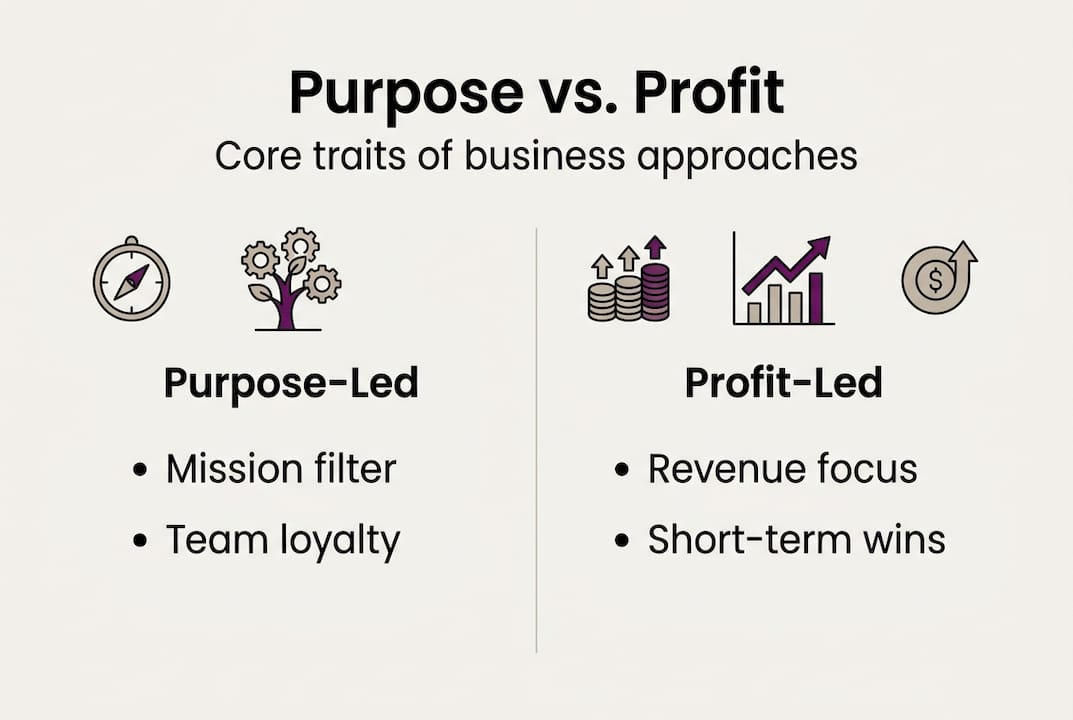
Brands with clear purpose outperform their peers in market growth. This is not because customers are idealistic. It is because clarity builds trust, and trust reduces the friction that normally slows purchasing decisions and referrals.
Here is how purpose-led and profit-led businesses compare across key dimensions:
| Dimension | Purpose-led business | Profit-led business |
|---|---|---|
| Decision filter | Values and mission | Revenue potential |
| Customer relationship | Long-term loyalty | Transactional |
| Employee retention | Higher | Lower |
| Brand differentiation | Strong and authentic | Often generic |
| Resilience in downturns | Higher | More vulnerable |
| Innovation driver | Solving real problems | Protecting margins |
Consider how some of the most recognized small and mid-size brands built their identity around a specific community or cause. They did not dominate through price wars. They built a reputation by standing for something, and that reputation compounded over time.
Purpose accelerates growth and resilience in specific ways:
- It shortens the sales cycle because trust is already partially established through brand alignment.
- It creates word-of-mouth referrals because customers identify with what the brand stands for.
- It attracts collaborators and partners who share values, reducing acquisition costs.
- It keeps the founder grounded during pivots because the mission does not change even when the product does.
Your brand purpose impact is only as strong as how clearly you communicate it. Customers should be able to understand what you stand for within seconds of encountering your brand. Internal teams should hear it in how leadership talks about priorities.
Pro Tip: State your purpose in one sentence and test it on someone outside your business. If they cannot explain it back to you, it needs to be clearer.
A clear purpose-driven strategy is not a marketing layer. It is the foundation every marketing, sales, and product decision should sit on.
How to realign your business toward purpose
Realigning a business toward purpose does not require starting over. It requires looking honestly at what exists and asking whether it reflects what you actually care about.
Clarifying business purpose boosts sustainable growth potential because it removes the drift that accumulates when decisions are made without a clear filter.
Here are the steps to realign your business with your core purpose:
- Audit your current activities: List what your business does and mark each item as aligned, neutral, or misaligned with what you care about.
- Name who you are building for: Be specific. Not “small business owners” but “solo service providers in their first three years who want predictable income.”
- Define the change you create: What is different for your customer after working with you? That difference is your purpose in action.
- Revisit your mission statement: If it sounds like it could belong to any business, rewrite it.
- Identify one misaligned action to stop: Purpose is also about what you choose not to do.
To make this concrete, here are examples of purpose-driven mission statements and their real-world effects:
| Mission statement | Key impact |
|---|---|
| We make financial planning accessible to first-generation wealth builders. | Builds deep community trust and referral networks. |
| We create tools that reduce food waste for independent restaurants. | Attracts press, partnerships, and loyal early adopters. |
| We help creators own their audience without depending on algorithms. | Generates strong brand advocates and recurring revenue. |
Use the resources on clarifying your brand purpose and the purpose-driven entrepreneurship steps as practical starting points for this work.
Pro Tip: Involve your team in this process. People support what they help build. A purpose that is handed down without input tends to stay on the wall. A purpose that was shaped together tends to show up in daily decisions.
The uncomfortable truth about purpose-driven success
Most articles on purpose-driven business stop at inspiration. Here is what they leave out.
Stating a purpose is easy. Acting on it consistently, especially when it costs you a client or a revenue stream, is where most businesses fall short. Purpose without operational alignment is marketing, not management. It is called purpose-washing, and it damages trust faster than having no stated purpose at all.
There is also a real tension between purpose and profit that does not get resolved by choosing one over the other. You need revenue to fund the mission. A business that cannot sustain itself cannot serve anyone. The question is not purpose or profit. It is whether your profit strategy reinforces or undermines your purpose.
Founders who have built impactful businesses over the long term tend to say the same thing: the purpose did not make everything easier, but it made the hard parts survivable.
The businesses that last are not the ones that found the perfect purpose statement. They are the ones that kept asking whether their actions matched it.
That ongoing self-check is the actual work of purpose-driven entrepreneurship.
Ready to ignite your purpose-led business?
If you have read this far, you already know that purpose is not a tagline to add to your website. It is the structure your decisions need to be built on. The frameworks in this article give you a starting point, but turning clarity into consistent action is where most entrepreneurs need real support.
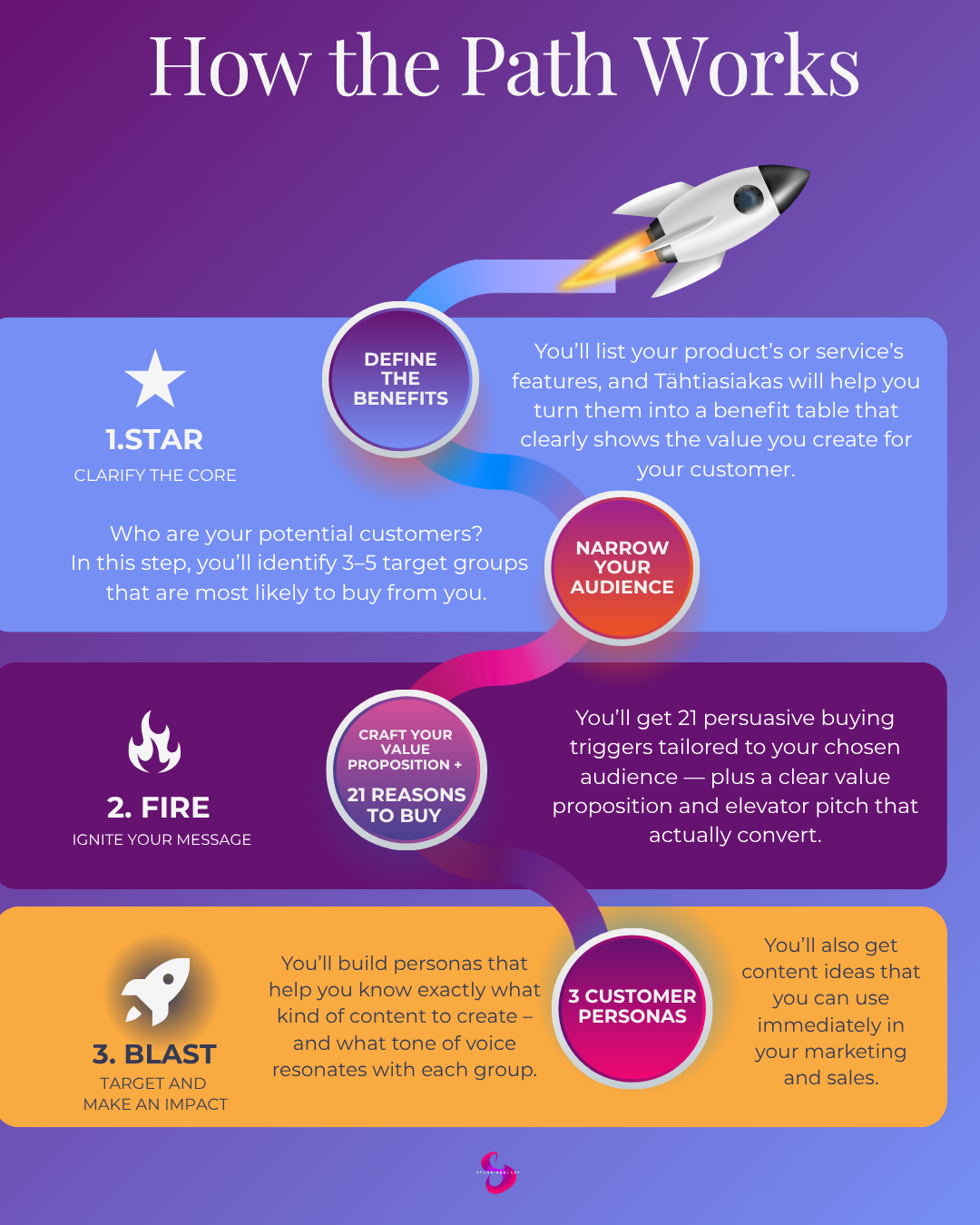
Starfireblast is built for exactly this stage. The Customer StarMap™ Workshop helps you identify who you are building for and why it matters before you spend another dollar on marketing or tools. If you are ready to stop guessing and start building with intention, explore what Starfireblast offers for purpose-led entrepreneurs who want results that are both meaningful and sustainable.
Frequently asked questions
How do I identify my business’s true purpose?
Reflect on your core values and the specific positive change you want to create for your customers. Most businesses succeed when purpose is clarified and owned by the founder rather than delegated to branding.
Can purpose-driven businesses also be profitable?
Yes. A clear organizational purpose improves loyalty and trust, which supports long-term profit. Purpose-driven brands outperform peers in market growth over time.
What’s a common mistake when shifting focus to purpose?
Many founders state a purpose without aligning their operations or resources to it. This creates purpose-washing, not real impact, and superficial purpose statements do not yield results.
How can I involve my team in defining our purpose?
Open workshops and structured dialogues help your team co-create and commit to the mission. Collaborative purpose clarification boosts team buy-in and daily alignment.
Recommended
- Purpose-Driven Entrepreneurship: Building Impactful Businesses – Starfireblast
- What Is Sustainable Entrepreneurship? Triple Bottom Line Explained – Starfireblast
- 7 Steps to a Purpose-Driven Entrepreneurship Checklist – Starfireblast
- What is purpose-driven business: build impact and growth – Starfireblast