Your guide to sustainable growth: balanced, profitable, responsible
Growth without direction is just speed. Many entrepreneurs hit a point where revenue climbs, headcount expands, and then something breaks. A key supplier fails. The team burns out. The mission gets lost in the noise. Companies like Tony’s Chocolonely show a different path: $220M in revenue at 25 to 30% annual growth, built on ethical sourcing. This guide walks you through the frameworks, metrics, and methods to grow your business in a way that holds up over time, for your people, your finances, and the planet.
Table of Contents
- What is sustainable growth, and why does it matter?
- Getting started: Mindsets and frameworks for responsible growth
- Step 1: Measure what matters — financial and non-financial metrics
- Step 2: Set actionable sustainability goals with practical methods
- Step 3: Build resilience with circular supply chains and stakeholder buy-in
- Step 4: Certification, verification, and scaling your impact
- Embed sustainable growth into your business journey
- Frequently asked questions
Key Takeaways
| Point | Details |
|---|---|
| Balance profit with purpose | True sustainable growth combines profitability with human and environmental responsibility for lasting business value. |
| Track the right metrics | Measure both financial metrics like SGR and non-financial KPIs such as energy usage or community impact. |
| Build resilience early | Invest in circular supply chains and stakeholder engagement to withstand shocks and sustain momentum. |
| Frameworks drive results | Apply proven models like the Triple Bottom Line and B Corp principles, even at the startup stage. |
| Start small, scale wisely | Begin with focused pilots, verify impact, and expand sustainable growth efforts as your business matures. |
What is sustainable growth, and why does it matter?
Sustainable growth is not just about growing slowly or carefully. It is about growing in a way that does not destroy the conditions that made growth possible in the first place. Traditional growth models focus on short-term profit maximization. Sustainable growth asks a different question: who benefits, and at what cost?
The Triple Bottom Line framework organizes this into three pillars: People, Planet, and Profit. Each pillar is a check on the others. Profit without people leads to burnout and turnover. Profit without planet leads to regulatory risk and supply chain fragility. The framework is not idealistic. It is practical.
Entrepreneurs who embed sustainability fundamentals early gain real advantages: stronger talent pipelines, more loyal customers, and better resilience against disruption. Measurable sustainability is now a competitive signal, not just a values statement.
“Sustainable growth is not the absence of ambition. It is ambition with accountability built in.”
Signs your growth may be unsustainable:
- Frequent team burnout or high staff turnover
- Negative press around labor or environmental practices
- Supply chain shocks with no backup plan
- Revenue growth that outpaces operational capacity
- Declining customer trust or brand reputation
| Trait | Sustainable growth | Unsustainable growth |
|---|---|---|
| Time horizon | Long-term | Short-term |
| Stakeholder focus | Broad (team, community, planet) | Narrow (shareholders only) |
| Supply chain | Resilient, circular | Fragile, linear |
| Talent strategy | Retention-focused | Replacement-focused |
| Risk management | Proactive | Reactive |
Getting started: Mindsets and frameworks for responsible growth
Before you build systems, you need to shift how you think about growth itself. Linear growth thinking treats expansion as the default goal. Regenerative thinking asks what your business gives back, not just what it extracts.
Three frameworks anchor this shift. The Triple Bottom Line (People, Planet, Profit) gives you a lens for every decision. ESG (Environmental, Social, Governance) provides a reporting structure that investors and partners recognize. B Corp certification offers a third-party verified standard for impact. You do not need all three at once. Pick the one that fits your stage.
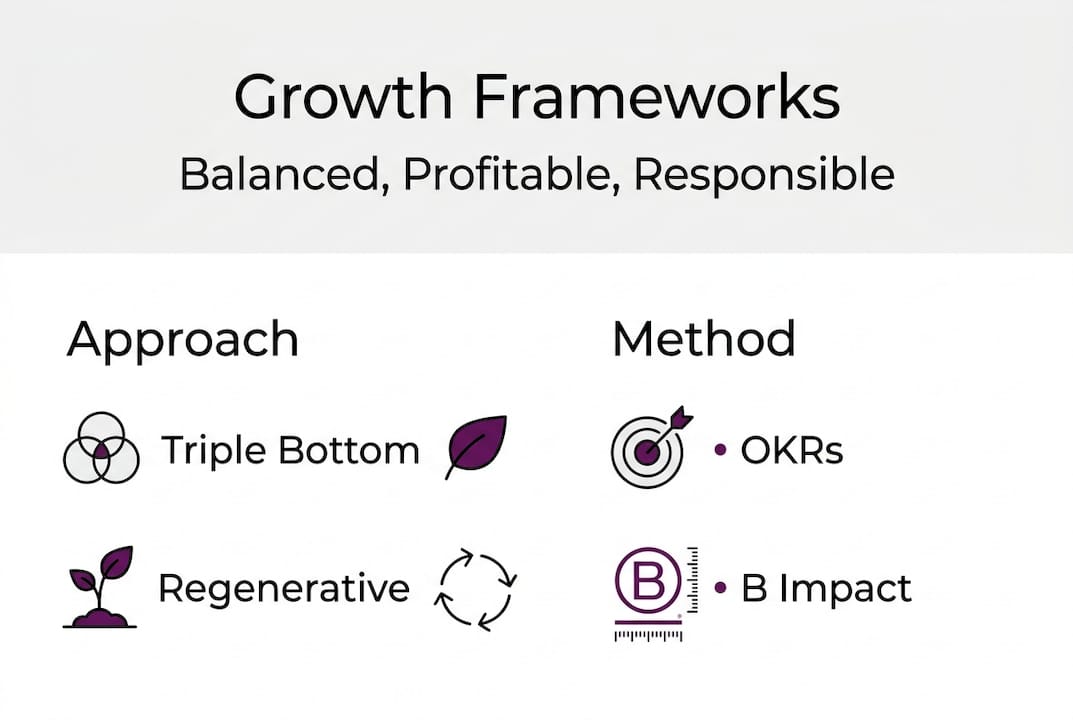
Embedding sustainability in OKRs from the start is more effective than retrofitting it later. Regenerative models outperform traditional sustainability approaches for long-term resilience. This is not a soft claim. It is a structural advantage.
78% of workers prefer purpose-driven employers. For solo founders and small teams, that stat matters. Your ability to attract and keep good people depends partly on whether your mission feels real.
Critical mindsets for responsible growth:
- Think in decades, not quarters
- Treat stakeholders as partners, not audiences
- Default to transparency, even when it is uncomfortable
- Iterate on impact metrics the same way you iterate on product
- Prioritize regenerative models over extractive ones
Pro Tip: You do not need to pursue full B Corp certification to benefit from its framework. Use the B Impact Assessment as a diagnostic tool. It will surface gaps in governance, worker well-being, and environmental impact that most founders miss.
For more on aligning priorities without sacrificing momentum, see balancing business priorities.
Step 1: Measure what matters — financial and non-financial metrics
You cannot manage what you do not measure. That applies to carbon output as much as cash flow.
Start with your Sustainable Growth Rate. The formula is: SGR = Return on Equity x Retention Ratio (1 minus Dividend Payout Ratio). This tells you the maximum rate your business can grow without needing external financing. For mature businesses, a healthy SGR sits between 10 and 15%. Growth-stage companies often run at 20% or higher. See SGR calculation details for a step-by-step walkthrough.
How to calculate your SGR:
- Calculate your net income and divide by total shareholder equity to get Return on Equity (ROE)
- Determine your retention ratio: subtract dividends paid from net income, then divide by net income
- Multiply ROE by the retention ratio
- Compare your result to your actual growth rate to spot overextension
Pro Tip: Track primary data wherever possible. Estimated figures introduce error that compounds over time. One accurate energy bill is worth more than three modeled projections.
| Metric type | Example metric | Target range |
|---|---|---|
| Financial | Sustainable Growth Rate | 10 to 20% depending on stage |
| Environmental | CO2 emissions per unit | Reduce 10% year over year |
| Social | Employee retention rate | 85% or higher |
| Governance | Stakeholder feedback cycles | Quarterly minimum |
For a broader view of how these metrics connect to strategy, explore growth strategy metrics and business evolution.
Step 2: Set actionable sustainability goals with practical methods
Metrics without goals are just data. Goals without methods are just intentions. The SMART framework (Specific, Measurable, Achievable, Relevant, Time-bound) applies directly to sustainability targets.
Examples: reduce energy use by 15% by 2027; shift to 50% recycled packaging by 2028; achieve zero landfill waste from operations by 2029. Each goal has a number, a deadline, and a clear owner.
Core sustainability methodologies include SMART goal-setting, resilient supply chain investment, circular economy models (repair, rental, recycling), life cycle assessments, and structured stakeholder engagement. These are not theoretical. They are operational.
Steps for stakeholder engagement:
- Conduct an energy audit and a supplier audit in the same quarter
- Share findings with your team before setting targets
- Invite input from customers, suppliers, and community partners
- Communicate your strategy publicly, even if it is incomplete
- Set a review cadence (quarterly or biannual) and stick to it
Pro Tip: Start with one supply chain element. Map it, measure it, improve it, then expand. Trying to overhaul everything at once leads to shallow progress across the board.
For goal-setting frameworks built for purpose-driven founders, see purposeful goal-setting and planetary productivity.
Step 3: Build resilience with circular supply chains and stakeholder buy-in
Goals are only as strong as the systems behind them. Circular supply chains replace the take-make-dispose model with loops: repair, resale, rental, and recycling. This reduces waste and cuts exposure to raw material price swings.
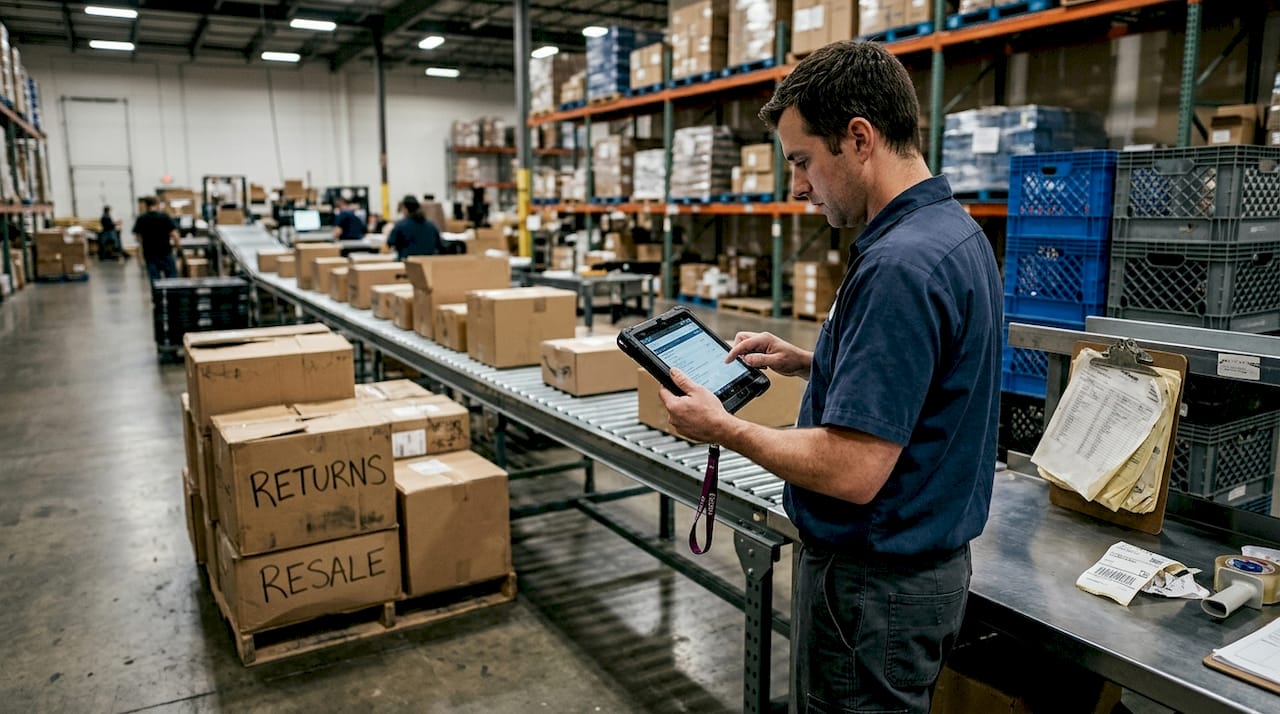
Decathlon scaled circular sales 6 to 10 times through second-hand and repair programs. Puma reduced emissions by 85% on Scope 1 and 2 while growing sales. These are not niche outcomes. They are repeatable models.
Simple circular economy tactics to try:
- Offer a repair or refurbishment option for your core product
- Partner with a resale platform to extend product life
- Audit your top three suppliers for waste and energy use
- Switch to recycled or compostable packaging on one product line
- Track material return rates as a KPI
“Rapid, unchecked expansion creates fragility. Supply chain bottlenecks, talent gaps, and reputational risks compound faster than revenue can absorb them.”
| Model | Risk level | Waste output | Growth potential |
|---|---|---|---|
| Linear supply chain | High | High | Short-term only |
| Circular supply chain | Lower | Minimal | Long-term, compounding |
Stakeholder buy-in accelerates all of this. Tony’s Chocolonely built a loyal customer base and a strong talent pipeline by making ethical sourcing visible and verifiable. Your team and your customers want to be part of something that holds up. Give them the evidence.
For practical steps on building a resilient operation, see resilience tips and community-driven growth.
Step 4: Certification, verification, and scaling your impact
External validation matters. It removes the burden of self-reporting and gives customers, partners, and talent a shortcut to trust.
B Corp certification requires a score of 80 or higher on the B Impact Assessment across five areas: Governance, Workers, Community, Environment, and Customers. The 2025 standards added seven mandatory Impact Topics including Climate Action and JEDI (Justice, Equity, Diversity, and Inclusion). It is a rigorous process. It is also a useful one.
Typical certification phases:
- Year 0: Complete a baseline B Impact Assessment, identify gaps, assign owners
- Year 1: Implement governance and worker well-being improvements
- Year 2: Address environmental and community metrics, begin formal reporting
- Year 3: Submit for certification, engage external verifier
Pro Tip: Even without pursuing the official label, using the B Corp framework as an internal audit tool builds credibility with stakeholders and sets a clear improvement roadmap.
Common mistakes to avoid:
- Letting impact data go stale (update at least annually)
- Making vague sustainability claims without data to back them up
- Treating certification as a one-time event rather than an ongoing practice
- Failing to involve your team in the process
For a broader view of how well-being connects to long-term success, see the well-being success guide.
Embed sustainable growth into your business journey
You have the frameworks. You have the metrics. You have the methods. The next step is putting them into a coherent plan that fits your actual business, not a generic template.
The Customer StarMap™ AI Power Workshop at Starfireblast is built for exactly this. It helps you clarify who you are building for, align your growth strategy with your values, and translate frameworks like TBL and B Corp into daily decisions. No agency required. No algorithm to game. Just a structured process for building something that lasts. If you are ready to move from knowing to doing, this is where to start.
Frequently asked questions
What is the sustainable growth rate (SGR) formula and why is it important for businesses?
The SGR formula is SGR = Return on Equity x Retention Ratio, showing the maximum growth a business can sustain without extra financing and highlighting the balance between profitability and reinvestment.
How do I start making my business model more sustainable?
Begin with an energy or supplier audit, set one sustainability metric, and use frameworks like TBL or B Corp even in early stages. SMART sustainability goals combined with stakeholder engagement give you a practical starting point.
Do small businesses really need certifications like B Corp?
No, but pursuing B Corp frameworks can add credibility, attract talent, and strengthen reputation, even without the official label.
How can I avoid greenwashing when setting sustainability targets?
Use primary data for accuracy, communicate progress honestly, and avoid vague claims. Track and share impact with specific numbers and timelines.