Human-Centered Productivity Explained: Sustainable Results
Every solo entrepreneur and small team in Central Europe knows the pressure to keep up with fast-paced business models. The challenge is finding productivity strategies that deliver meaningful growth without sacrificing well-being or facing burnout. By embracing the principles of human-centered productivity, you can build a more resilient and sustainable business, grounded in practices proven to increase long-term motivation, creativity, and quality of work.
Table of Contents
- Defining Human-Centered Productivity For Work
- Variations And Contrasts With Hustle Models
- Core Principles: Clarity, Focus, Recovery
- Business Impact: Quality, Innovation, And Sustainability
- Risks Of Ignoring Human Limits In Business
- Practical Strategies For Healthier, Lasting Results
Key Takeaways
| Point | Details |
|---|---|
| Human-Centered Productivity | Emphasizes well-being, cognitive capacity, and adaptation to individual energy patterns over traditional output metrics. |
| Core Principles | Focus on clarity, strategic focus, and intentional recovery to enhance productivity and performance. |
| Impact on Organizations | Fosters higher quality, innovation, and resilience while reducing burnout and turnover rates. |
| Leadership’s Role | Leaders must facilitate employee growth and create adaptive environments that support individual and organizational needs. |
Defining human-centered productivity for work
Human-centered productivity transforms traditional work approaches by prioritizing individual well-being and cognitive capacity over pure output metrics. Unlike conventional productivity models that treat workers like machines, this approach recognizes human beings as complex, dynamic systems with unique energy patterns, emotional needs, and sustainable performance limits.
At its core, human-centered productivity represents a fundamental shift in understanding workplace effectiveness. The concept emerged from research demonstrating that worker-focused organizational practices can dramatically improve both individual and collective performance. This approach integrates critical elements that traditional models often ignore:
- Respecting individual energy rhythms
- Prioritizing mental health and recovery
- Creating adaptive work environments
- Valuing quality over pure quantity of output
- Recognizing human variability and potential
Traditional productivity frameworks typically measure success through linear metrics like hours worked or tasks completed. In contrast, human-centered productivity evaluates performance through a more nuanced lens that includes worker engagement, creativity, long-term sustainability, and holistic well-being.
The International Labor Organization’s research confirms that human-centered management practices can increase workplace productivity by fostering environments where employee capabilities are genuinely developed and sustained. This approach doesn’t just benefit workers – it creates more resilient, innovative, and adaptable organizations.
Pro tip: Start tracking your energy levels and work quality instead of just hours worked to understand your true productivity potential.
Variations and contrasts with hustle models
Hustle culture and human-centered productivity represent fundamentally different approaches to work, with profound implications for individual and organizational performance. While hustle models glorify constant effort, overwork, and perpetual acceleration, human-centered frameworks prioritize sustainable engagement and worker well-being.
The key distinctions between these models emerge through several critical dimensions:
-
Effort Perception
- Hustle Model: More hours equals more value
- Human-Centered Model: Quality and strategic impact matter more than time spent
-
Energy Management
- Hustle Model: Linear, constant output expected
- Human-Centered Model: Recognizes natural energy fluctuations and recovery needs
-
Performance Metrics
- Hustle Model: Quantity of tasks completed
- Human-Centered Model: Depth of work, innovation, and long-term sustainability
Traditional hustle models operate on an industrial-era paradigm that treats workers as interchangeable components, expecting consistent high-speed performance without consideration of individual differences. In contrast, human-centric productivity advocates for balanced work practices that respect individual cognitive capacities and emotional landscapes.
The psychological toll of hustle culture is significant. Constant pressure leads to burnout, decreased creativity, and diminished overall performance. Human-centered productivity recognizes that sustainable high performance requires intentional rest, reflection, and adaptive work strategies that align with human cognitive and emotional needs.
Here’s a clear comparison of hustle culture and human-centered productivity:
| Dimension | Hustle Culture Approach | Human-Centered Productivity |
|---|---|---|
| Work Value | Measured by hours logged | Measured by quality and outcomes |
| Energy Use | Expects constant intensity | Adapts to natural energy cycles |
| Worker View | Treats workers as parts | Sees workers as individuals |
| Long-Term Outcome | High risk of burnout | Sustained motivation and health |
| Innovation | Discouraged by pressure | Fostered by well-being focus |
Pro tip: Design your work schedule around your natural energy cycles instead of forcing constant productivity.
Core principles: clarity, focus, recovery
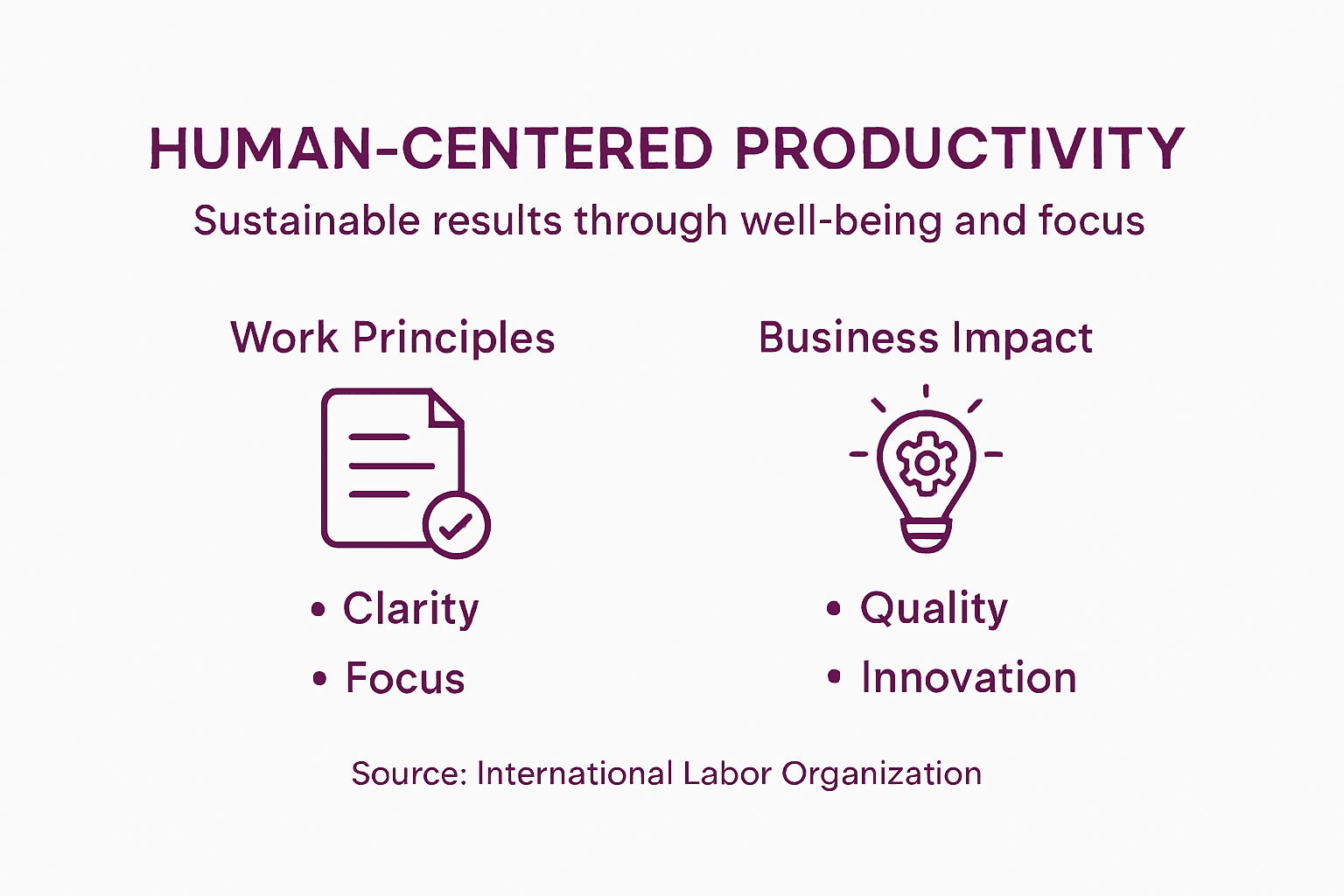
Human-centered productivity is built on three foundational principles that transform how we approach work and personal performance. Core strategies for sustainable productivity emphasize creating intentional frameworks that respect human cognitive capabilities and emotional resilience.
Core Principles:
- Clarity: Defining precise, meaningful objectives
- Focus: Dedicated, uninterrupted work on critical tasks
- Recovery: Intentional periods of rest and mental restoration
Clarity serves as the critical first principle, requiring professionals to move beyond vague goals and create specific, actionable objectives. This means transforming broad intentions into concrete, measurable outcomes that provide genuine direction and motivation.
Focus represents the strategic allocation of cognitive resources. Sustainable work strategies involve creating environments and practices that minimize distractions and support deep, concentrated work. This might include time-blocking techniques, dedicated workspace design, and disciplined communication management.
Recovery is perhaps the most overlooked yet essential principle of human-centered productivity. It recognizes that consistent high performance requires intentional rest, reflection, and mental reset periods. Effective recovery isn’t passive relaxation but active restoration of cognitive and emotional energy.

Pro tip: Create a daily ritual that marks clear transitions between focused work and intentional recovery.
Business impact: quality, innovation, and sustainability
Human-centered productivity transcends traditional performance metrics, offering a transformative approach to business success that integrates human potential with organizational goals. Industry 5.0’s human-centric framework demonstrates how prioritizing employee well-being directly contributes to enhanced business outcomes.
Key Business Impacts:
- Quality improvements through deeper employee engagement
- Sustained innovation by respecting human creativity
- Long-term resilience through holistic performance strategies
- Reduced burnout and talent retention
- Enhanced organizational adaptability
Quality emerges as a critical outcome of human-centered productivity. When organizations move beyond mechanistic performance models, employees contribute more meaningfully, bringing nuanced problem-solving skills and intrinsic motivation to their work. This approach transforms quality from a compliance metric to a dynamic, collaborative process.
Innovation flourishes under human-centered models. Sustainable business competitiveness depends on creating environments where employees feel psychologically safe to experiment, share ideas, and challenge existing approaches. By recognizing individual capabilities and providing supportive frameworks, businesses unlock creative potential that traditional productivity models suppress.
Sustainability represents the most profound impact of this approach. Human-centered productivity isn’t just about immediate performance but about creating regenerative work systems that support individual growth, organizational resilience, and broader societal well-being. This holistic perspective ensures that business success doesn’t come at the cost of human or environmental health.
Pro tip: Develop quarterly reflection sessions where team members can share insights on improving work processes and organizational culture.
Risks of ignoring human limits in business
Businesses that disregard human cognitive and emotional boundaries risk catastrophic long-term consequences that extend far beyond immediate productivity metrics. Human factors in organizational performance reveal systematic breakdown occurs when human needs are consistently overlooked.
Primary Risks of Ignoring Human Limits:
- Accelerated employee burnout
- Increased error rates and quality degradation
- Higher turnover and talent loss
- Diminished innovation capacity
- Reduced psychological safety
- Potential legal and ethical vulnerabilities
Psychological consequences emerge as the most immediate and profound risk. When organizations treat employees as replaceable resources rather than complex human beings, they trigger a cascade of negative outcomes. Motivation declines, creativity suffers, and employees become increasingly disconnected from their work, leading to a fundamental erosion of organizational resilience.
Ethical breaches in technological practices demonstrate how ignoring human autonomy can create systemic failures. These risks manifest through decreased employee engagement, increased mental health challenges, and a fundamental breakdown of trust between workers and organizational leadership.
The economic implications are equally significant. Companies that fail to recognize human limits experience higher recruitment costs, lower productivity, and decreased competitive adaptability. The short-term gains achieved through pushing human capabilities become long-term strategic vulnerabilities that can fundamentally compromise organizational sustainability.
Pro tip: Conduct regular anonymous employee well-being assessments to proactively identify and address potential systemic stress points.
Practical strategies for healthier, lasting results
Transforming workplace productivity requires intentional, systematic approaches that prioritize human well-being and organizational performance. Strategic employee experience design demands more than superficial wellness programs, instead requiring comprehensive, holistic interventions.
Key Implementation Strategies:
- Create clear, meaningful performance expectations
- Design flexible work environments
- Establish rhythmic recovery periods
- Support individual energy management
- Foster psychological safety
- Develop adaptive leadership practices
Effective implementation begins with reframing performance metrics. Traditional quantitative measures must evolve to capture qualitative dimensions of work, including creativity, collaboration, and sustainable engagement. This means measuring outcomes rather than hours, and valuing depth over mere volume of output.
Holistic workplace well-being approaches recognize that productivity is fundamentally interconnected with individual health drivers. Organizations must create supportive ecosystems that address critical human needs like social connection, stress management, sleep quality, and economic security.
Leadership plays a crucial role in this transformation. Managers must become facilitators of human potential, designing work experiences that align individual capabilities with organizational objectives. This requires active listening, personalized support, and a genuine commitment to employee growth beyond immediate task completion.
This summary highlights critical leadership actions for lasting workplace transformation:
| Leadership Action | Expected Result | Organizational Benefit |
|---|---|---|
| Facilitate employee growth | Increased engagement | Higher retention rates |
| Encourage holistic well-being | Improved mental health | Reduced absenteeism |
| Foster psychological safety | Openness to ideas | More innovation |
| Support flexible work styles | Better work-life balance | Stronger performance |
| Conduct regular check-ins | Early stress detection | Faster problem solving |
Pro tip: Implement monthly individual check-ins focused on personal development and work satisfaction, not just performance review.
Embrace Sustainable Human-Centered Productivity with Starfireblast
The article highlights the struggle many entrepreneurs and creators face balancing productivity with well-being. If you find yourself overwhelmed by hustle culture and searching for clarity, focus, and recovery strategies that truly respect your natural energy and mental health, you are not alone. Starfireblast understands these challenges deeply, offering a purpose-driven platform that helps you clarify who you are building for and why it matters — before scaling your marketing or tools.
By combining customer understanding, brand clarity, and practical AI-assisted tools, Starfireblast supports sustainable growth aligned with human-centered productivity principles. This means fostering quality, innovation, and long-term resilience without burning out. Ready to transform your approach to work and build a meaningful business that honors your limits?
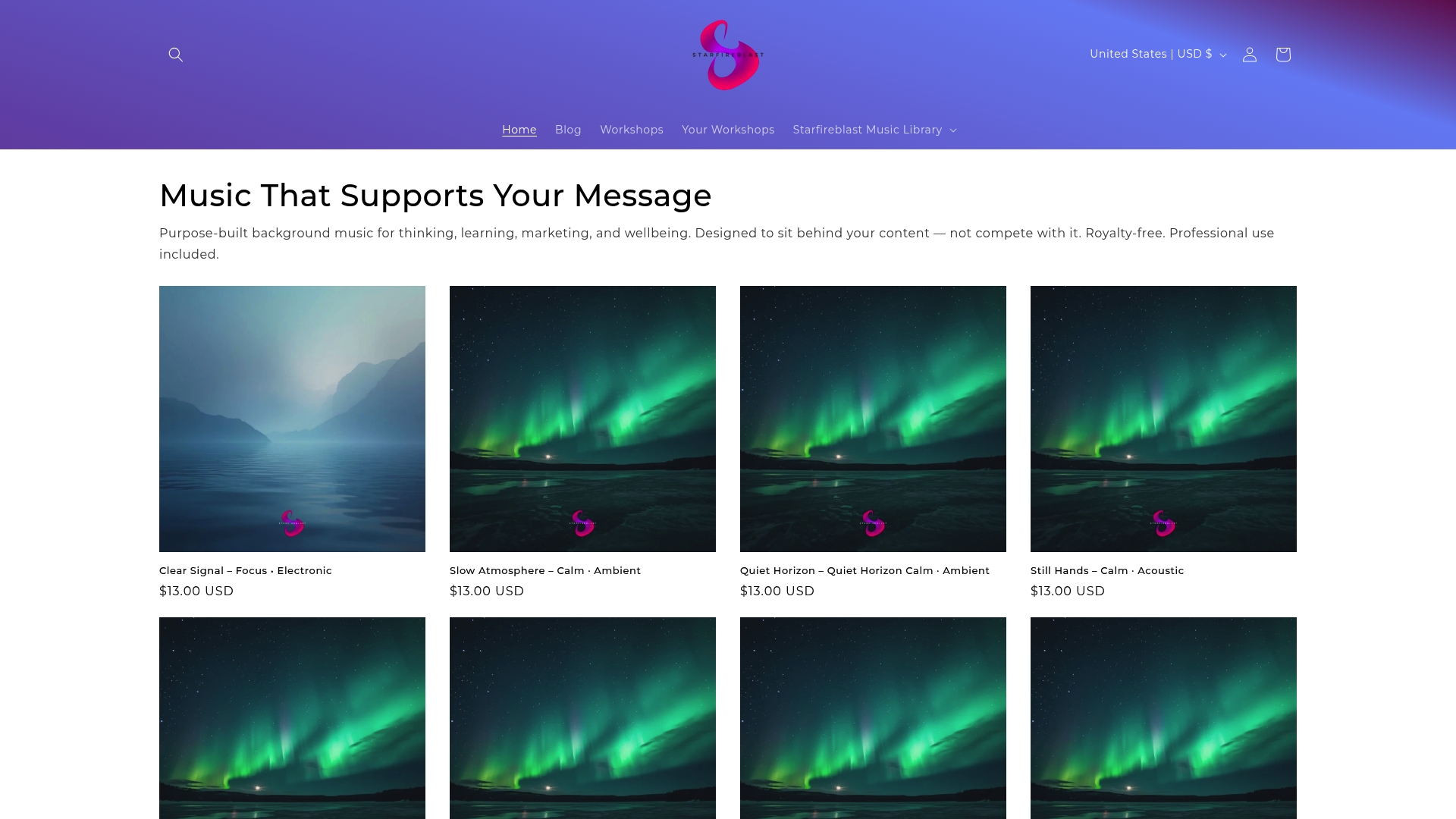
Discover how Starfireblast can help you design a business that thrives on well-being and strategic impact. Start creating with intention and avoid the pitfalls of overwork today. Visit Starfireblast to learn more and take your next step toward sustainable success.
Frequently Asked Questions
What is human-centered productivity?
Human-centered productivity is an approach that prioritizes individual well-being and cognitive capacity over traditional output metrics. It recognizes workers as complex systems with unique energy patterns and emotional needs, aiming for sustainable performance rather than just maximizing hours worked.
How does human-centered productivity differ from hustle culture?
Human-centered productivity contrasts with hustle culture by focusing on sustainable engagement and well-being rather than glorifying constant effort and overwork. While hustle culture measures success through hours logged, human-centered productivity values quality, innovation, and recovery.
What are the core principles of human-centered productivity?
The core principles include clarity, focus, and recovery. Clarity emphasizes meaningful objectives, focus encourages dedicated work on critical tasks, and recovery highlights the importance of intentional rest and mental restoration for sustained performance.
What are the business benefits of adopting a human-centered productivity approach?
Adopting a human-centered productivity approach can lead to improved quality, increased innovation, reduced burnout, higher employee retention, and enhanced organizational adaptability, resulting in long-term business success.
Recommended
- Planetary Productivity Explained: Sustainable Progress for Entrepreneu – Starfireblast
- Top 8 Starblaze.co Alternatives in 2026 for Creative Teams Seeking Sus – Starfireblast
- Top 8 Starfire.live Alternatives in 2026 for Boosting Your Online Pres – Starfireblast
- Business Evolution Explained: Sustainable Growth for Entrepreneurs – Starfireblast