Storytelling in Positioning: Clarifying Brand Relevance
Facing unclear positioning can feel like speaking a different language than your customers. For solo entrepreneurs and small teams across Central Europe, clarity in communication is not just a competitive advantage, it is essential for sustainable brand growth. By embracing storytelling as a positioning tool, you can translate complex internal thinking into customer language, build relevance, and avoid burnout from wasted effort. Discover how purposeful narrative practices connect your business identity directly to the real needs of your ideal audience.
Table of Contents
- Defining Storytelling As A Positioning Tool
- Translating Internal Clarity Into Customer Meaning
- Grounding Stories In Real Customer Language
- Practical Example: Clarifying Unclear Positioning
- Common Pitfalls In Brand Storytelling
Key Takeaways
| Point | Details |
|---|---|
| Storytelling as a Tool | Storytelling is a strategic communication method that translates internal complexity into clear customer understanding, focusing on value recognition. |
| Customer-Centric Language | Effective positioning stories use language that reflects the customer’s perspective, avoiding internal jargon to enhance clarity. |
| Translation of Expertise | It involves distilling organizational capabilities into relatable narratives that address specific customer challenges and needs. |
| Avoiding Common Pitfalls | Brands should prioritize genuine customer understanding over self-promotional narratives to create meaningful and relatable stories. |
Defining Storytelling as a Positioning Tool
Storytelling is far more than a creative exercise - it’s a strategic communication tool designed to translate complex internal thinking into meaningful customer understanding. Unlike traditional brand narratives that focus on inspirational tales, positioning storytelling serves a precise purpose: making a company’s core value immediately recognizable to its target audience.
In the context of positioning, storytelling functions as a precise translation mechanism. It transforms abstract organizational concepts into concrete, relatable language that potential customers can quickly assess. Narrative practices help establish identity by connecting organizational purpose with audience perception, creating a clear communication bridge.
Effective positioning stories share several critical characteristics:
- They prioritize clarity over emotional manipulation
- They speak directly to the specific problems customers face
- They demonstrate immediate relevance without unnecessary complexity
- They use customer language rather than internal jargon
- They enable fast decision-making about product/service fit
Positioning storytelling is not about crafting a mythology or generating empty inspiration. Instead, it’s a deliberate process of translating organizational capabilities into customer-recognizable value. Scientists recognize storytelling as a powerful communication tool that connects complex concepts meaningfully and personally.
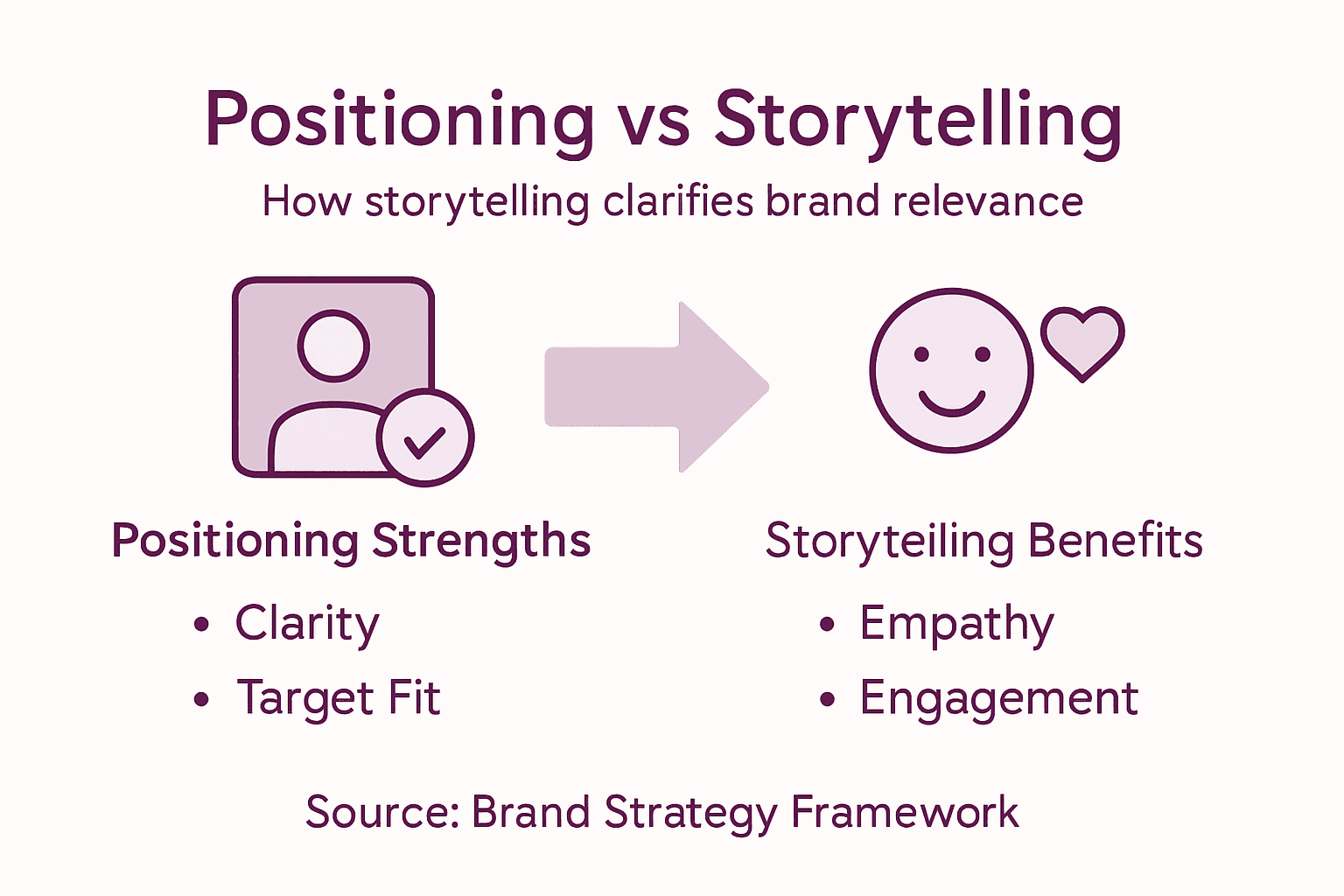
The goal is simple: help potential customers understand quickly whether this product or service is designed for them. A well-crafted positioning story acts like a precise targeting mechanism, filtering out misaligned prospects while attracting ideal customers.
Here’s how storytelling as a positioning tool compares to traditional brand storytelling:
| Aspect | Positioning Storytelling | Traditional Brand Storytelling |
|---|---|---|
| Primary Objective | Clarify value to target customer | Inspire or entertain audiences |
| Language Used | Customer-centric, concrete | Company-centric, aspirational |
| Decision Impact | Enables fast product fit assessment | Builds broad emotional connection |
| Jargon Level | Minimal, clear, accessible | May use industry or internal terms |
Pro tip: Develop your positioning story by first mapping your customer’s specific language and challenges, then craft a narrative that speaks directly to those precise needs.
Translating Internal Clarity Into Customer Meaning
Translating internal organizational thinking into meaningful customer language requires more than simple communication - it demands a strategic approach that bridges the gap between institutional knowledge and audience understanding. Organizational communication must move beyond internal jargon and abstract concepts to create resonant, actionable messages that customers can immediately comprehend.
Successful translation involves breaking down complex internal perspectives into clear, relatable narratives. Effective employer branding strategies emphasize the critical importance of aligning internal communication with external perception, ensuring that the core message remains consistent and meaningful across all touchpoints.
Key elements of effective translation include:
- Identifying the specific problems customers actually experience
- Using language that reflects customer perspectives, not organizational terminology
- Removing technical complexity while preserving core value propositions
- Connecting organizational capabilities directly to customer needs
- Creating narratives that enable rapid understanding and decision-making
This translation process is not about simplification, but about distillation. It requires carefully extracting the most relevant aspects of organizational capability and reframing them through the customer’s lens. The goal is to transform internal expertise into an immediately comprehensible value proposition that feels tailored and relevant.
Effective translation turns organizational complexity into customer clarity, making sophisticated capabilities feel accessible and directly applicable.
Ultimately, the most powerful positioning stories are those that make customers feel understood, not impressed. They demonstrate an intimate understanding of customer challenges while showcasing the unique approach an organization brings to solving those challenges.
Consider these practical methods to translate organizational expertise into clear customer messaging:
| Translation Method | Business Impact | Example Application |
|---|---|---|
| Customer Interviews | Reveals true pain points | Crafting targeted marketing |
| Support Transcript Analysis | Identifies real language and issues | Improving product descriptions |
| Value Distillation | Focuses core benefits | Sharpening website messaging |
| Jargon Removal | Increases clarity and reach | Enhancing sales presentations |
Pro tip: Map your customer’s language by conducting direct interviews and analyzing their actual communication, then use those exact phrases and pain points to craft your positioning narrative.
Grounding Stories in Real Customer Language
Grounding brand stories in authentic customer language is not a creative exercise, but a strategic communication approach that demands precision and deep understanding. Customer language serves as the fundamental bridge between organizational intentions and audience perception, transforming abstract concepts into meaningful, relatable narratives.
Conversational grounding is critical to establishing shared meanings, where brands must dynamically create understanding through carefully selected linguistic and contextual cues. This process goes beyond mere translation - it requires a nuanced approach of listening, interpreting, and reflecting customers’ actual experiences and communication patterns.
Key strategies for authentic language grounding include:
- Conducting direct customer interviews using open-ended questions
- Analyzing customer support transcripts and feedback
- Mapping the exact words and phrases customers use to describe their challenges
- Identifying emotional triggers and pain points in customer narratives
- Removing internal jargon that creates distance or confusion
Successful language grounding transforms positioning from an internal monologue to a genuine dialogue. Consumer-brand relationships thrive when narratives authentically reflect lived consumer experiences, creating deeper emotional connections and increased brand loyalty.
Authentic storytelling happens when brands listen more than they speak, using customers’ own language to create resonance.
The most effective positioning stories do not just describe a product or service - they demonstrate a profound understanding of the customer’s world, using their language, acknowledging their specific challenges, and offering solutions that feel intimately tailored.
Pro tip: Create a customer language repository by systematically collecting and categorizing verbatim quotes from interviews, support interactions, and feedback to ensure your positioning remains consistently authentic.
Practical Example: Clarifying Unclear Positioning
Unclear positioning often emerges when companies describe themselves using internal language that sounds impressive but means nothing to potential customers. Positioning clarity requires translating complex organizational capabilities into straightforward, customer-focused statements that immediately communicate value.

Positioning analysis reveals narrative ambiguities by examining how stakeholders actually perceive and discuss an organization. Consider a technology startup that initially described itself as “delivering innovative digital transformation solutions” - a statement so generic it could apply to virtually any tech company.
The transformation process involves several critical steps:
- Stripping away technical jargon and buzzwords
- Identifying specific customer problems being solved
- Articulating unique approach or methodology
- Using direct, concrete language
- Demonstrating immediate, tangible value
In our example, after careful analysis, the startup’s positioning was refined to: “We help small manufacturing businesses reduce inventory costs by 30% through predictive AI technology.” This statement is precise, measurable, and speaks directly to a specific audience’s concrete challenge.
Positioning clarity happens when you stop talking about your capabilities and start explaining the specific problems you solve for real customers.
The most effective positioning stories do not attempt to impress - they aim to be immediately understood. They answer the fundamental customer question: “What can this company do for me, specifically?”
Pro tip: Test your positioning statement by asking five customers to explain what your company does in their own words, and use their language to refine your narrative.
Common Pitfalls in Brand Storytelling
Brand storytelling often fails when organizations prioritize internal perspectives over genuine customer understanding. Storytelling effectiveness requires moving beyond self-congratulatory narratives to create meaningful, authentic connections that truly resonate with audiences.
Common storytelling challenges undermine communication by creating disconnects between organizational intentions and audience perceptions. These pitfalls emerge when brands mistake storytelling for marketing propaganda rather than a nuanced communication strategy.
Key storytelling pitfalls include:
- Relying on generic, meaningless corporate language
- Focusing on company achievements instead of customer problems
- Creating narratives that sound impressive but lack substance
- Ignoring the specific context of target audience experiences
- Overcomplicating messages that should be simple and direct
Successful storytelling requires a fundamental shift from self-promotion to genuine problem-solving. Storytelling designs must consider audience context to create narratives that feel authentic and immediately relevant.
Effective brand stories are not about how great your company is, but about how well you understand your customers’ challenges.
The most compelling stories demonstrate deep empathy, showing customers that you comprehend their specific struggles more thoroughly than they might understand them themselves. This requires listening more than speaking, and translating organizational capabilities into direct, meaningful solutions.
Pro tip: Develop your brand story by spending more time interviewing customers about their challenges than crafting internal marketing messages.
Transform Your Positioning Story Into Clear Customer Connection
The challenge many entrepreneurs and creators face is turning complex internal ideas into simple, meaningful stories that truly resonate with their customers. This article highlights common pain points like unclear positioning, overwhelming jargon, and narratives that miss customer language. To overcome these hurdles you need a strategic approach that clarifies your value using customer-centric language and directly addresses real problems.
Starfireblast is designed precisely to help you move from internal complexity to customer clarity. By combining deep customer understanding and positioning techniques with brand and strategy clarity, we empower you to craft positioning stories that attract the right audience fast. Our practical, AI-assisted tools simplify the process of translating your unique strengths into communication that is authentic and actionable.
Discover how you can shift from generic marketing noise to impactful storytelling at Starfireblast. Explore our platform to define who you are building for and why it matters through methods grounded in real customer language and strategic clarity. Start your journey to meaningful brand relevance without the burnout or guesswork by visiting Starfireblast today.
Elevate your brand positioning with insights and tools tailored to purpose-driven entrepreneurs at Starfireblast.
Take the first step toward storytelling that truly connects.
Ready to clarify your positioning story using your customers own language
Join Starfireblast now to turn your internal expertise into powerful stories your audience understands and acts on. Visit Starfireblast to start transforming your brand communication today.
Frequently Asked Questions
What is positioning storytelling?
Positioning storytelling is a strategic communication tool that translates complex organizational concepts into clear, customer-centric narratives. It focuses on making a company’s core value immediately recognizable to its target audience.
How can I create an effective positioning story for my brand?
To create an effective positioning story, map your customer’s specific language and challenges. Then craft a narrative that speaks directly to those needs, ensuring clarity and relevance without using internal jargon.
Why is customer language important in storytelling?
Customer language is vital because it establishes a direct connection between a brand’s message and the audience’s understanding. Grounding narratives in authentic customer language transforms abstract concepts into relatable and meaningful stories.
What are common pitfalls in brand storytelling?
Common pitfalls include relying on generic language, focusing on company achievements rather than customer problems, and creating messages that lack substance. Successful storytelling should center on understanding and solving the specific challenges faced by customers.