Discover living business: sustainable value for entrepreneurs
TL;DR:
- A living business evolves by serving people and the planet, not just maximizing profit.
- It is built on purpose, relationships, regeneration, and adaptability for long-term resilience.
- Small, intentional actions across purpose, stakeholders, and sustainability create lasting impact.
Most entrepreneurship advice focuses on one thing: growth. More clients, more revenue, more reach. But many solo entrepreneurs and small teams hit a wall when that growth starts to cost them their values, their health, or their relationship with the world around them. The traditional business model asks you to pick a side: profit or purpose. A living business rejects that choice entirely. This guide breaks down what a living business is, why it works better in the long run, and how you can start building one right now, even if you’re starting from scratch.
Table of Contents
- Defining a living business
- The three pillars: People, planet, and profit
- Why a living business wins in the real world
- How to start building your living business
- Why thinking of your business as a living system changes everything
- Build your living business with Starfireblast
- Frequently asked questions
Key Takeaways
| Point | Details |
|---|---|
| Holistic success | A living business integrates profit, people, and planet for true sustainability. |
| Practical steps | Solo entrepreneurs can build living businesses with clear, actionable moves. |
| Resilient model | This approach creates businesses that adapt and thrive amid market shifts. |
| Greater fulfillment | Focusing on purpose and well-being increases satisfaction for owners and clients. |
Defining a living business
A living business is not a legal structure or a certification. It is a way of operating. The core idea is simple: your business adapts, evolves, and endures by serving the well-being of people and the planet, not just financial returns.
Traditional businesses are often built like machines. They have fixed processes, defined inputs, and measured outputs. When something breaks, you fix it. When the market shifts, many of these businesses struggle because they were optimized for a specific set of conditions, not for change.
A living business operates differently. It is designed to respond, learn, and grow in relation to its environment. Living businesses integrate human well-being, economic viability, and ecological responsibility, making them far more resilient over time. That integration is not a compromise. It is a competitive design choice.
Four core attributes define a living business:
- Purpose-driven: Every decision connects back to a clear reason for existing beyond profit.
- People-centered: The business serves the well-being of clients, team members, and community.
- Regenerative: It actively contributes to the health of its environment rather than depleting it.
- Adaptable: It can shift priorities and structures as conditions change.
Here is how a living business compares to a traditional business model:
| Attribute | Traditional business | Living business |
|---|---|---|
| Primary goal | Maximize profit | Balance profit, people, planet |
| Response to change | Resist or react | Adapt and evolve |
| Resource view | Resources as inputs | Resources as systems to sustain |
| Success measure | Revenue growth | Long-term viability and impact |
| Relationship to clients | Transactional | Relational and values-aligned |
For those exploring sustainability fundamentals for small entrepreneurs, this shift in mindset is often the first and most important step.
The three pillars: People, planet, and profit
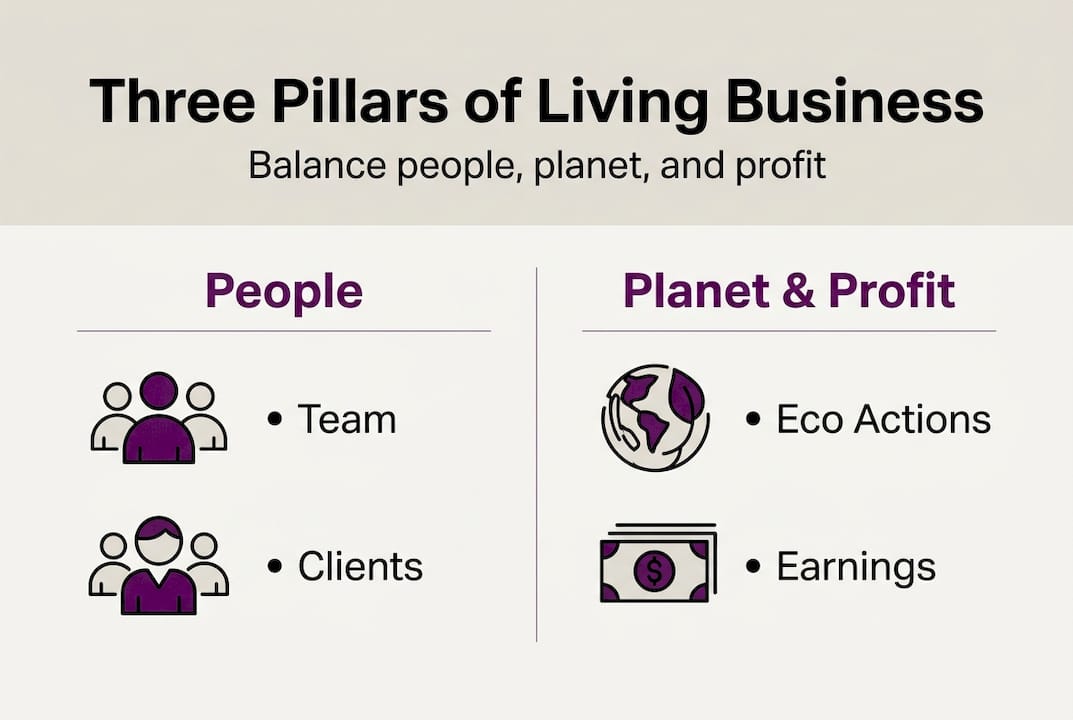
A living business rests on three pillars. Each one supports the others. Neglect any single pillar and the whole structure becomes unstable.
People refers to the human layer of your business. This includes your clients, collaborators, suppliers, and yourself. A business that exhausts its founder, ignores fair compensation for contractors, or treats clients as targets is not built for longevity. Human well-being inside and around the business is a core operating condition, not a bonus.

Planet does not require you to become an environmental nonprofit. At any scale, responsible choices matter. Using digital tools over physical waste, choosing ethical suppliers, or reducing energy use in your workflow all count. Sustainable entrepreneurship requires integrating social, ecological, and economic purpose, and that integration can start small.
Profit is not the enemy. Economic health is what gives you the stability to maintain the other two pillars. A living business treats profit as a condition for sustainability, not the sole definition of success.
Here is a quick view of practical actions across all three:
| Pillar | Example actions |
|---|---|
| People | Set fair rates, protect your time, build genuine client relationships |
| Planet | Go paperless, use ethical hosting, reduce unnecessary shipping |
| Profit | Track cash flow, price for resilience, build recurring revenue |
To assess your current balance, follow these three steps:
- Audit each pillar. Write down three things your business currently does well under each of people, planet, and profit. Then identify one gap in each area.
- Rank by urgency. Which gap is creating the most strain right now? Start there.
- Set one action per pillar. Small, consistent actions compound faster than big one-time overhauls.
Understanding why sustainable entrepreneurship matters helps you see why this three-pillar model is not optional. And when you need to work through balancing business priorities, this framework gives you a clear structure to follow.
Pro Tip: You do not need to fix all three pillars at once. One small, intentional step in each area each quarter creates real momentum without burnout.
Why a living business wins in the real world
This is not just an ethical argument. There is a practical case for building a living business.
First, living businesses are more resistant to economic shocks. When market conditions change, a business built on relationships, adaptability, and genuine value can pivot without losing its core. A business built purely on price competition or volume often cannot.
Second, client retention improves. Clients who choose you because your values align with theirs are far less likely to leave for a cheaper alternative. They are buying more than a service. They are buying alignment. That loyalty has measurable economic value.
Businesses prioritizing sustainable values often outperform those focused solely on short-term gains, particularly in markets where trust and consistency matter more than low cost.
Here are some practical scenarios where the living business approach creates real wins:
- A freelance consultant who communicates openly about capacity and workload retains long-term clients because reliability builds trust.
- A small product business that uses ethical sourcing attracts a segment of customers willing to pay a premium and refer others.
- A solo service provider who protects their own schedule avoids burnout and maintains quality, which protects revenue over time.
Reviewing sustainable growth for entrepreneurs gives a clearer picture of why this outperformance is consistent, not accidental. And for specific strategies, exploring business resilience tips provides actionable frameworks for staying stable during disruption.
Pro Tip: When a problem appears in your business, ask what it is telling you about an imbalance across your three pillars. Challenges are often signals, not failures.
How to start building your living business
The shift to a living business does not require a complete restart. It requires clarity and consistent action.
Follow this roadmap:
- Define your purpose. Write one clear sentence that answers: why does this business exist beyond making money? Be specific. Vague purpose statements do not guide real decisions.
- Identify your stakeholders. Who are the people most affected by your business? Clients, community, suppliers, collaborators. Map them and consider their well-being in your decisions.
- Assess your three pillars. Use the audit method from the previous section. Know where you stand before you plan where to go.
- Set a 90-day integration goal. Pick one action per pillar that moves you toward better balance. Track it monthly.
- Review and adjust. At the end of each quarter, revisit your purpose statement and stakeholder map. Living businesses evolve. Your plan should too.
Clear positioning and mindful strategy are key to building a purpose-driven, sustainable business. Without that clarity, actions pile up without direction.
“When your business actions align with your true purpose, every decision becomes clearer, every relationship becomes more meaningful, and every result carries more value.”
Common pitfalls to avoid:
- Paralysis by planning. Waiting until everything is perfect before acting. Start with one pillar.
- Neglecting profit. Focusing so heavily on values that financial sustainability suffers. Profit enables purpose.
- Going it alone. Treating this as a solo exercise. Involve your clients and collaborators in the process.
The workflow for sustainable impact helps you structure these steps in a practical sequence. And understanding why clarity matters at each stage multiplies the impact of every action you take.
Pro Tip: Clarity at the purpose level makes every downstream decision faster and more consistent. Revisit your purpose statement every six months to keep it accurate.
Why thinking of your business as a living system changes everything
Most business advice treats your business like a machine with levers to pull. Increase marketing spend, reduce costs, optimize conversion. These are useful tactics. But they miss something important.
A machine breaks down and needs repair. A living system, when healthy, repairs itself and grows. The difference is not just philosophical. It changes what you pay attention to.
Entrepreneurs who adopt a living system mindset stop trying to fix every problem directly. They start asking: what conditions allow this business to thrive? That shift moves your focus from firefighting to cultivation.
This also changes how you relate to clients. Building a deeper client connection becomes less about persuasion and more about genuine fit. You stop chasing and start attracting. The result is not just more satisfying work. It is also more stable revenue.
What most entrepreneurs overlook is that the living business model rewards consistency over intensity. Small, aligned actions taken repeatedly create conditions for growth that no single big campaign can replicate.
Build your living business with Starfireblast
If this framework resonates with you, Starfireblast was built specifically for this kind of work.
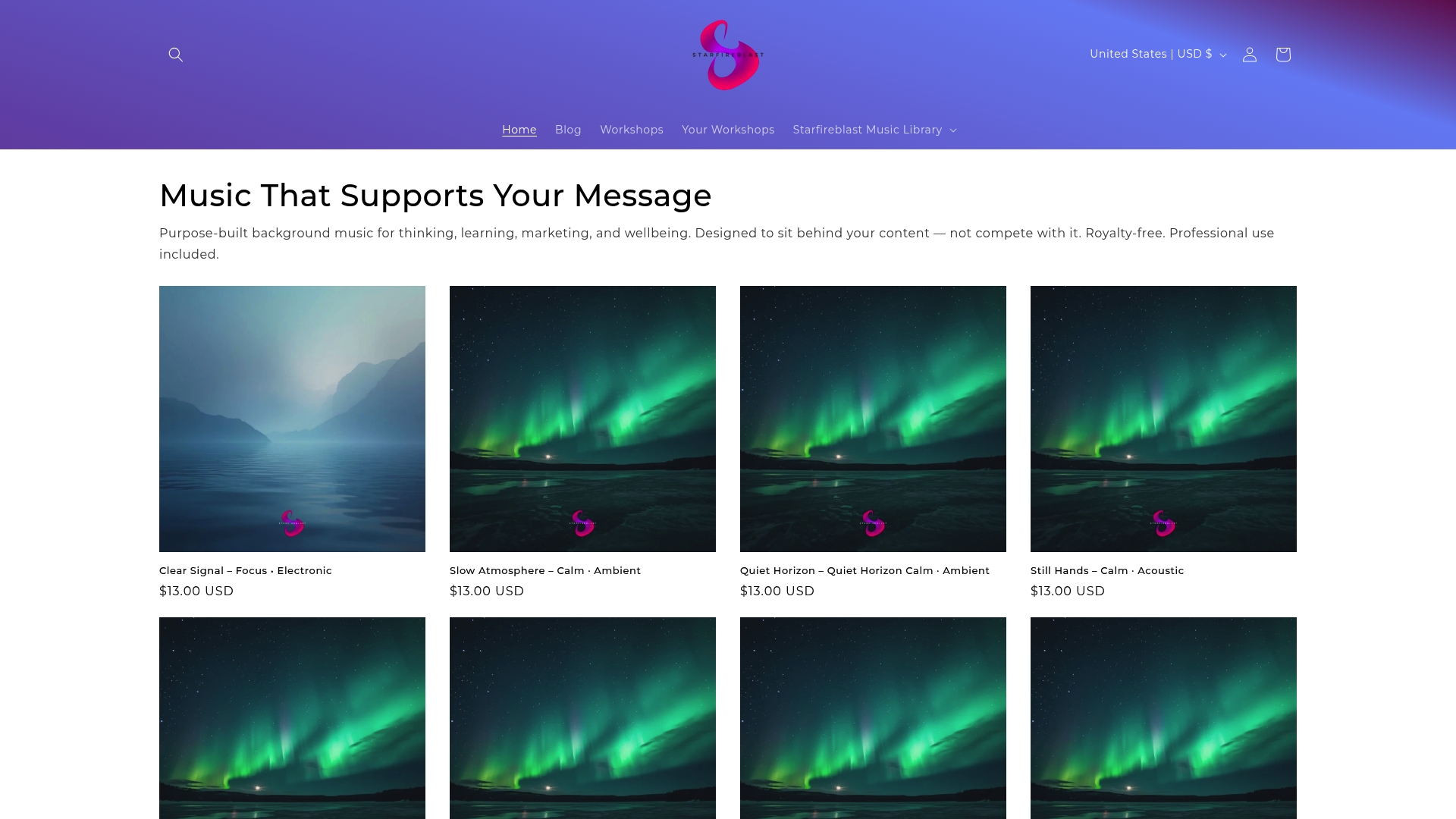
The platform combines customer understanding, brand clarity, and practical tools to help you build a business that is purpose-driven and economically strong. The Customer StarMap™ Workshop gives you a structured process to clarify who you serve, why they choose you, and how to align your business around that. Whether you are just starting or recalibrating, explore Starfireblast to find the tools and community built for entrepreneurs who want growth without burning out or compromising what matters.
Frequently asked questions
What makes a business ‘living’ compared to traditional businesses?
A living business adapts to change and integrates purpose, people, and planet alongside profit for long-term success. Unlike traditional models, living businesses integrate purpose, people, and planet as core operating conditions.
Is building a living business possible for a solo entrepreneur?
Yes, any size business can focus on relationships, responsible choices, and resilience one step at a time. Sustainable entrepreneurship is accessible for solo entrepreneurs regardless of revenue stage or team size.
Does a living business compromise profit for values?
No, living businesses aim to align profit and values, creating more resilient and adaptable long-term results. Sustainable values can boost business profit and longevity when integrated correctly.
How do I start transitioning toward a living business model?
Begin by clarifying your purpose, engaging key stakeholders, and making small changes in people, planet, and profit areas. Clear positioning and strategy are essential for making that transition stick over time.
Recommended
- Why sustainable entrepreneurship matters for solopreneurs – Starfireblast
- Business sustainability fundamentals for small entrepreneurs in 2026 – Starfireblast
- Business Evolution Explained: Sustainable Growth for Entrepreneurs – Starfireblast
- Well-being entrepreneurship: sustainable success guide – Starfireblast